Commercial investors are unwilling to make the necessary investments to scale up district heating in Europe. The solution is democratic ownership of district heating utilities.
By Magnus Skovrind Pedersen, CEO of Think Tank Brundtland, and Lasse Skou Lindstad, analyst at Think Tank Brundtland.
Published in Hot Cool, edition no. 2/2026 | ISSN 0904 9681 |
The coming investment wave
Europe is entering the largest heat infrastructure expansion in modern history.
District heating will play a central role in the transition to renewable energy, energy independence, and a more flexible energy system. Most European countries are expected to expand their networks significantly in the coming decades.
How should Europe organize and finance this scale-up?
Commercial district heating investors who demand adequate returns are unwilling to make the necessary investments. This creates a structural financing gap between the investments we need and those that yield a high enough return to satisfy private investors. As a result, we instead need to promote democratic ownership structures, in the form of municipal and consumer-owned utilities, to deliver the necessary investments. The ability of democratically owned utilities to deliver the necessary investments is supported by evidence from the electricity sector, where publicly owned utilities invest more in renewable energy than their private counterparts.
From technical potential to political economy
Infrastructure transitions rarely fail because of engineering constraints. They stall because institutions are misaligned with investment needs.
A research team led by Daniel Møller Sneum recently examined barriers to the rollout of district heating [1]. The conclusion was clear: The most difficult and decisive barriers are economic and political. Not technical.
This finding is consistent with Brundtland’s [2] broader analytical work on energy infrastructure. When transitions require patient capital and governance of natural monopoly networks, ownership becomes central. Markets alone rarely deliver optimal outcomes without institutions that reduce risk and ensure legitimacy.
Commercial investors cannot deliver decarbonized heat at scale
When it comes to assessing risk in the district heating sector, it is essential to distinguish between new and existing systems.
Existing systems benefit from established customer bases and stable operations. Risks are lower and more predictable.
New systems face uncertainty regarding customer uptake, regulatory stability, construction costs, and local capabilities. These uncertainties translate into financial risk.
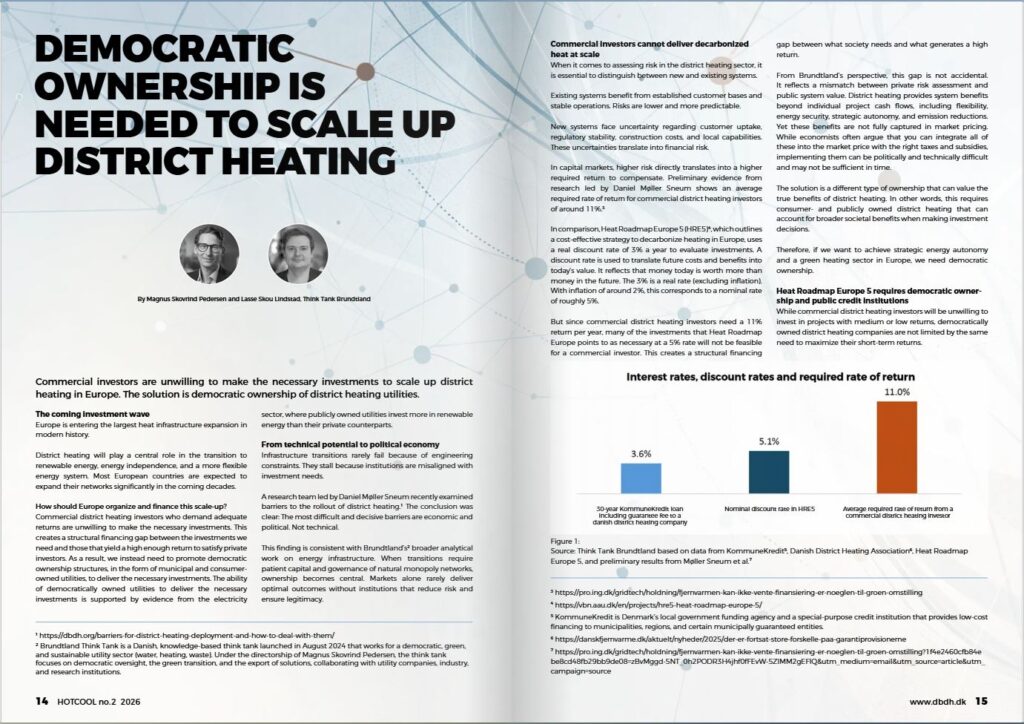
In capital markets, higher risk directly translates into a higher required return to compensate. Preliminary evidence from research led by Daniel Møller Sneum shows an average required rate of return for commercial district heating investors of around 11%. [3]
In comparison, Heat Roadmap Europe 5 (HRE5) [4] , which outlines a cost-effective strategy to decarbonize heating in Europe, uses a real discount rate of 3% a year to evaluate investments. A discount rate is used to translate future costs and benefits into today’s value. It reflects that money today is worth more than money in the future. The 3% is a real rate (excluding inflation). With inflation of around 2%, this corresponds to a nominal rate of roughly 5%.
But since commercial district heating investors need a 11% return per year, many of the investments that Heat Roadmap Europe points to as necessary at a 5% rate will not be feasible for a commercial investor. This creates a structural financing gap between what society needs and what generates a high return.
From Brundtland’s perspective, this gap is not accidental. It reflects a mismatch between private risk assessment and public system value. District heating provides system benefits beyond individual project cash flows, including flexibility, energy security, strategic autonomy, and emission reductions. Yet these benefits are not fully captured in market pricing. While economists often argue that you can integrate all of these into the market price with the right taxes and subsidies, implementing them can be politically and technically difficult and may not be sufficient in time.
The solution is a different type of ownership that can value the true benefits of district heating. In other words, this requires consumer- and publicly owned district heating that can account for broader societal benefits when making investment decisions.
Therefore, if we want to achieve strategic energy autonomy and a green heating sector in Europe, we need democratic ownership.
Heat Roadmap Europe 5 requires democratic ownership and public credit institutions
While commercial district heating investors will be unwilling to invest in projects with medium or low returns, democratically owned district heating companies are not limited by the same need to maximize their short-term returns.
Interest rates, discount rates, and required rate of return
![Figure 1. Source: Think Tank Brundtland based on data from KommuneKredit , Danish District Heating Association [Gæ9.1], Heat Roadmap Europe 5, and preliminary results from Møller Sneum et al.](https://dbdh.org/wp-content/uploads/2026/03/Figure-1-1-e1773662605677.jpg)
Figure 1. Source: Think Tank Brundtland based on data from KommuneKredit [5], Danish District Heating Association [6], Heat Roadmap Europe 5, and preliminary results from Møller Sneum et al. [7]
As an example, a democratically owned Danish district heating company can get a loan of around 3.6% per year for a 30-year loan through the public credit institution called KommuneKredit. KommuneKredit borrows through sovereign bonds issued by the Danish central bank. Here, the Danish state can issue a 30-year bond with an interest rate of around 3%.
On top of that, the municipality that facilitates the KommuneKredit loan guarantees the loan and on average demands a yearly guarantee commission of around 0.6%. The combination of democratic ownership and the help of a public credit institution means that the district heating company can borrow at 3,6%. If the goal of an investment by a democratic district heating company is just to “break even”, then the investments in Heat Roadmap Europe 5 discounted at a rate of 5% become feasible.
Democratic ownership increases energy investments
The ability of democratic ownership to increase green investments is confirmed by a growing literature. One study by Steffen et al. 2022 looked at energy utilities across Europe and found that public utilities had a significantly higher rate of investments going towards renewables. This study was based on power utilities, but some of their investments overlap with some district heating as well, such as biomass and geothermal energy.
Share of investments going to renewables in EU-28
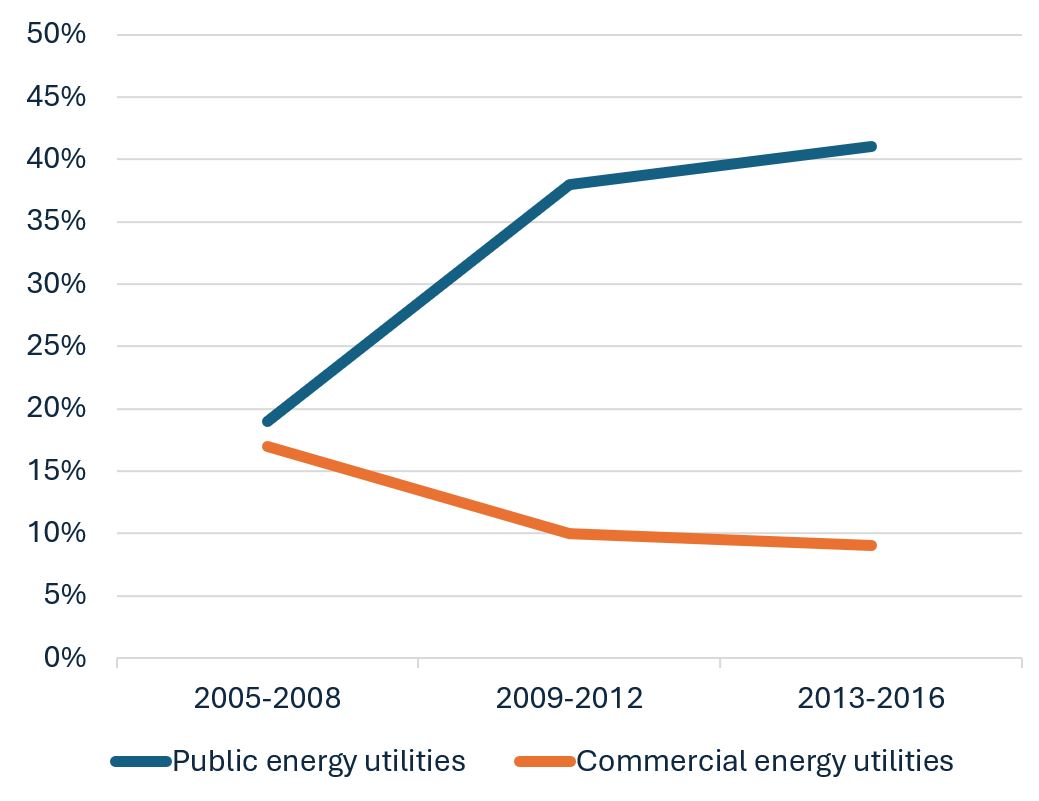
Figure 2. Source: Think Tank Brundtland, based on Steffen et al. 2022 [8]
Likewise, research from the OECD has found that a higher level of public ownership among electric utilities is associated with significantly higher investment in renewables. A 10-percentage-point higher share of public ownership in the energy sector was associated with a 31% increase in investment in renewable energy. In comparison, introducing a typical state aid scheme for renewables, a feed-in tariff, was associated with a 10% increase in renewable investment.
Change in renewable investment
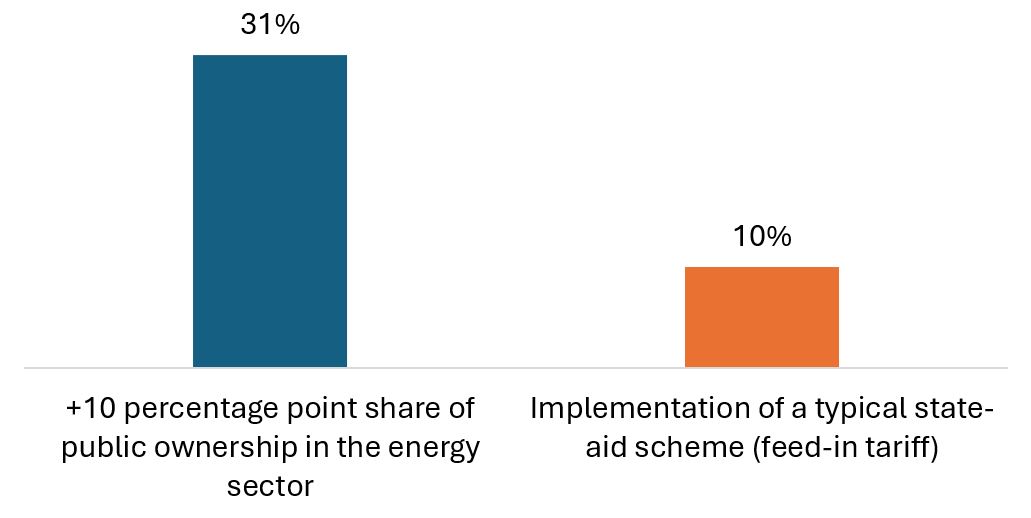
Figure 3. Source: Think Tank Brundtland based on Prag et al. 2018 [9]
These results cannot necessarily be translated 1:1 to the district heating sector, but they point to the pivotal role of democratic ownership in accelerating and scaling the green transition.
Democratic ownership is the necessary catalyst
Europe does not lack the necessary technology to expand district heating. It lacks the right institutional framework. Commercial investors who demand double-digit returns leave a structural gap between societal need and private profitability. Democratic ownership, on the other hand, has lower capital costs and required rates of return, enabling patient investment in the rollout of district heating. This is also supported by evidence from the power sector, where publicly owned utilities and companies invest more in renewables. If Europe wants rapid decarbonization, energy security, and strategic autonomy, democratic ownership is essential.