Ranking DH barriers: Difficulty and importance
By asking 94 energy and DH experts to rank barriers, we can quantify their importance and difficulty. Transferring this ranking into the main categories shows economic and political barriers as “tough nuts”, i.e., the most important and difficult barriers (see figure 1).
This finding is important in terms of prioritising efforts nationally, e.g., in the upcoming EU Strategy on Heating and Cooling. That said, a balanced view across all categories remains important, as any single barrier can range from a pebble on the road that is easily brushed aside to an insurmountable project-stopping wall.
For instance, lacking technology development can make DH uncompetitive, or legal structures may not accommodate successful business models. In both cases, the barriers would increase in importance.
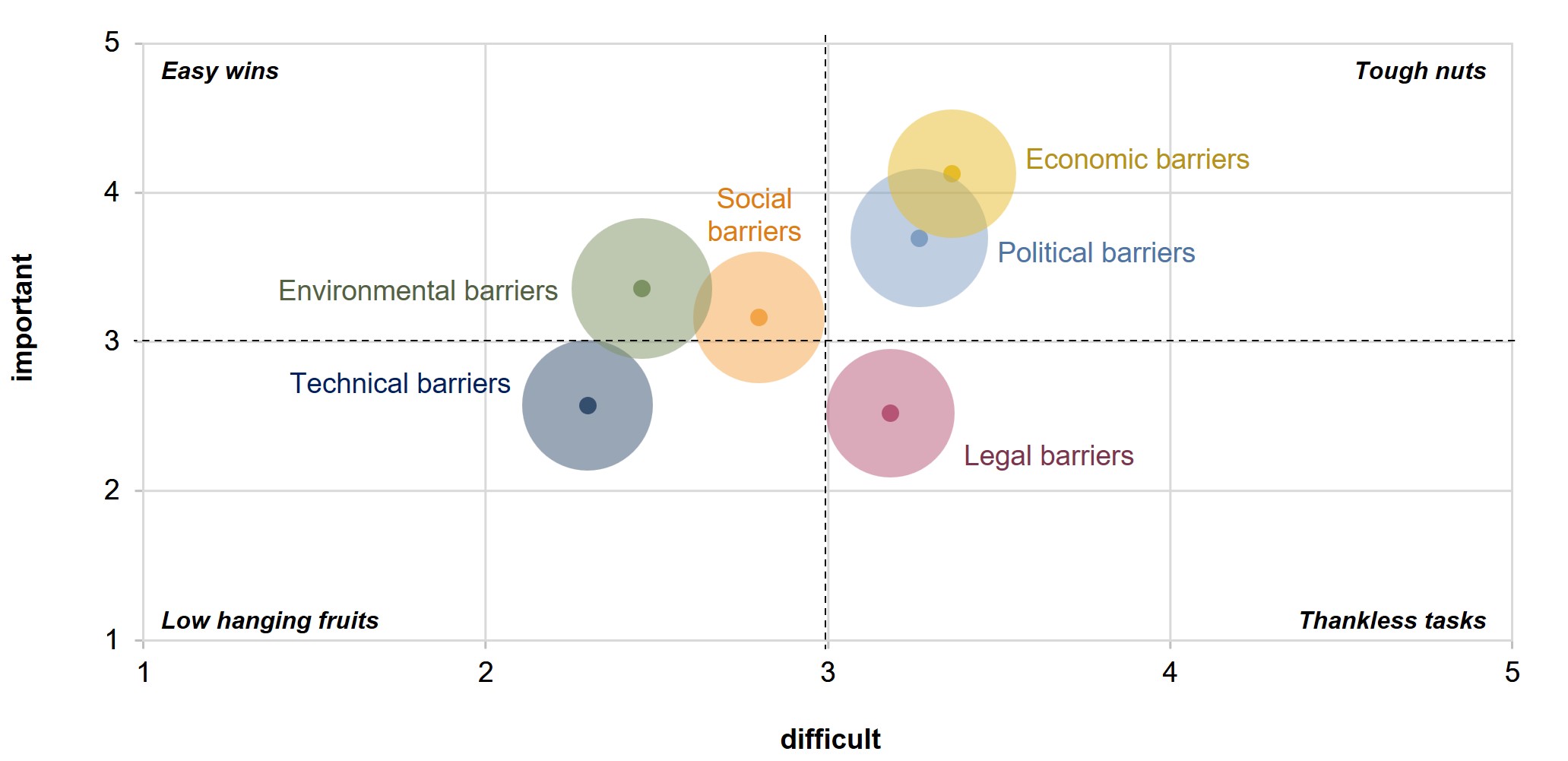
Figure 1: Barriers plotted by difficulty (horizontal axis) and importance (vertical axis). “Tough nuts” (top-right) demand urgent attention, while “low-hanging fruits” (bottom-left) may offer quick wins.
Further, we grouped survey responses geographically. This showed that respondents from countries with lower shares of DH (e.g., Germany, Austria, or France) ranked social and technical barriers higher than respondents from high-DH-share countries (e.g., Denmark, Sweden, or Lithuania).
Similar differences were observed when grouping by the share of renewables in DH. This indicates a need for differentiated mitigation efforts, depending on the maturity of the DH market: less mature markets may benefit from a focus on demonstrating DH’s technical capabilities (pilots, knowledge sharing with high-DH countries) and on social acceptance (communication, transparent regulation for consumers, developers, and operators).
History and real-life show that widespread deployment is possible
All the solutions for widespread DH deployment are here. We do not conclude this based on sophisticated mapping, statistics, or even artificial intelligence, but simply based on Boulding’s first law: Anything that exists is possible.
As readers of this magazine are likely aware, the widespread deployment of DH does indeed exist in cities across Asia, Europe, and North America. Slightly more challenging is the combination of “decarbonised” and “widespread”, but here too, both real-world and scenario-based cases exist: Scandinavian low-carbon sources (e.g., biomass, electricity, and excess heat, plus early sprouts of geothermal).
Likewise, the iterations of Heat Roadmap Europe have demonstrated the technical potential of widespread decarbonised DH markets.
The solutions
We have organized the solutions into a series of questions and corresponding solutions. We refer to the scientific study for the detailed discussion, and provide summarised solutions here:
1. Is there sufficient space for the DH infrastructure?
Strategic heat planning and priority for DH to allocate current and future space, e.g., by reserving corridors for DH pipes decades in advance, or plots of land for thermal storage.
2. Is there sufficient heat demand, also long-term?
Better demand data, enabled by more sophisticated IT, supports more effective demand management and diversification of business models (e.g., cooling and ancillary services in the electricity market).
3. Can stakeholders with legacy heating technologies coordinate effectively and adopt DH?
Long-term policies setting the direction, planning to effectuate it, and organising parties (e.g., regional competence centres) with sufficient sticks and/or carrots to motivate stakeholders.
4. Is the regulation stable and straightforward?
Clear and streamlined regulatory framework, including customer protection measures that ensure trust and transparency for both developers and end-users.
5. Can stakeholders afford the investment?
Innovation on lowering costs, spanning the components and the construction, e.g., by modularising, and by industrial policy ensuring a long-term pipeline, allowing for the build-up of a supply chain.
6. Are there policies in place to integrate across sectors and overcome existing barriers, and is there enough time and capital for DH deployment?
It has taken approximately 100 years to reach 9% global DH coverage, 13% in Europe. We have 25 years to double, or even quadruple, this, according to studies of European potential. The substantial funding required and the speed of such a transition necessitate alternatives to the current “1%-point per decade” approach, as noted by the Draghi report. In such an ambitious “1-2%-points per year” approach, policies like the EU Heating and Cooling Strategy scheduled for 2026 must start at the fundamentals: balanced according to fundamental needs-based principles such as the energy trilemma’s equity (i.e., cost), security, and sustainability – for the end-users, the nation states, and Europe.
If speed is essential, a clear long-term policy and a solid regulatory base are necessary to enable the long pipelines necessary for derisking investments for the investors. Furthermore, such a long-term policy hinges on the deployment of supportive “infrastructure”, ranging from regulatory authorities to component manufacturers to contractors.
Good “parenting” for success
While experts have emphasised the importance of especially political and economic barriers, our study indicates that failure may indeed not be an orphan but can derive from many different barriers. We also find that the successful deployment of DH indeed must have many “parents”, highlighting the importance of good coordination within a healthy institutional framework. Together, (and aided by our study’s “checklist”), we can ensure DH’s next 100 years are faster than its first.
Which barrier is tripping up your project? Share your challenges – and solutions – with us.
For further information: Daniel Møller Sneum, daniel@energymodellinglab.com
For the full barrier rankings and case studies, see our open-access paper: bit.ly/barriersDH
Acknowledgements: The authors received funding from the IEA DHC Annex XIV Project 03 Financial frameworks’ impact on district heating and the German Federal Ministry of Education and Research (Ariadne project FKZ 03SFK5D0-2).