District heating utilities face a constant challenge: efficiently managing and refurbishing a vast underground network of pipes. For decades, maintenance decisions for the roughly 60,000 km of district heating pipes in Denmark alone have often relied on a simple “first-in, first-out” principle, replacing the oldest pipes first. While logical, this approach ignores the actual condition of the infrastructure, where local conditions can significantly alter the aging process of pipes.
By Peter Friis Østergaard, Senior Specialist & Thomas Schrøder Daugbjerg, Consultant, Danish Technological Institute
Published in Hot Cool, edition no. 2/2026 | ISSN 0904 9681 |
Simultaneously, traditional energy meters at the consumer, used solely for billing, have been replaced by remotely read “smart meters” that provide hourly data. Apart from providing valuable insights into consumption patterns and network loads, enabling better forecasting and operational planning, these meters also enable utilities to offer motivational tariffs based on, e.g., absolute return temperatures.
However, a fundamental limitation remains: these meters are built as billing devices, not high-precision laboratory instruments. Their data, while useful, is not intended to serve as precise, absolute measurements, which complicates fine-grained analysis of the network’s physical health. But what if these meters could become the key to a smarter, safer, and even more cost-effective network?
What if, instead of acting as isolated billing devices with insufficient data quality for advanced system optimization, your meter could operate as part of a network of intelligent sensors? By co-calibrating, they allow you to pinpoint exactly which pipes are losing the most heat and which meters are drifting toward inaccuracy.
Advanced analyses have demonstrated the ability to accurately estimate the energy meter’s temperature offset with precision below 0.5 °C and the insulation level of service pipes with precision down to 0.01 W/m/K, all in real time, enabling fast responses from utilities when required. Knowing these values with high precision allows for utilities to focus their maintenance at places where they have the highest impact with significant potential savings as a result.
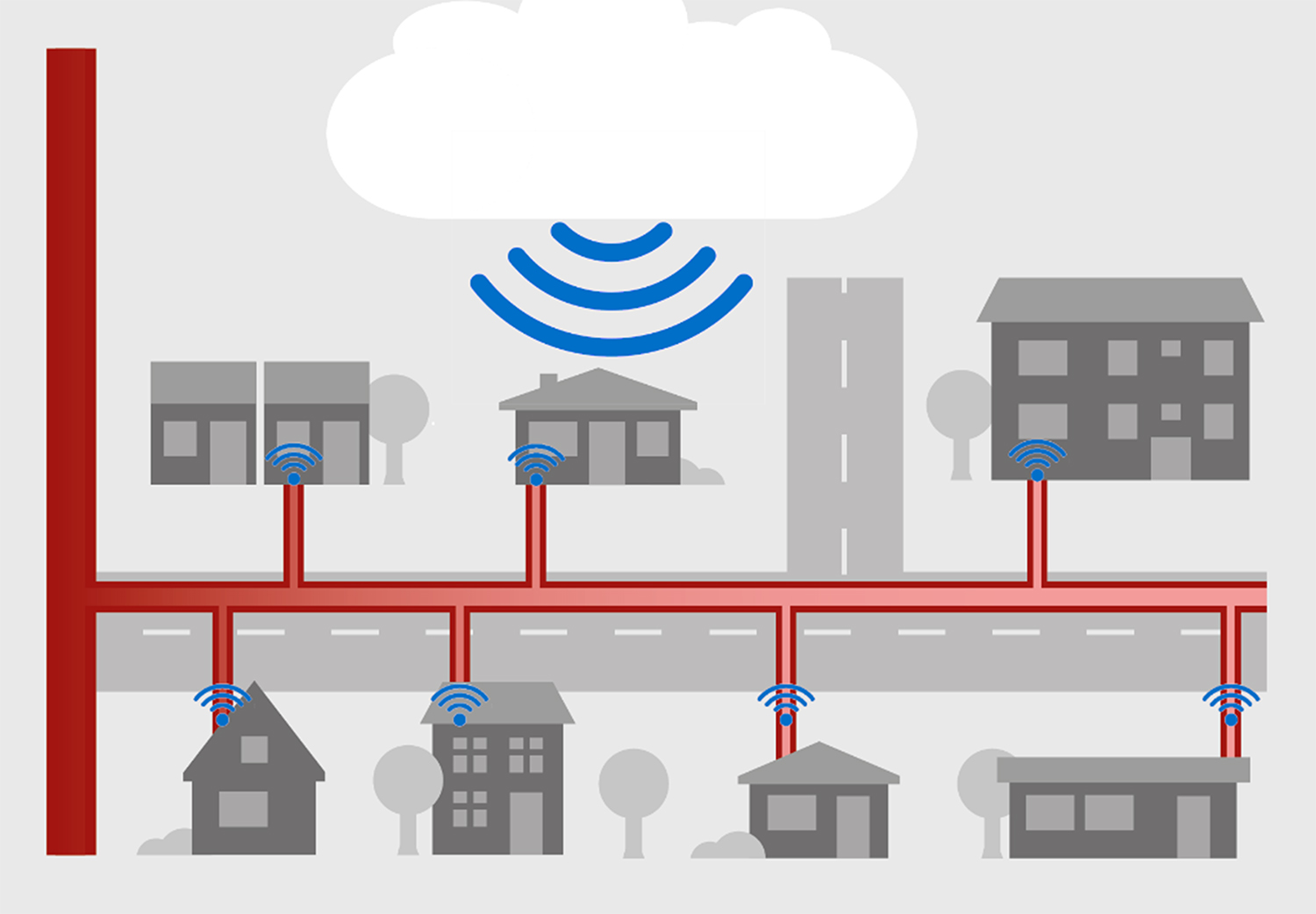 Figure 1: Data from remotely ready meters should be analyzed based on the physical network in which they are located. Including neighbouring meters in an analysis improves the potential value manyfold, as correlations between meters and the physical network can be exploited.
The challenge: Data you aren’t meant to trust
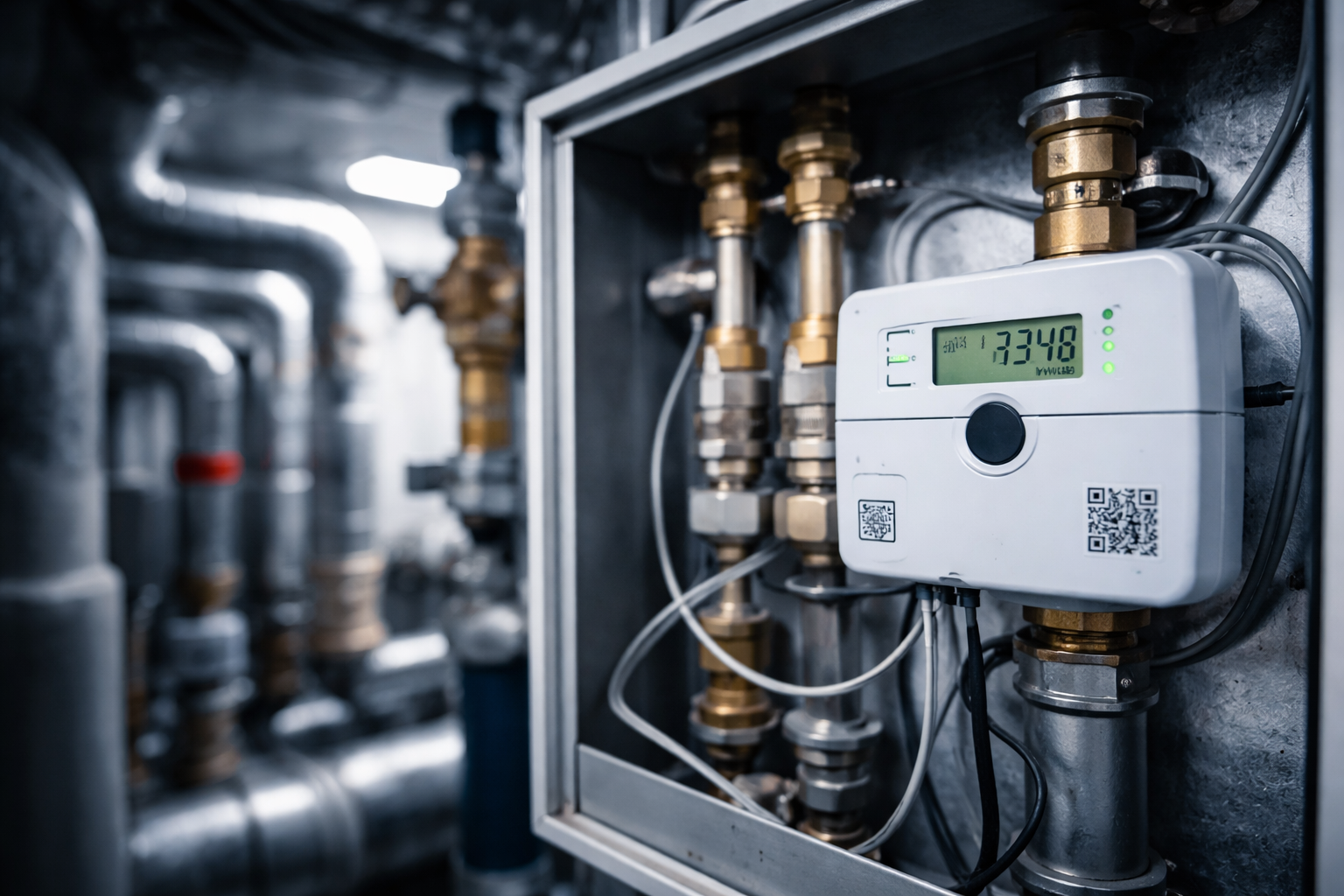
District heating meters are designed to measure energy consumption by tracking water flow and the temperature difference between the supply and return pipes. They are factory-calibrated for this specific purpose. Since the temperature sensors in an energy meter are placed in roughly the same environment throughout their lifetimes, it can be expected, from a physical standpoint, that they will age identically. As such, their temperature difference measurement will remain stable, while the absolute temperature reading can develop an offset over time.
While meters are factory-calibrated and must meet standards before installation, their long-term stability is rarely verified. Utilities must perform spot checks on a small sample from a batch, but most sensors are left unmonitored unless an obvious error occurs. On top of this, sensor couples can get damaged by accidents. While the sensors can be replaced and the energy consumption measured reliably, the new sensor couple will have a different measurement offset, which is not necessarily implemented in the utility meter.
This creates some significant challenges; to justify the cost of remotely read meters, utilities want to extract as much knowledge as possible from the vast amounts of data they provide. While valuable knowledge can be subtracted from the data as it is, more advanced analysis requires higher data quality to ensure the validity of the results; a data quality that the meter was never intended to provide.
A new approach: Turning meters into self-calibrating sensor networks
Recognizing this challenge, the Danish Technological Institute, as part of the European research project FunSNM, has developed a groundbreaking method to address the situation. The solution lies in treating the entire collection of meters not as individual units, but as an interconnected network.
The core idea is simple yet powerful: physics doesn’t lie. The water temperature in a district heating network follows fundamental principles of energy conservation. It naturally decreases as it travels from the production plant, and this heat loss can be precisely modeled as a function of flow rate, ground temperature, and insulation levels of the pipes.
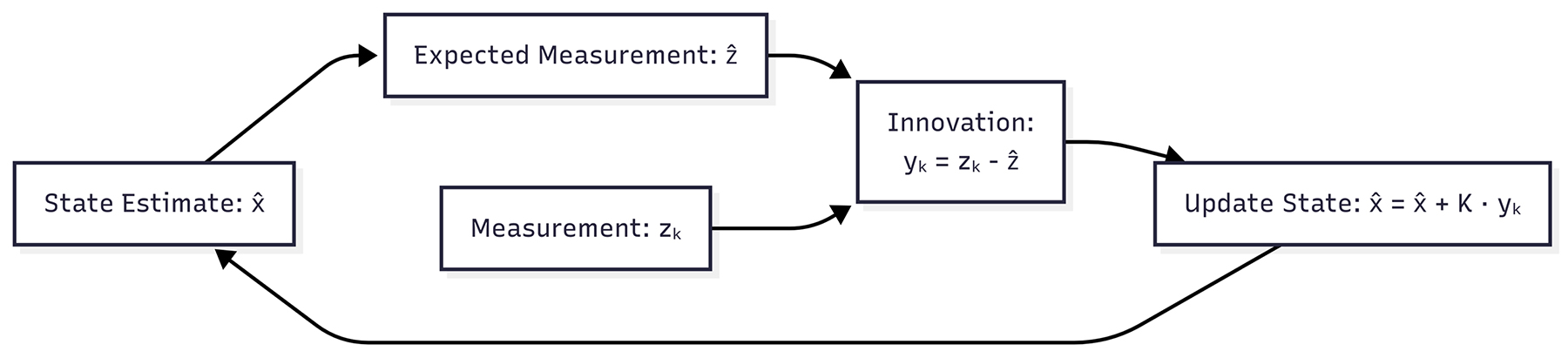
Figure 2: Sketch over the Unscented Kalman Filter. The “State Estimate” (meter offsets and service pipe insulation levels) is given. This, along with flows in the system, gives an “Expected Measurement” at each meter for the next time step. These are compared to the actual “Measurement”, and any differences (“Innovations”) are used to give an “Updated State”, which is used in the next cycle.
Our tool uses a sophisticated algorithm (an Unscented Kalman Filter, UKF) and a detailed physics model to build a dynamic digital twin of the network. The UKF works by calculating the expected temperature at all utility installations at each time. These temperatures are then compared to the actual measurements performed at the installations. When temperatures change during the day, the UKF can simultaneously identify two key parameters:
- The actual insulation level of each individual pipe segment.
- The measurement offset (or drift) of each meter’s temperature sensors.
This process isn’t a one-time calibration; it’s a continuous, dynamic update that allows the meters to effectively “correct” each other in real-time and to determine slow degradation of the insulation levels of the pipes.
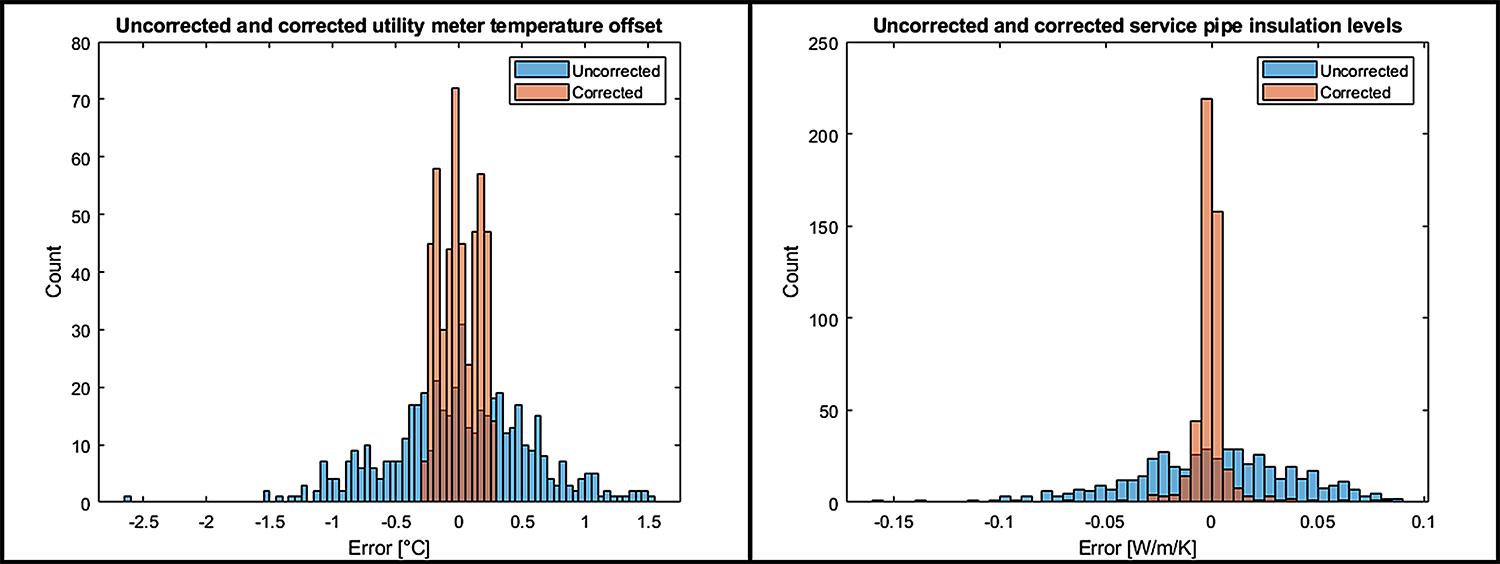
Figure 3: Error in expected meter offset (left) and error in estimated insulation level (right) before and after analysis for one heating season. Prior to analysis, temperature offset errors are up to 1.5 °C, and insulation levels are off by almost 0.1 W/m/K. After the analysis, the temperature offset is below 0.5, and the estimated insulation level is down to 0.01 W/m/K. The analysis is carried out on synthetic data to determine the true meter offset and insulation level.
Ensuring robust and traceable accuracy
This self-calibration method is powerful, but it has some limitations:
- Group drift: A general drift of all meters in a group might go undetected. To ensure accuracy, multiple high-precision reference thermometers can be installed in the network. By anchoring the model’s predictions to these trusted measurements, we eliminate any group offset and ensure all readings are traceable and reliable.
- Missing data: In any real-world network, some meters will inevitably be offline temporarily. Our model is resilient to this. While the flow in the main pipe segment leading to an offline meter is technically unknown, the system can intelligently estimate it using consistent data from neighboring meters. This ensures that a few missing data points do not compromise the integrity of the surrounding network analysis, always maintaining high-value insights for the vast majority of the system.
The value of trusted data: Smarter refurbishment and enhanced consumer safety
The benefits of this network-based approach move heat meters far beyond their traditional role. For utilities, the advantages are immediate and tangible:
- Informed, cost-effective refurbishment: Instead of replacing pipes based on age, utilities can generate a data-driven “hit list” of the worst-performing service pipes. This allows for targeted investments that deliver the greatest impact on reducing heat loss and improving network efficiency.
- A new tool in the fight against biofilms: The risk of biofilm formation is directly linked to water temperature. By providing an accurate, network-wide temperature map, our system moves from reactive testing to proactive risk management. Utilities can identify specific pipe segments where temperatures consistently fall into risk zones, enabling targeted flushing, temperature adjustments, or other preventive measures. This data-driven approach not only enhances public safety but also optimizes the resources used to maintain water quality.
- Proactive meter maintenance: The system automatically flags meters with drifting temperature readings, enabling proactive maintenance before billing accuracy or consumer trust is compromised.
- Enhanced consumer and utility safety and trust: When consumers are billed using accurate data (for instance, in tariffs related to return temperature), they can be confident in the fairness of the charges, and utilities can be sure they are encouraging the correct users to improve their heating installations.
Ultimately, this transformation of meters into an intelligent sensor network is about more than just data – it’s about future-proofing district heating. As the sector moves towards lower supply temperatures and greater integration with renewable energy sources, network efficiency and precision become paramount.
By unlocking the hidden intelligence in existing infrastructure, utilities can make smarter investments, build lasting consumer trust, and secure the role of district heating as a cornerstone of the sustainable energy systems of tomorrow. Altogether, strengthening the potential to reduce supply temperatures, leading to even greater savings for utilities.

Peter Friis Østergaard
Senior Specialist, Danish Technological Institute
What makes this subject exciting to you?
District heating is vital for the green transition in Denmark. Utilizing domain knowledge from District Heating, in combination with general physics, contributes to the value creation from utility meter data. This field is still quite new, and it is interesting to be part of it from the beginning and observe its development.

Thomas Schrøder Daugbjerg
Consultant, Danish Technological Institute
What makes this subject exciting to you?
Domestic district heating meters may be viewed as a collective sensor network. This poses an interesting problem, where it may be possible to use data to derive useful information about the district heating network that goes beyond the original data.
What will your findings do for DH?
We believe that district heating utilities may benefit from allocating their resources to maintenance where they have the greatest impact. Knowing which segments of the district heating networks have the highest heat losses, it is possible to focus your resources there, rather than replacing the oldest pipes first. Likewise for the utility meters. Consumers need to trust the devices used to bill them. Novel methods for evaluating measurement accuracy may help ensure reliability and fairness for customers.