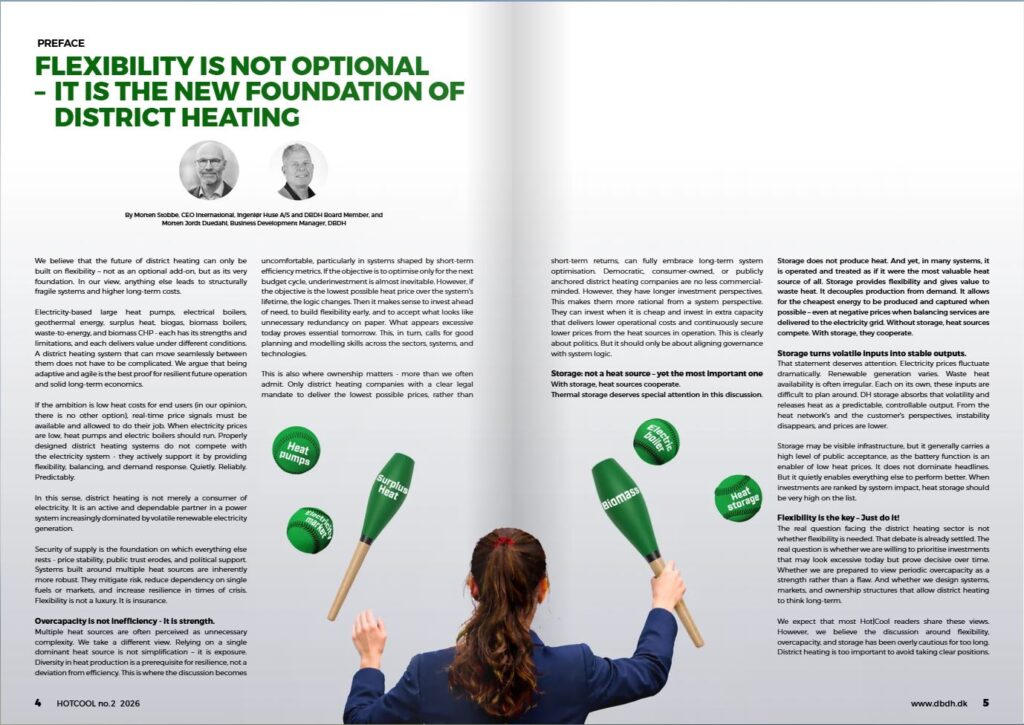
![Flexibility[MJ1.1] Is Not Optional – It Is the New Foundation of District Heating](https://dbdh.org/wp-content/uploads/2026/03/1.JPG-e1773675928156.jpg "1.JPG")
After many discussions, the EU finally reached an agreement on 3 December 2025 to phase out imports of Russian gas by the end of 2027.
By Morten Stobbe, CEO International, Ingeniør Huse A/S and DBDH Board Member, and Morten Jordt Duedahl, Business Development Manager, DBDH
Published in Hot Cool, edition no. 2/2026 | ISSN 0904 9681 |
We believe that the future of district heating can only be built on flexibility – not as an optional add-on, but as its very foundation. In our view, anything else leads to structurally fragile systems and higher long-term costs.
Electricity-based large heat pumps, electrical boilers, geothermal energy, surplus heat, biogas, biomass boilers, waste-to-energy, and biomass CHP – each has its strengths and limitations, and each delivers value under different conditions. A district heating system that can move seamlessly between them does not have to be complicated. We argue that being adaptive and agile is the best proof for resilient future operation and solid long-term economics.
If the ambition is low heat costs for end users (in our opinion, there is no other option), real-time price signals must be available and allowed to do their job. When electricity prices are low, heat pumps and electric boilers should run. Properly designed district heating systems do not compete with the electricity system – they actively support it by providing flexibility, balancing, and demand response. Quietly. Reliably. Predictably.
In this sense, district heating is not merely a consumer of electricity. It is an active and dependable partner in a power system increasingly dominated by volatile renewable electricity generation.
Security of supply is the foundation on which everything else rests – price stability, public trust erodes, and political support. Systems built around multiple heat sources are inherently more robust. They mitigate risk, reduce dependency on single fuels or markets, and increase resilience in times of crisis.
Flexibility is not a luxury. It is insurance.
Overcapacity is not inefficiency – It is strength.
Multiple heat sources are often perceived as unnecessary complexity. We take a different view. Relying on a single dominant heat source is not simplification – it is exposure. Diversity in heat production is a prerequisite for resilience, not a deviation from efficiency.
This is where the discussion becomes uncomfortable, particularly in systems shaped by short-term efficiency metrics. If the objective is to optimise only for the next budget cycle, underinvestment is almost inevitable.
However, if the objective is the lowest possible heat price over the system’s lifetime, the logic changes. Then it makes sense to invest ahead of need, to build flexibility early, and to accept what looks like unnecessary redundancy on paper. What appears excessive today proves essential tomorrow. This, in turn, calls for good planning and modelling skills across the sectors, systems, and technologies.
This is also where ownership matters – more than we often admit. Only district heating companies with a clear legal mandate to deliver the lowest possible prices, rather than short-term returns, can fully embrace long-term system optimisation. Democratic, consumer-owned, or publicly anchored district heating companies are no less commercial-minded. However, they have longer investment perspectives. This makes them more rational from a system perspective. They can invest when it is cheap and invest in extra capacity that delivers lower operational costs and continuously secure lower prices from the heat sources in operation. This is clearly about politics. But it should only be about aligning governance with system logic.
Storage: not a heat source – yet the most important one
With storage, heat sources cooperate.
Thermal storage deserves special attention in this discussion. Storage does not produce heat. And yet, in many systems, it is operated and treated as if it were the most valuable heat source of all. Storage provides flexibility and gives value to waste heat. It decouples production from demand. It allows for the cheapest energy to be produced and captured when possible – even at negative prices when balancing services are delivered to the electricity grid. Without storage, heat sources compete. With storage, they cooperate.
Storage turns volatile inputs into stable outputs.
That statement deserves attention. Electricity prices fluctuate dramatically. Renewable generation varies. Waste heat availability is often irregular. Each on its own, these inputs are difficult to plan around. DH storage absorbs that volatility and releases heat as a predictable, controllable output. From the heat network’s and the customer’s perspectives, instability disappears, and prices are lower.
Storage may be visible infrastructure, but it generally carries a high level of public acceptance, as the battery function is an enabler of low heat prices. It does not dominate headlines. But it quietly enables everything else to perform better. When investments are ranked by system impact, heat storage should be very high on the list.
Flexibility is the key – Just do it!
The real question facing the district heating sector is not whether flexibility is needed. That debate is already settled. The real question is whether we are willing to prioritise investments that may look excessive today but prove decisive over time. Whether we are prepared to view periodic overcapacity as a strength rather than a flaw. And whether we design systems, markets, and ownership structures that allow district heating to think long-term.
We expect that most Hot|Cool readers share these views. However, we believe the discussion around flexibility, overcapacity, and storage has been overly cautious for too long. District heating is too important to avoid taking clear positions.
“Flexibility Is Not Optional – It Is the New Foundation of District Heating” was published in Hot Cool, edition no. 2/2026. You can download the article here:

Did you find this article useful?
Subscribe to the HOT|COOL newsletters for free and get insightful articles on a variety of topics delivered to your inbox twice a month!