As climate policy scenarios show, the electrification of heat supply will play a key role in the transition of district heating systems over the next two to three decades. At the same time, the transition of the electricity system from fully adaptable to fluctuating, renewable electricity generation requires greater demand-side flexibility. District heating based on power-to-heat generation, combined with thermal storage, can provide this flexibility: through flexible procurement in wholesale markets and by supplying ancillary services, particularly frequency control.
By Shervin Balali, Expert Renewable Heat, Dr. Jana Bosse, Senior Expert for Renewable Heat, Dr. Rita Ehrig, Team Leader for Renewable Heat, and Dr. Tim Mennel, Lead Expert for Market Design, German Energy Agency (dena)
Published in Hot Cool, edition no. 2/2026 | ISSN 0904 9681 |
The analysis presented in this article is based on a literature review of publicly available studies and reports, as well as eleven structured interviews with Danish and German industry experts. Participants included professionals from district heating companies, transmission system operators, and researchers.
While Denmark and Germany both strive to electrify their heating network supply, they are currently at different stages of development. Denmark already meets a notable share of its heat demand through power-to-heat technologies, harnessing their flexibility to support the electricity system. In contrast, German district heating providers currently use very little power-to-heat appliances, with plans to expand their use in the future. In that respect, Germany resembles other European nations seeking to decarbonise their district heating systems.
For district heating operators, electrification is not only a path to decarbonization but also offers new revenue opportunities through participation in the electricity market by providing flexibility. District heating can provide flexibility, for example, through system-friendly geographical relocation of heat generation and the provision of ancillary services. At the same time, participation in wholesale and ancillary service markets can improve the techno-economic performance of heat-generation assets and strengthen the business case for electrified heating technologies overall.
The supply of ancillary services is one of the challenges for an electricity system with a high share of renewable energy, and the provision of flexibility through wholesale markets is another.
The electricity grid has no storage capacity. Supply and demand must thus be constantly balanced, or, in technical terms, the frequency of the European interconnected alternating current grids must be equal to, or close to, 50 hertz. To ensure network stability, network operators procure so-called ancillary services from participants in the electricity markets [1].
The procurement of ancillary services is organised along grid zones rather than bidding zones. Western Denmark and Germany are both part of the Continental European System Area (CESA), one of the largest synchronous electrical grids in the world [1]. Most of the regulations and requirements are therefore identical, although there are some differences in national implementation. Overall, the following ancillary services are available for frequency control (also called balancing services) in this control area: frequency control reserve (FCR), automatic frequency restoration reserve (aFRR), and manual frequency restoration reserve (mFRR). The services differ in terms of the activation timeline; see Figure 1.
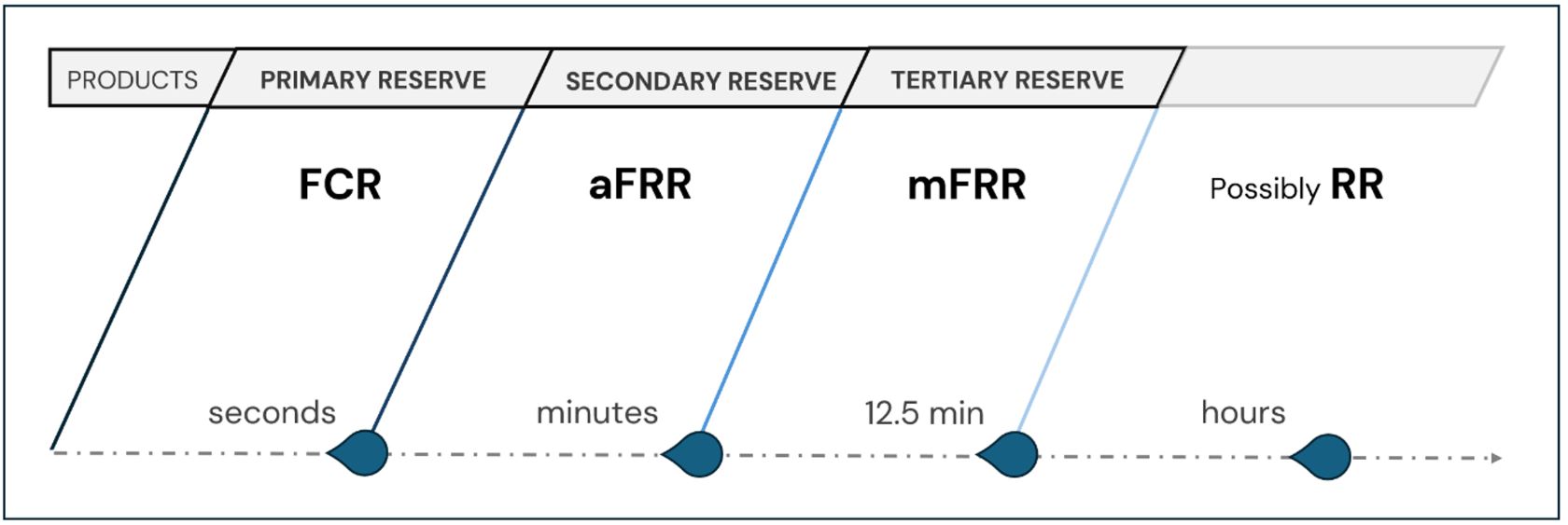
Figure 1: Balancing services in CESA (own illustration based on Nextkraftwerke, 2025 [2])
In the past, thermal electricity plants provided the bulk of ancillary services; in particular, gas turbines with their high reactivity are technically suitable for frequency control and other ancillary services. Moreover, pumped hydro storage plants contribute to the supply of ancillary services, in particular frequency control. When the expansion of renewable generation began in the 2000s, some observers feared that the fluctuations in wind and solar generation would necessitate vast frequency-control capacity.
Today, it is clear that the warnings were exaggerated. The introduction of intraday markets alleviated the negative effects of fluctuations on the scheduling of generation assets. However, the phase-out of thermal generation at a more advanced stage of the electricity system’s transition creates a need for new suppliers of ancillary services, particularly in systems without (or with only small shares of) hydropower. Some ancillary services can indeed be provided by renewable assets themselves, many others by batteries and by demand response technologies.
It must be emphasised that the use of flexible assets in the electricity system does not end here. Flexible demand (as well as storage) can and is marketed in the spot market. Here, it helps accommodate fluctuating electricity feed-in, allowing for a match of demand and volatile supply via arbitrage. In terms of volume, the spot market is, of course, much more important than the frequency control market: the financial trading volume in the German day-ahead market is around 30 times higher than that of the balancing market.
The provision of ancillary services demands prequalification and different technical requirements.
In Germany, the list of prequalified capacity for frequency control services shows a clear picture: pumped hydro storage leads by a wide margin across FCR, aFRR, and mFRR. Battery storage comes next for FCR, while natural gas plants rank second for aFRR and mFRR. However, this snapshot no longer reflects actual market behaviour. Today, batteries deliver around 95% of FCR.
There has been a sharp rise in new battery storage, mainly due to price advantages linked to temporary exemptions from grid fees. A look at Denmark tells a different story, with prequalified FCR capacity being largely dominated by electric boilers and batteries. Regarding aFRR and mFRR, again, electric boilers play a major role for both up- and down-regulation, followed by wind turbines and conventional plants. Figure 2 summarises the prequalified assets for FCR in Germany and (Western) Denmark.
| Prequalified Unit | Germany | (Western) Denmark |
|---|---|---|
| Battery | 810 MW | 1 MW |
| Consumption | 10 MW | – |
| Electric Boiler | – | 75 MW |
| Fossils + Biomass | 699 MW | – |
| Electric vehicles | – | – |
| Water (PSH) | 2890 MW | – |
| Other | 110 MW | – |
Figure 2: Prequalified capacities for the provision of FCR (own illustration based on Regelleistung.net [3] and Energinet [4])
This comparison highlights fundamental differences between the two countries. Denmark is already advanced in sector coupling, with heat generation, especially electric boilers, playing a central role. That said, prequalification alone does not determine actual use. Activation ultimately depends on marginal prices, and large volumes of qualified capacity do not necessarily translate into frequent use, as the case of pumped hydro storage and batteries in Germany illustrates.
As energy systems and generation portfolios evolve, the demand for ancillary services might grow. Thus, assessing the potential of additional capacities, such as district heating assets, is attracting growing interest. Combined heat and power plants can technically provide FCR, aFRR, and mFRR, although suitability varies by plant type. Large-scale heat pumps can also support frequency stabilisation, with different operating time windows. Minute reserve can be delivered without further technical adjustments, while faster response requires partial-load operation. Sub-minute activation still depends on technologies with very fast reaction capabilities. By design, both electric and electrode boilers are flexible electricity consumers and are technically capable of providing FCR, aFRR, and mFRR.
The electricity market offers a business opportunity for district heating providers.
The actual deployment of assets within a district heating system depends on the framework conditions and the heat portfolio. Even if plants are prequalified for ancillary services, it is not always beneficial for district heating operators to use them. Reasons for this include, among others, heating obligations and the opportunity costs of flexibility. Simulation tools for price and climate forecasts help to assess the individual business case*.
IN DENMARK, PROVIDING FLEXIBILITY ALREADY GENERATES SIGNIFICANT PROFITS
Danish district heating companies pursue different market strategies, depending on the facilities at their disposal. While the ancillary services market is central to some actors*, the spot market is the largest in terms of volume and the one most used for purchasing electricity for heat supply. In principle, however, balancing energy markets enables the generation of higher incomes.
This is especially true during high-price phases in the ancillary services market, which occur more often in Denmark, where price volatility is higher than in Germany. One of the companies interviewed explains that the provision of ancillary services is, in fact, considered a bonus and accounts for around 5-10% of revenues*.
Similarly, another company describes aFRR as an important market and the central application area for electric boilers. The cheapest overall heat production price in their network is achieved by deploying electric boilers on the aFRR market*. When revenues on the aFRR market are not so high, mFRR will be offered instead, or the intraday market will be used. When electricity prices are high, a switch to biomass plants is made, sometimes on an hourly basis.
According to the company, the use of biomass plants is associated with costs of around 300 EUR/MWh, whereas heat generation with electric boilers can generate profits of up to 100 EUR/MWh. Thus, taking advantage of price differences in the electricity market is of enormous importance for the economic heat generation of this company*. Overall, trading across various electricity markets is widespread among Danish district heating companies. Around three-quarters of those who operate electrified heat generators participate in balancing power markets. Many of them are active in various markets, thereby improving the profitability of their facilities*.
IN GERMANY, MARKET PARTICIPATION IS STILL LIMITED – BUT EXPECTED TO GROW
In Germany, these business models appear to be less prevalent at present, and the assets required for their implementation are not connected to the grid in large numbers. A German operator of several heating networks underlines that there are too many disincentives and uncertainties for the use of power-to-heat. Consequently, mixed systems are primarily used, as encouraged by CHP subsidies*. In the course of the district heating transformation, however, large-scale heat pumps are expected to provide more base load, with potential economies of scale having a positive impact on costs*.
Electric boilers will be used more frequently to generate peak load in the future due to their lower investment costs. Their short technical response time enables them to participate in balancing markets. Thermal storage will be a key enabler for both technologies, allowing heat to be generated when electricity prices are low and integrating it into the heating network when needed. The expected roll-out of power-to-heat technologies could thus enable German district heating operators to effectively participate in electricity markets and enhance the technoeconomic optimisation of their operations.
Yet, certain obstacles to electrifying district heating in Germany remain.
German district heating operators face higher transformation costs than their Danish counterparts, as their networks must be expanded and transformed alongside decarbonisation efforts. Simultaneously, income opportunities in the electricity market, especially the balancing energy market, remain low. This mainly results from the diverging availability of balancing energy. In Germany, sufficient capacity is available, largely due to the significant increase in large battery storage in recent years.
In contrast, Denmark faces shortages, which have led to higher prices and growing demand for ancillary services*. This supports viable business cases for heat pumps and electric boilers, making their financing comparatively easy in Denmark*. In Germany, however, flexibility is not rewarded under the grid tariff system, making it difficult to monetise flexible operation and finance investments*.
In addition, longstanding subsidies for CHP continue to disadvantage alternative technologies. Low gas prices, in particular in the past, also add to the prevalence of CHP in district heating. In fact, in countries where the electrification of heat supply is more advanced (e.g., Finland and Sweden), electricity taxes are lower than gas taxes. Finally, insufficient development of the electricity grid remains a barrier to power-to-heat assets in both Denmark and Germany.
Electrification is a key pathway for future district heating.
In future district heating systems, active integration with the electricity market will be among the most cost-effective solutions for climate-neutral heat generation. Denmark already demonstrates how electric heat generators successfully interact with the electricity market by taking advantage of low-price periods and providing ancillary services. In Germany, in order to spur the development of electrification and thus achieve decarbonisation in a cost-efficient manner, several obstacles still need to be overcome.
In this context, the comparison between Denmark and Germany primarily indicates:
- Given the strong position of batteries, the ancillary services market currently plays only a limited role for German district heating operators. Its future relevance will largely depend on how flexibility for electricity consumers is rewarded.
- Participation in an increasingly fluctuating electricity market can contribute to reducing district heating prices.
- In Germany, rising electrification and fluctuating renewable energy feed-in are expected to drive more price-sensitive electricity procurement in wholesale markets. These dynamics will increasingly shape the operating strategies of district heating operators.
- The unfavourable ratio of electricity to gas prices, as well as the preferred treatment of CHP, remain major obstacles to the electrification of German district heating. Progress will depend on sufficient grid development and a rapid expansion of renewable energy.
Regardless of the specific business models, this assessment affirms that expanding electrified heat generation and closer integration with the electricity market open significant opportunities for district heating operators. In this sense, flexibility is set to become a core business in both countries. Enabling this transition requires reliable access to affordable electricity and effective incentives for an integrated energy system.
This article was written within the framework of a conducted comparative analysis of Denmark and Germany, commissioned by the Consulate General of Denmark – The Trade Council in Hamburg.
*Information based on an interview.
Footnotes
[1] Next Kraftwerke. (n.d.). Ancillary Services. Retrieved November 20, 2025, from https://www.next-kraftwerke.com/knowledge/ancillary-services
[2] Next Kraftwerke. (n.d.) What are Balancing Services? Retrieved November 20, 2025, from https://www.next-kraftwerke.com/knowledge/balancing-services
[3] Regelleistung.net. (n.d.). Präqualifizierte Leistungen in Deutschland. Retrieved November 3, 2025, from https://www.regelleistung.net/xspproxy/api/staticfiles/regelleistung/startseite/pq-leistung-in%20deutschland.pdf
[4] Energinet. (n.d.). Outlook for ancillary services 2024–2040. Retrieved November 3, 2025, from https://en.energinet.dk/media/aobhuqqk/151124_en_outlook-for-ancillary-services-2024-2040.pdf
For more information, please contact: shervin.balali@dena.de
“Flexibility by Electrification of District Heating” was published in Hot Cool, edition no. 2/2026. You can download the article here:
Did you find this article useful?
Subscribe to the HOT|COOL newsletters for free and get insightful articles on a variety of topics delivered to your inbox twice a month!