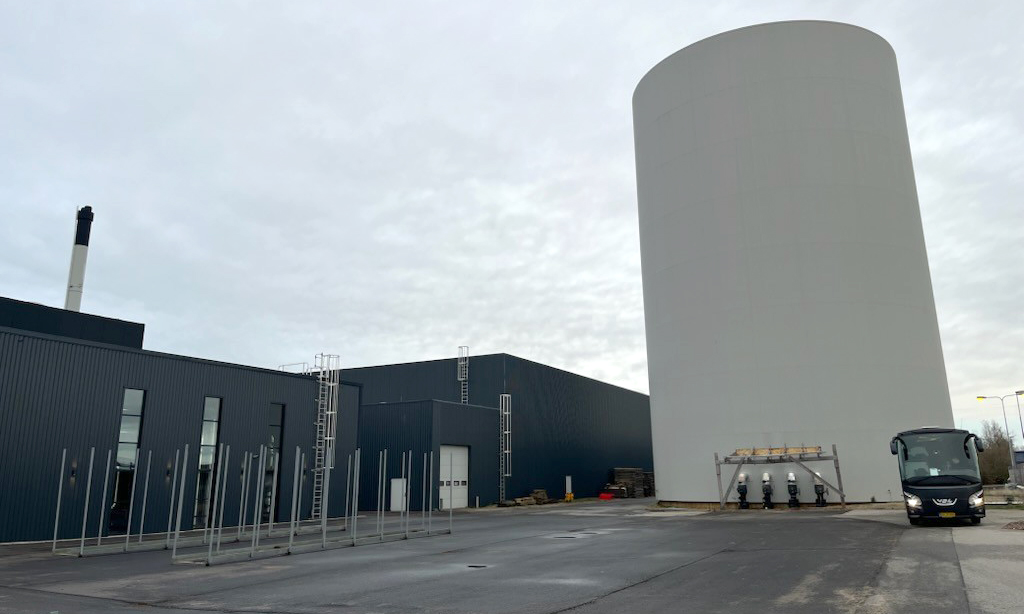
A green Denmark, independent of Russian gas, requires more industrial companies to switch to electricity-based production. In Billund, the district heating utility has invested DKK 250 million in the transition and can now reduce heat prices by 25%.
Article translated from the original Danish article by Victor Emil Kristensen in Finans, Jyllandsposten, published December 10, 2025
When Billund is highlighted in travel guides to Denmark, it is usually because of Legoland’s colorful bricks and spectacular attractions.
But these days, there is a more down-to-earth reason why businesspeople from Germany, France, Lithuania, and China are flocking to the East Jutland town. They want to visit something else quite remarkable.
The local district heating plant.
“Yes, Billund District Heating is not usually the main attraction around here,” says CEO Jens Enevoldsen.
With buildings shifting in shades from coke gray to concrete and anthracite, the exterior of Billund District Heating is unlikely to inspire visitors’ creativity in the same way as the colorful world of Legoland. What happens behind the walls of the heating plant, however, certainly does.
Here, the district heating utility has achieved what many parts of Danish industry have struggled with: electrifying its production.
In recent years, electrification has become one of the hottest buzzwords in Danish business. Following Russia’s invasion of Ukraine, electrification was no longer just a climate initiative but also a security policy tool to break free from Putin’s grip on energy supplies due to the EU’s dependence on Russian gas.
At Billund District Heating, however, Jens Enevoldsen and his team have, within a few years, transformed the company from one that was almost entirely reliant on biomass and a small amount of natural gas to one predominantly powered by electricity.
By 2026, the utility expects more than 70 percent of its energy consumption to come from a newly installed heat pump and an electric boiler, with the remaining share supplied by biomass.
This has required an investment of 33,500€, and final tests ahead of full commercial operation are being conducted in the coming weeks. However, citizens of Billund already benefit from the district heating system being powered by electricity.
As a result of electrification, the utility has reduced electricity prices by 25%, which for an average detached house translates into annual savings of approximately 300€.
“It is a surprise that using green electricity is so much cheaper than biomass,” says Jens Enevoldsen.
“We have achieved greater operational savings than we expected,” the CEO adds.
When the district heating utility began looking for new energy sources in the autumn of 2022, the driving forces were primarily a municipal need to develop the heat supply and a desire to reduce the use of natural gas and biomass as much as possible.
Natural gas prices had exploded in the wake of Russia’s invasion of Ukraine, and Jens Enevoldsen had also taken note of a certain resistance in the public debate toward biomass, which, according to the CEO, could make it a risky technology to rely on.
“We probably feared that some form of regulation of biomass would emerge. Without it being said explicitly, we sensed at the time that there was political headwind against biomass,” says Jens Enevoldsen.
In this context, combined with local conditions such as proximity to the high-voltage grid, the obvious solution was to pursue electrification with a 30-megawatt electric boiler and a 16-megawatt heat pump.
This also meant that Billund District Heating inadvertently became a world leader, as such a large air-to-water heat pump using CO₂ as a refrigerant had not previously been installed anywhere in the world.
In the end, and contrary to the CEO’s expectations, the result was significantly cheaper district heating for the citizens of Billund.
“We expected to keep prices stable, and honestly, I would consider it a success to invest DKK 250 million and maintain stable prices. We did not expect a reduction,” says Jens Enevoldsen.
According to the CEO, the positive outcome is partly due to electricity prices now appearing lower than expected in 2022, and partly because Billund District Heating is paid to regulate its energy consumption in ways that support grid stability.
The latter, known as system services, has been particularly good business for Billund District Heating.
Jens Enevoldsen stresses, however, that by taking advantage of fluctuating electricity prices, the utility is not dependent on revenues from system services to maintain a relatively low district heating price.
This is why Billund District Heating is rewarded for being a first mover. As more industrial companies begin to use electricity for production and overall electricity consumption increases, electricity prices are expected to rise somewhat, while the value of so-called system services is expected to decline.
For that reason, Jens Enevoldsen can, quite selfishly, hope that only a few industrial companies choose to make the switch to electricity.
“But if it were me running their business, I would say: ‘Do it. Just get started,” he says.
 Curious to learn more?
You can find all our district energy news here.