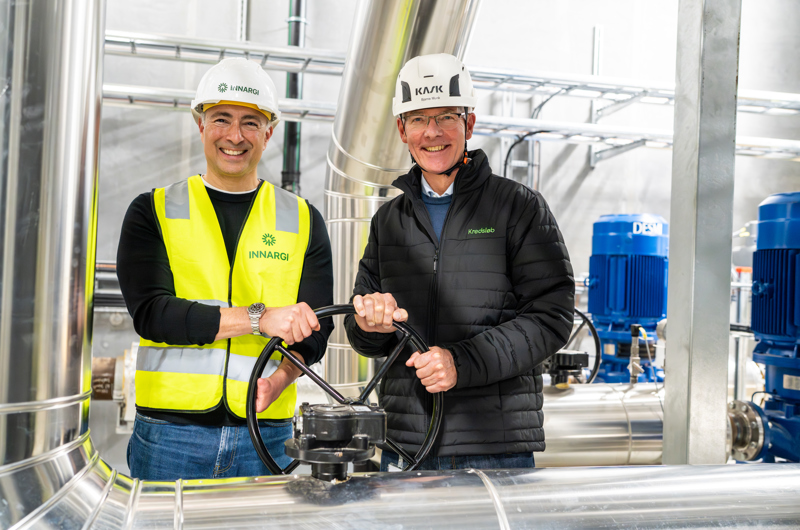
Everything has gone according to plan with the first phase of the geothermal project in Aarhus. And that bodes well for others dreaming of subsurface heat, says Innargi CEO Samir Abboud, which is working with Kredsløb to bring geothermal district heating to Aarhus.
29 December 2025 | Original article in Danish by Karen Grønning Mikkelsen, the Danish District Heating Association
Photo caption: Samir Abboud (left) and the CEO of Kredsløb, Bjarne Munk Jensen, helped open the valves, enabling geothermal heat to strengthen and secure district heating in Aarhus. Photo: Innargi.
On 31 October, Aarhus’ mayor, Anders Winnerskjold (S), opened the valves at the city’s new geothermal plant. A historic moment, which was also marked at Dansk Fjernvarme’s national conference held the same day in Odense.
In this context, Magasinet Fjernvarmen spoke with Innargi CEO Samir Abboud about how the project has progressed, the tasks ahead, and what it all means for the future of geothermal energy in Denmark.
Samir – How has the project, and especially the drilling work, progressed so far?
“Both have progressed very sensibly. I won’t hide the fact that we’re pleased to be delivering the first heat to Kredsløb on time and on budget. We signed the agreement in 2022, and the heat was flowing in 2025. Many people have contributed to that. It’s due, for example, to very strong cooperation with Kredsløb and the Municipality of Aarhus.”
What challenges have you encountered, and how did you overcome them?
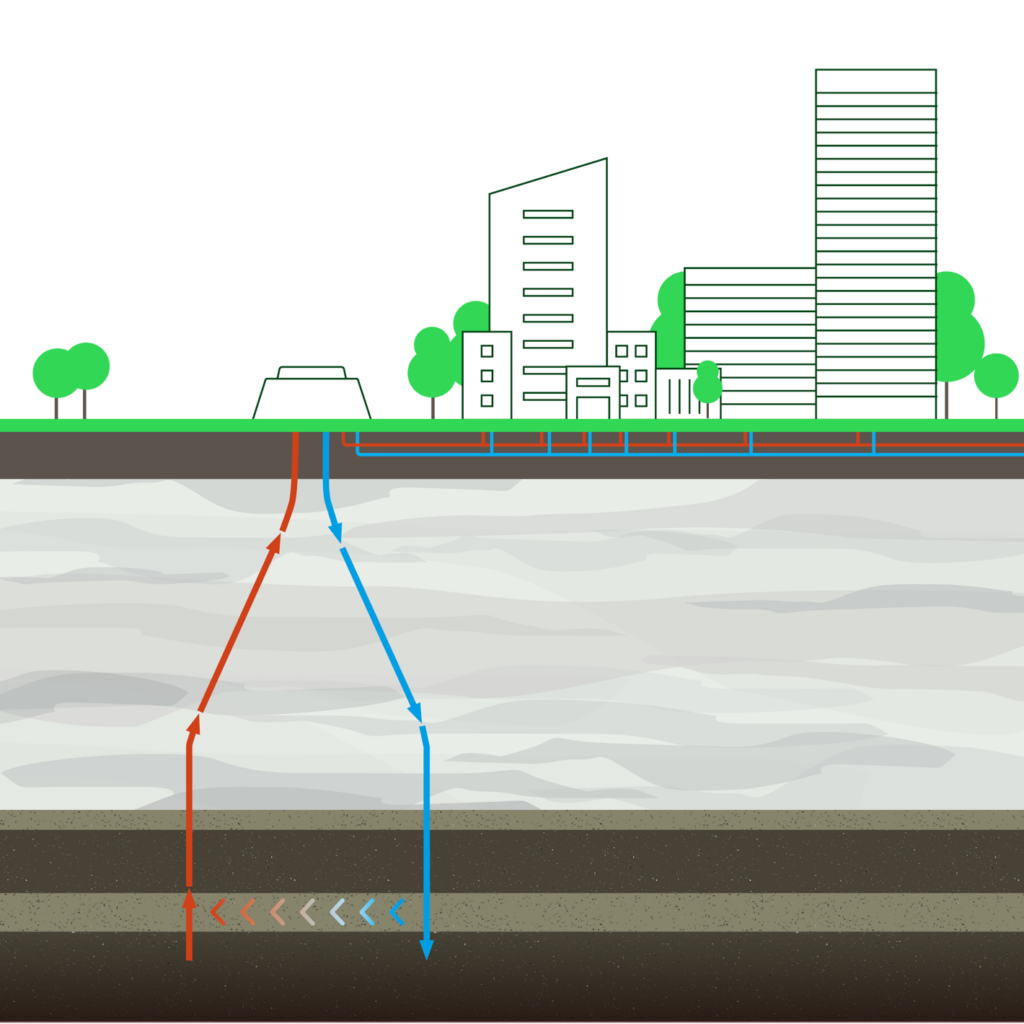
“The first two wells in Aarhus were exploration wells intended to teach us more about the subsurface. And we did learn more – among other things, we found several sandstone layers in northern Aarhus, one of which in particular has very good permeability.
Based on those results and on positive technological developments, we therefore updated the project together with Kredsløb. Now the same amount of heat will be delivered from three locations instead of the seven originally planned,” says Samir Abboud, adding that advances in heat pump technology and Kredsløb’s work to lower temperatures in the district heating network make this update possible.”
He continues:
“We’ve also learned from the dialogue with neighbours living close to the first site. Geothermal is a good neighbour – it doesn’t make noise, smell, or take up space. But the drilling period inevitably affects those living closest. We’ve identified which types of noise barriers are most effective, and we’ve entered into an agreement with a new rig supplier that has developed a rig specifically designed for drilling in built-up areas.
It can’t eliminate the disturbance entirely during the roughly six weeks it takes to drill a well, but it can reduce it. And the neighbours have been very, very kind and patient, because they want green, emission-free and noise-free district heating for the next 30 years.”
Did you find what you hoped for – or how did reality differ from expectations?
“We found exactly what we expected in Skejby. Perhaps even slightly better. However, we found lower permeability in the southern part of Aarhus than we had hoped. That’s a condition you have to accept when drilling exploration wells – and a good argument for why the geothermal company should carry the subsurface risk.”
…and what does that mean for how the project continues?
“It means that we concentrate the next facilities in the northern part of Aarhus – and that we’ll return to Skejby to drill two more wells.”
What are the next steps?
“The next steps are the permitting processes for the next location, which is in Halmstadsgade, and then we plan the next drilling at the beginning of 2027. The entire project still has to be completed before 2030.”
What does your project – and the way it has unfolded – say about the potential for rolling out geothermal elsewhere in Denmark?
“I think many people may have been a bit curious about whether we could actually make it work. That’s understandable given geothermal’s history in Denmark. But it works.
Six million litres of geothermal water now circulate in Skejby every single day. All district heating professionals are welcome to see it. I think that will make a difference,” he says, elaborating:
“There’s real potential for geothermal in Greater Copenhagen and North Zealand, in many places on Zealand around the larger cities, and in Eastern and Central Jutland. These are areas where you find both good subsurface conditions and large district heating networks.”
Samir Abboud adds that Innargi is currently developing a project together with Vestforbrænding just north of Copenhagen.
“And I hope that collaboration can grow. The district heating of the future will be electric, and geothermal will play an important role in the puzzle that many district heating companies need to solve. So, I’m confident, though of course also impatient.”
Are the opportunities primarily for large players like Kredsløb, or can smaller utilities also participate?
“We need to invest a considerable number of hours and must be able to off-take all the heat a well pair delivers, so the greatest potential is in large and medium-sized cities.”
Overall, what does it mean for the future of geothermal in Denmark that the Aarhus project appears to be succeeding as planned?
“Together with Kredsløb, we’re showing that geothermal has an important role to play in the energy mix of a modern district heating system. We’re part of a major electrification of district heating in Aarhus, where imported wood pellets are being phased out. Overall, Kredsløb also expects district heating prices to fall for consumers.
“And the Aarhus project means that there’s no longer any need to doubt the technology – if anyone did.”
4 QUESTIONS FOR KREDSLØB
- The valves have now been opened for the first part of the geothermal project in Aarhus. What does this mean for Kredsløb?
“It marks the culmination of many years of strategic work and planning, and it is therefore very gratifying that the first geothermal heat in Aarhus is now flowing for the benefit of the city and its residents.” - How do you feel the project has progressed so far?
“We have benefited from a professional collaboration with Innargi and, not least, a forward-looking Municipality of Aarhus. From the outset, we have built our work on openness, transparency, and stakeholder involvement as cornerstones. Naturally, there have been small bumps along the way, but overall the project is progressing well and as expected.” - How do you view the next phases of the project?
“We must stay focused and ensure progress on all fronts to reach the finish line, but we look forward to the many upcoming milestones in the project.” - What good advice would you pass on to other district heating companies considering making geothermal part of their future?
“Determination, a strong work ethic, and close cooperation with authorities – focused on how best to ensure value for the many customers – are together what make the difference in a successful project. And, of course, it’s essential to learn from past experiences, not least along the way during the project.”
Source: Lasse Sørensen, Head of Business Development at Kredsløb.
 Curious to learn more?
You can find all our district energy news here.