Modern district heating should not be based on a single heat source. Successful utilities operate a portfolio of technologies – large-scale heat pumps, electric boilers, solar thermal, utilisation of excess heat, biomass CHP and boilers, and more, including thermal energy storage. Production shifts hour by hour: solar thermal delivers heat when the sun shines; heat pumps and electric boilers run when electricity prices are low. This operational flexibility allows district heating companies to choose the most cost-effective and climate-friendly heat source every hour of the year – and is precisely why large-scale heat pumps are becoming a cornerstone of electrified district heating systems.
Original article by Karen Grønning Mikkelsen, the Danish District Heating Association
International version by Morten Jordt Duedahl, DBDH
Published in Hot Cool, edition no. 8/2025 | ISSN 0904 9681 |
What advantages does a large-scale heat pump offer – and what are its limitations? This article explains how large-scale heat pumps work and where they fit into the future green energy system.
While the pace and regulatory context differ by country, the underlying logic is the same: electricity-based heat production offers flexibility, decarbonisation, and stronger coupling between the power and heat sectors. This article explains how large-scale heat pumps work, what they are good at, and where their limitations lie, with a focus on their role in modern, low-carbon district heating systems.
Electrification is accelerating
In recent years, large-scale electric heat pumps and electric boilers have moved from niche technologies to mainstream solutions in Danish district heating. Hundreds of megawatts of electricity-based heat-production capacity have been installed in a single year.
Looking ahead, a growing share of district heating will be produced using large-scale electric heat pumps and electric boilers. This development offers clear advantages for consumers, utilities, and the wider energy system. At the same time, these technologies are not universal solutions -far from. At certain times, other heat sources remain more suitable if the objective is a low-cost, low-carbon, and secure heat supply.
Baseload, mid-load, and peak load
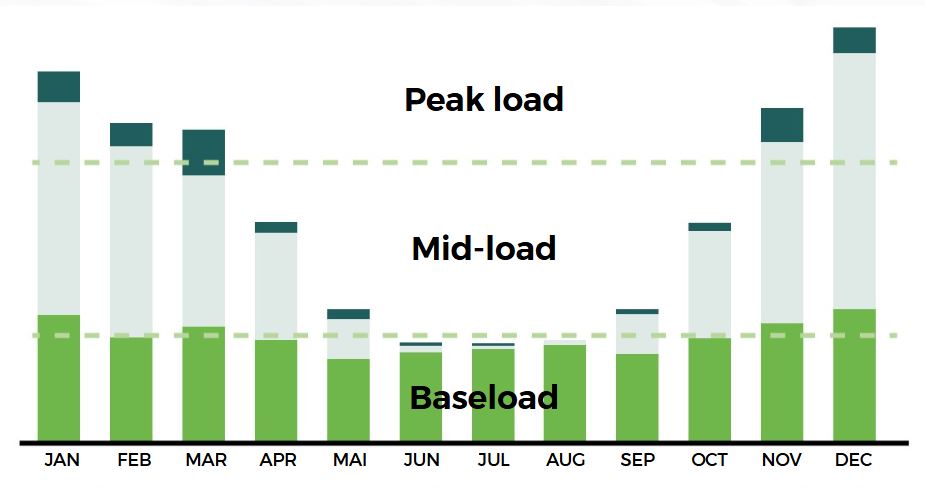
Heat demand in district heating systems is typically divided into baseload, mid-load, and peak load.
- Baseload covers year-round heat demand, including summer production for domestic hot water.
- Mid-load usually operates from autumn through winter and into spring, with fewer full-load hours than baseload units.
- Peak load occurs only during the coldest days of the year, when heat demand is highest.
Case Sdr. Felding has a 2.5 MW heat pump, a 10 MW electric boiler, and 3.000 m3 of storage, but requires only up to 5 MW on the coldest day. It may appear to be overinvested by a factor of 2.5, but it is not. An electric boiler is very inexpensive, so is the storage, and the heat pump can operate at different load levels.
Sdr Felding DH company can now offer services to the electricity grid – and make a lot of money there, also at times where there is no immediate heat demand. This results in very low operating costs that more than compensate for what appears, at first glance, to be a significant overinvestment.
Listen to the podcast about Sdr. Felding or read the article about Billund District Heating or in a mobile-friendly version here: [Link to website]
What is this monster?
Heat pumps are expensive to install due to their technical complexity. However, they are cheap to operate, as they can utilise low-temperature energy from air, seawater, groundwater, industrial excess heat, or other sources that are often freely available. Electricity is required as an input, and its price may vary over time.
Because of the high upfront investment and low operating costs, heat pumps need many operating hours to be economically viable. This often makes them well-suited for baseload and, in some systems, mid-load operations.
For peak load, however, other technologies are more cost-effective. Peak load occurs only for limited periods, and investing in heat pumps to cover those few hours or days would unnecessarily accelerate total investment costs. As a result, it is rarely feasible or cost-effective to meet the entire demand of a district heating system with heat pumps alone.
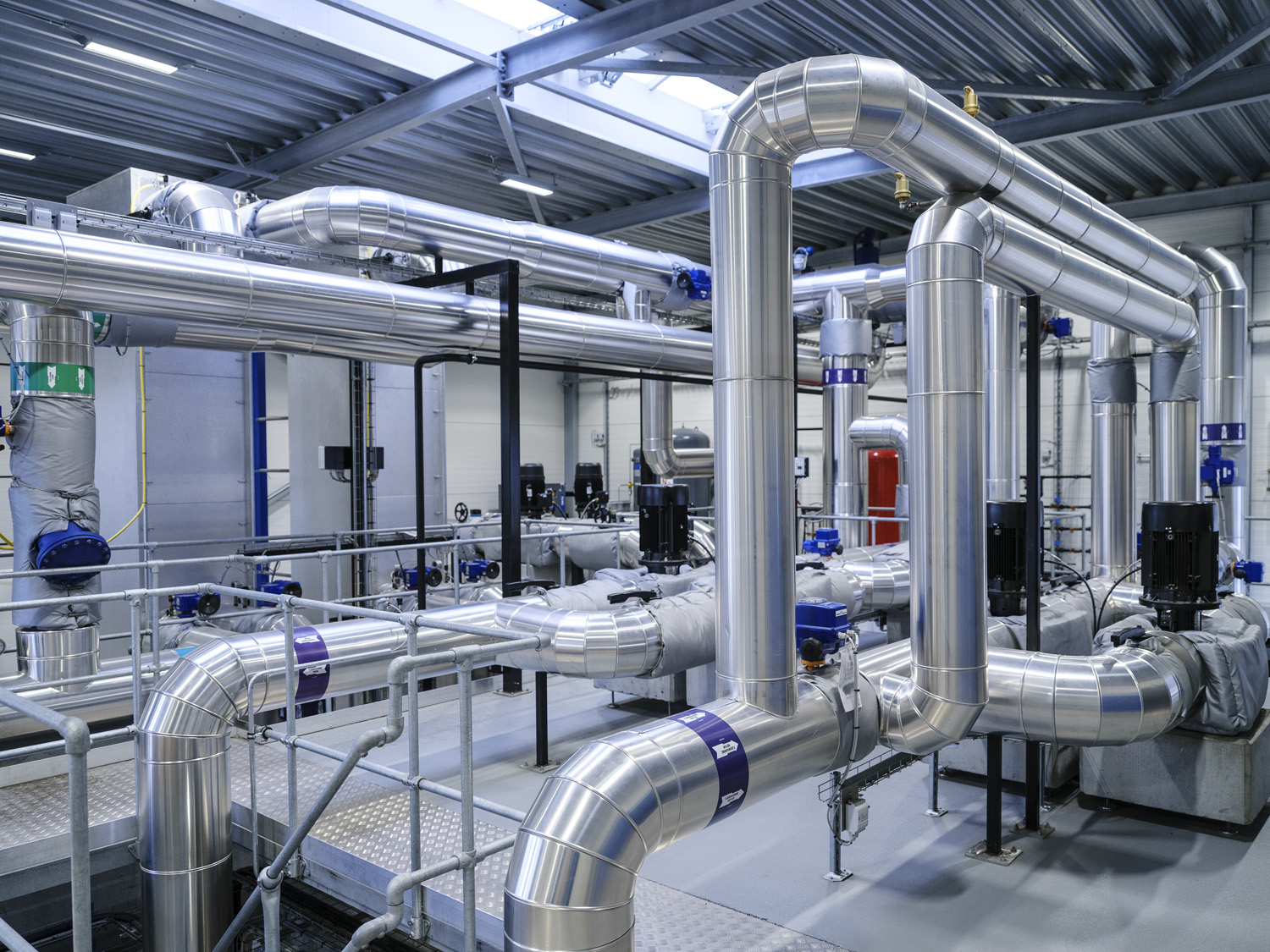
Large-scale heat pumps are electrically driven and consist of several key components, including a compressor and a system for extracting heat from the chosen source. As a result, they typically require significant space.
The compressor can be regarded as the “heart” of the system. It resembles a large motor and is responsible for producing heat. The compressor is electrically driven and is used to raise the temperature from the heat source.
Heat pumps are characterized by high efficiency. A typical coefficient of performance (COP) of 4 means that for every unit of electricity consumed, the heat pump delivers four units of heat.
A typical technology mix
Many district heating companies operate several different production units. Some, as described, are expensive to invest in but cheap to operate. Others are cheap to invest in but expensive to operate. By using a mix of production technologies, district heating companies become more resilient to fluctuating “fuel” prices and can deliver from different sources at different times to lower prices, like in Billund.
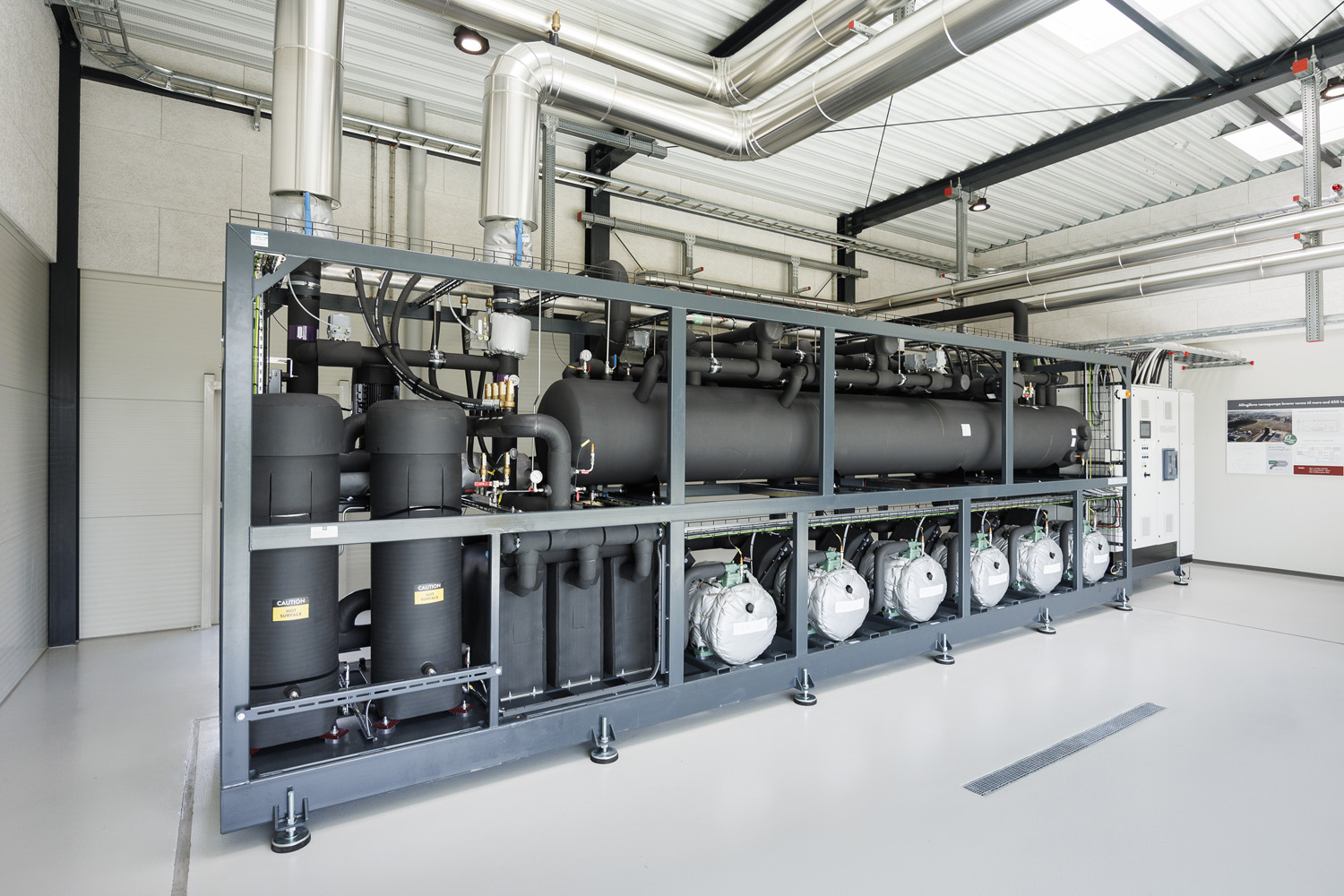
The heat pump at Allingåbro District Heating Plant (photo above) is manufactured by Fenagy. What makes it unique is that it was built on a frame at the manufacturer’s site and then delivered fully assembled to the heating plant, where it was subsequently connected. Photo by Jesper Voldgaard
A typical district heating company may therefore have a large-scale electric heat pump, an electric boiler, solar thermal, biomass, or other technologies as part of its heat production – should there be free excess heat, that should be used first, i.e; when electricity prices are low, heat is supplied by heat pumps or electric boilers, and always by surplus heat if available.
District heating companies switch between production unit’s hour by hour based on what is cheapest and most environmentally friendly.
This is very different from the situation of an individual homeowner who relies solely on a pellet boiler, a natural gas boiler, or a small heat pump. In those cases, the household is much more dependent on the price of a single “fuel” source – whether wood pellets, natural gas, or electricity.
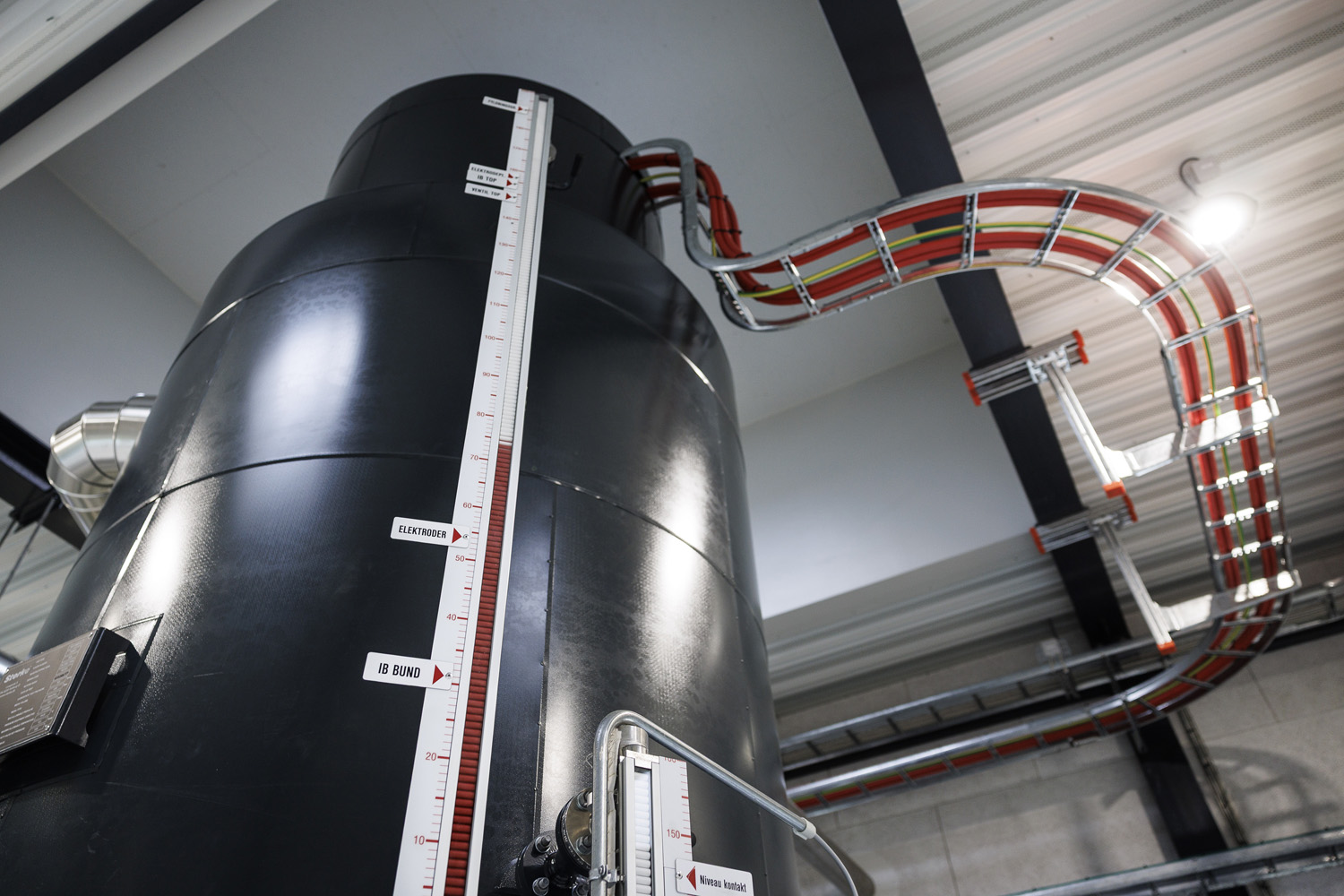
Electric boiler operating at 3 MW (photo above). When the water level is above the arrow marked “electrodes,” the boiler produces heat. The higher the megawatts, the higher the load. Photo by Jesper Voldgaard
Balance in the energy system
The growing number of large-scale heat pumps and electric boilers in district heating also have an effect on the overall energy system and the need for investments in the energy infrastructure. A positive one!
Because heat pumps and electric boilers, together with heat storage, are flexible, they can and must be used to balance the electricity system.
When the wind is blowing and the sun is shining, electricity production from renewable energy is high, and electricity prices are usually low. At those times, large-scale heat pumps and electric boilers could use green and low-cost electricity for heat production.
They can do this regardless of whether there is an immediate demand for heat, because the heat can be stored in large tanks (thermal storage and accumulation tanks). This is why we see many DH companies establish much more storage these days.
Flexibility is crucial
Because district heating can store energy, the sector can also reduce or completely shut down electricity consumption when electricity demand – and thus prices – are very high, by drawing on stored heat instead.
Electric boilers are not only relevant on an hourly basis. The electricity system is constantly affected by the variability of renewable energy production from wind and solar, and a balance must be maintained every second.
Here, electric boilers play a central role, as they can respond extremely quickly to changes in the electricity system by switching on and off as needed. Balancing the electricity system is crucial for the national electricity security of supply. As a result, electric boilers benefit not only the local district heating network but also the national electricity grid.
More electrification in the future
The expected electrification of district heating will make district heating companies among the largest electricity consumers in Denmark, alongside data centers and Power-to-X plants. Over time, district heating companies will shift from being net producers of electricity via combined heat and power to net consumers of electricity through electric boilers and heat pumps, and the total capacity of electric solutions in district heating will almost triple.
In 2025, the Danish Energy Agency expects that by 2030, heat pumps with a total electrical capacity of approximately 1,000 MW will be installed . In 2050, the number is 1.500 MW. This corresponds to a heating capacity of around 3,400 MW in 2030 and 5,100 MW in 2050. At the same time, the agency expects electric boilers with a total electrical capacity of approximately 3,500 MW in 2030 and more than 5,000 MW in 2050.
Listen to the Sdr. Felding podcast for further information, or read the article about Billund District Heating or here: [Link to website]
For further information, please contact: Morten Jordt Duedahl, at md@dbdh.dk