As societies move toward a decarbonized energy supply, district heating (DH) systems have emerged as a key part and enabler of the transition. To maximize the low-carbon potential of DH and infrastructure efficiency, it is important to minimize the operating temperatures of both the supply and return lines. By lowering operating temperatures, we can improve system efficiency, reduce energy losses, and support the transition to 4th-generation low-temperature DH (4GDH).
By Jan Eric Thorsen, Director, Danfoss A/S, Climate Solutions, Oddgeir Gudmundsson, Director, Danfoss A/S, Climate Solutions, and Marek Brand, Senior Specialist, Danfoss A/S, Climate Solutions
Published in Hot Cool, edition no. 6/2025 | ISSN 0904 9681 |
As part of the European ARV project [1], which focuses on climate-friendly renovation and energy innovation, we evaluated four substation concepts to lower the DH return temperature (see Figure 1). Our goal is to quantify the extent to which each concept can reduce return temperatures under different building and DH system conditions and climate profiles relative to a baseline concept.
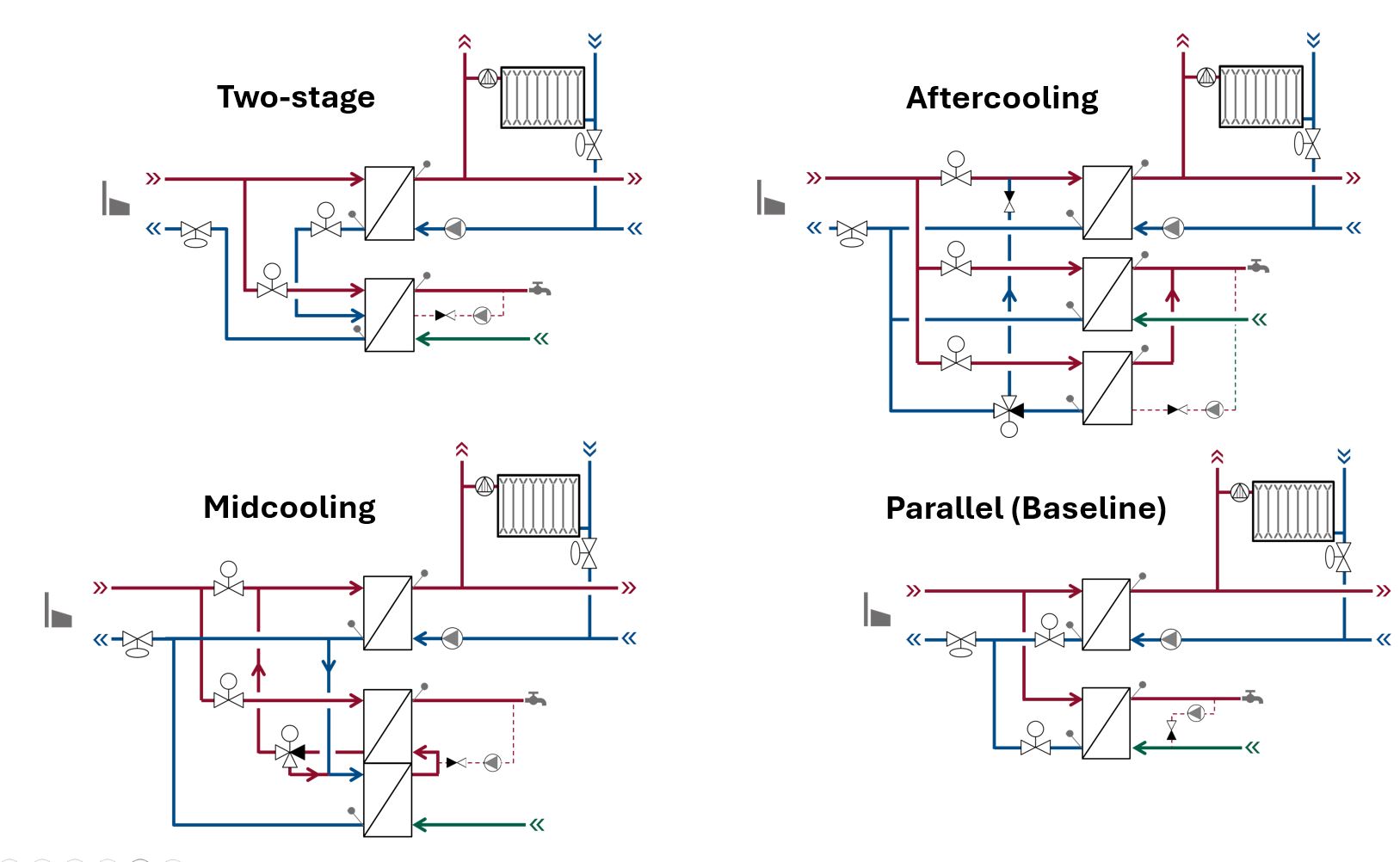
Figure 1. Analyzed cascaded substation concepts as well as the baseline concept. [2]
To map the potential for return temperature reduction, we perform simulations for four European cities: Copenhagen, Helsinki, Paris, and Rome. This allows us to compare how each substation concept performs across cold and warm climates.
Overall, our study shows that cascaded substation designs, including the aftercooling and midcooling concepts, significantly reduce the DH return temperature by 1,5°C to 9,5°C for 3rd generation systems (3GDH) and by 3°C to 9,5°C for 4GDH systems, underlining that the designs are future-proof. A two-year field test focusing on one of the analyzed concepts confirms the analysis.
Smarter ways to design the substation: A look at the concepts
DHW circulation is a well-known challenge when it comes to realizing a low DH return temperature. Therefore, the substation concepts investigated include DHW circulation service, typically applied for multi-family buildings with central heating and DHW preparation.
When it comes to heating buildings through DH systems, the way we couple the heat exchangers inside a substation makes a big difference. Many buildings use the parallel concept, which serves as the baseline setup when comparing the cascading substation designs.
In this simple design, one heat exchanger prepares domestic hot water (DHW) (both for tapping and for circulation), while another connected in parallel supplies heat to the building space heating installation. Due to the simplicity of the application and control logic, as well as the limited economic benefits of low return temperature in the past, it became the default substation design principle.
However, as we transition toward more energy-efficient DH, relying on low-temperature waste heat and renewable sources, the benefit of low return temperatures, in respect to heat-generation efficiency is increasing significantly, thereby paving the way for cascading substation designs.
1. Two-stage concept
The two-stage concept is well known and has traditionally been applied to reduce the DH return temperature from buildings with high-temperature space-heating installations. In this setup, the DHW heat exchanger is divided into two parts: upper and lower.
The lower part preheats the cold-water supply by utilizing heat from the space-heating circuit return flow. In this way, the heating return is further cooled, resulting in a lower DH return temperature. The upper part boosts the DHW to the set DHW temperature using additional heat from the DH system.
2. Aftercooling concept
As DH systems have transitioned to low-temperature operation, both regarding the DH supply and the space-heating return temperature, the benefits of pre-heating the cold-water supply, as by the two-stage concept, are reduced, which in turn has paved the way for an alternative cascading of the flows. In the aftercooling setup, a dedicated heat exchanger is added for the DHW circulation loop.
By doing so, the relatively high return-flow temperature from this service can be directed into the heating loop and then “aftercooled” to the level of the heating return temperature. During the summer, when no heating is applied, it’s still beneficial, as a separate heat exchanger for DHW circulation improves the DH return temperature.
3. Midcooling concept
The midcooling concept combines the strengths of the two-stage and aftercooling concepts. It both preheats the cold-water supply using the space-heating return flow and aftercools the DHW circulation through the space-heating system.
Building energy use, heating installation, DH generation, and climate influence
Several parameters influence the potential for cascading concepts to reduce the DH return temperature.
Building energy use:
To determine how much the return temperature from the building can be lowered, we must understand the buildings themselves. A building’s yearly return temperature reduction potential depends on the energy-use characteristic expressed by the share used for the services of DHW, DHW circulation, and space heating.
To identify the main operating envelope for the solutions we looked at seven existing Danish apartment buildings, ranging from older, unrenovated blocks to more modern, energy-efficient ones. Additionally, they have vastly different DHW usage profiles. Together, they established a representative range of building energy-use characteristics for our analysis.
Heating installation and DH generation:
Because the building’s return temperature depends on its space-heating installation, we investigated both traditional radiator systems and underfloor heating. The design temperatures of the space heating installation were further defined in accordance with common practice in 3GDH and 4GDH; see Figure 2.
For each combination, the operating temperatures of the space-heating installations were defined based on the outdoor temperature. This tells us how the system behaves throughout the year and determines the flow cascading potential, and is therefore essential for predicting how much each substation concept can reduce DH return temperatures.
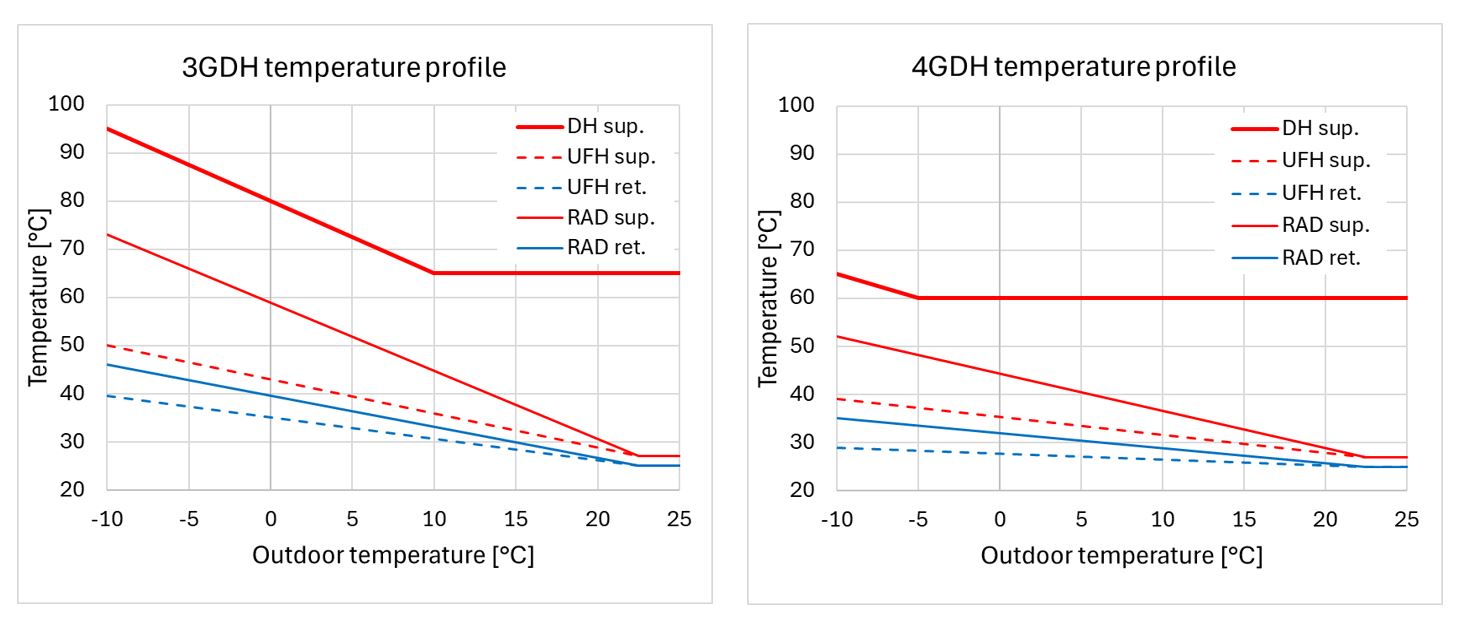 Figure 2. Temperature profiles for 3GDH and 4GDH, shown for both underfloor heating (UFH) and radiators (RAD).
Climate:
Finally, we used outdoor temperature profiles from Helsinki, Copenhagen, Paris, and Rome to represent a wide range of European climates. Two climate factors are especially important:
- How long the heating season lasts, as this determines how long the space-heating system can absorb “aftercooling”.
- How mild the climate is during the heating season, as a milder climate results in lower space heating return temperatures, improving the potential for aftercooling the DHW circulation DH return.
What the results show:
First, the potential is significant, making cascading concepts highly relevant for multi-family buildings connected to 3GDH and 4GDH systems. The DH return temperature reduction potential for a specific building can easily be predicted based on the ratio between space heating, DHW, and DHW circulation demands.
The range of DH return-temperature reduction potential compared to the baseline parallel concept is shown in Figure 3. In the figure, the blue bars represent the full range of the seven reference buildings, whereas the yellow bars highlight one “typical” building range .
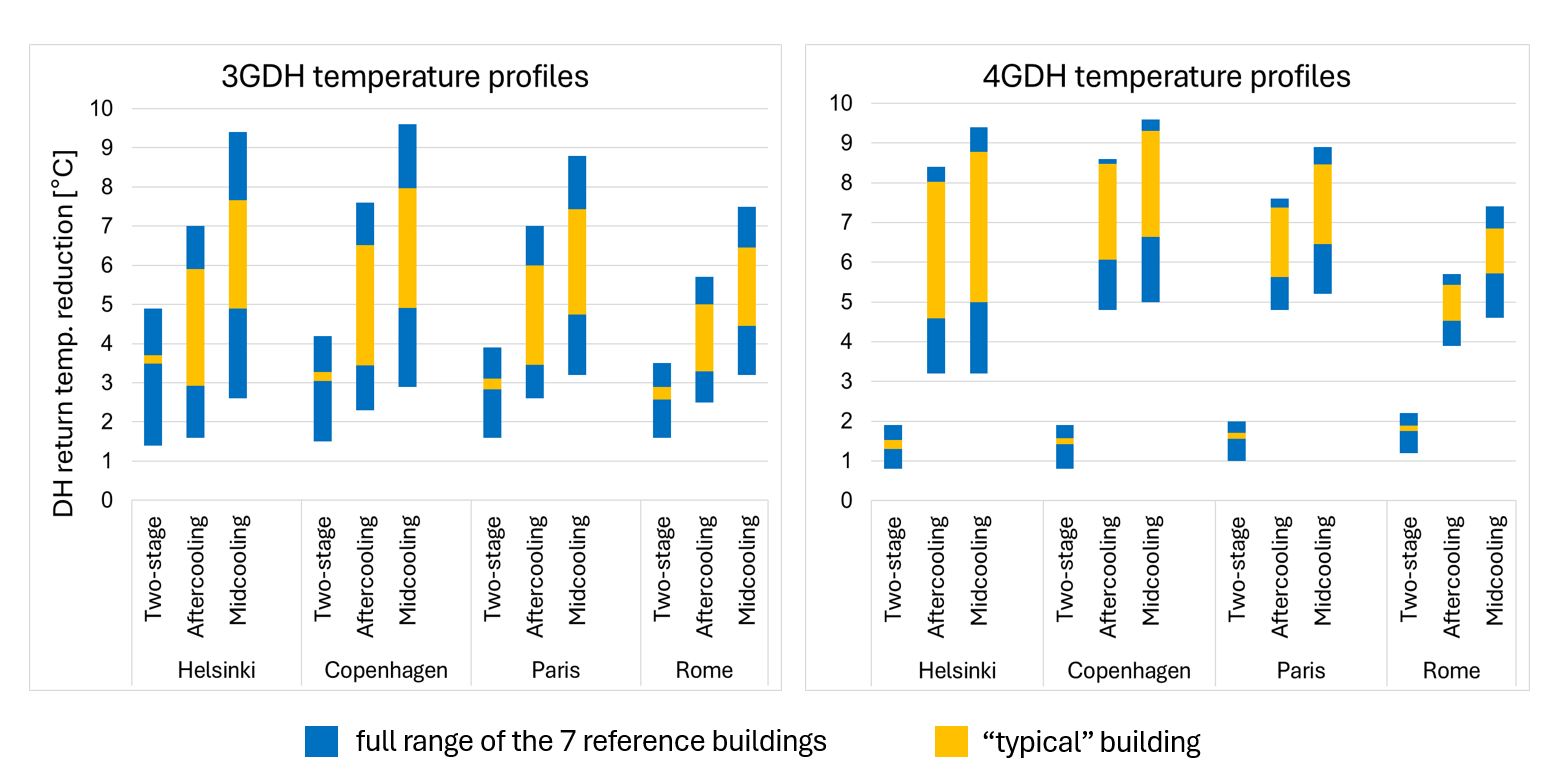
Figure 3. District heating return temperature reduction potentials 3GDH and 4GDH cases.
Radiator-based systems are at the lower end of the range, whereas underfloor heating systems are at the higher end. This indicates that the type of heating installation has a significant impact on the potential.
3GDH: Good potential
Most DH systems today operate at 3GDH temperature levels, aiming to transition to 4GDH temperature levels. The analysis shows that for the 3GDH system, the potentials of the cascading concepts are promising:
- Two-stage concept:
Here, the improvements range from 1.5 to 5°C.
It works best in colder climates, such as Helsinki, with long heating seasons, high DH temperatures, and where DHW demand is high.
In Rome’s climate, the upper end drops to about 3.5°C because of the shorter heating season. - Aftercooling and midcooling concepts: Perform good under 3GDH conditions for all climates, ranging from 1,5 to 9,5°C. Rome shows a slightly lower potential due to a shorter heating season.
4GDH: Great potential
Under low-temperature 4GDH conditions, we see clear differences between the concepts:
- Two-stage concept:
This design gives a modest reduction in return temperature, about 1 to 2°C, basically regardless of location or climate. - Aftercooling and midcooling concepts:
Both perform great, reducing return temperatures by 3 to 9.5°C.
The midcooling concept is the overall top performer, which makes sense because it combines the strengths of both the two-stage and aftercooling designs.
Climate matters:
- Copenhagen shows the biggest improvements (up to 9.5°C) thanks to the long heating season and moderate outdoor temperatures during the heating season.
- Rome shows the lowest improvements, yet still significant (around 4 to 7.5°C) due to the short heating season.
For the “typical” building (yellow range), midcooling and aftercooling achieve a 4.5-9°C reduction.
Field Test Confirms reduced return temperatures for the Aftercooling concept and validates the analysis
The aftercooling concept was demonstrated under real-life conditions in a two-year field test in a Danish apartment building from the 1970s, see Figure 4. It was built on site, and the technical installation is shown in the figure to the right. See the added heat exchanger in the middle of the figure.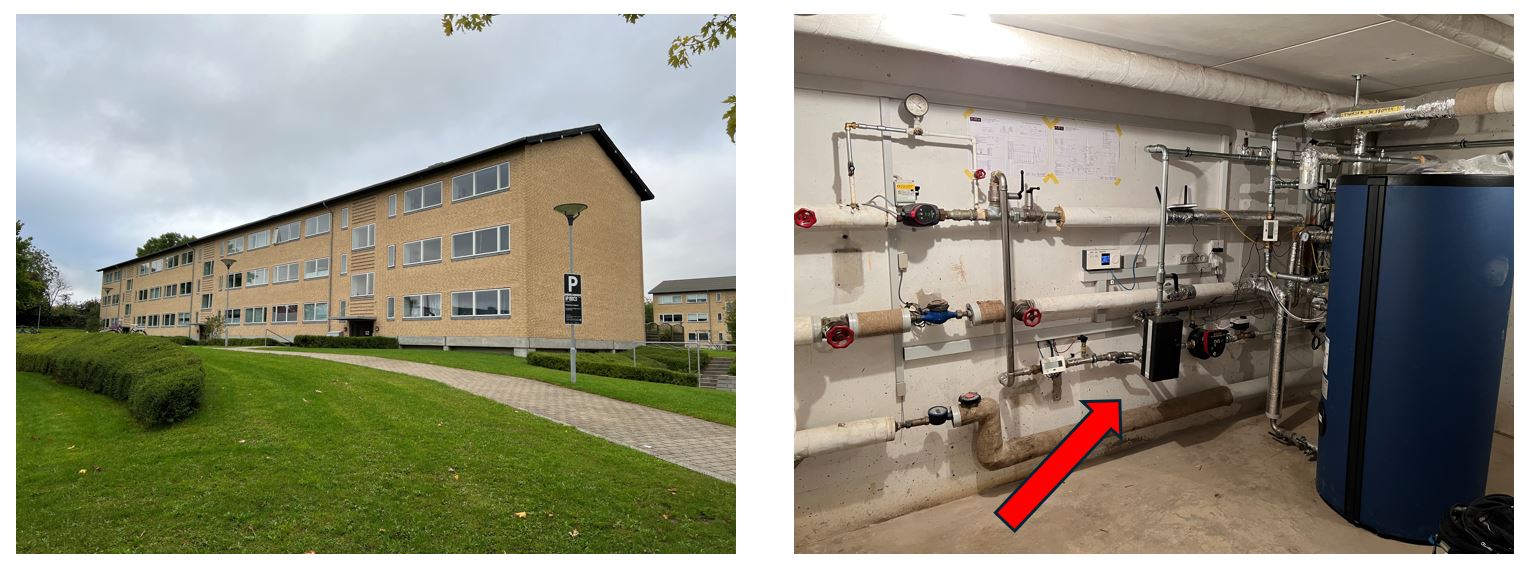
Figure 4. Building used for field test and basement DH substation. The red arrow points to the added heat exchanger for heating the DHW circulation.
Over the full year, this setup reduced the building’s flow-weighted return temperature by 3.0°C. This result lines up well with our analytical predictions for a radiator-based building using the 3GDH temperature profile and climate profile comparable to Copenhagen. 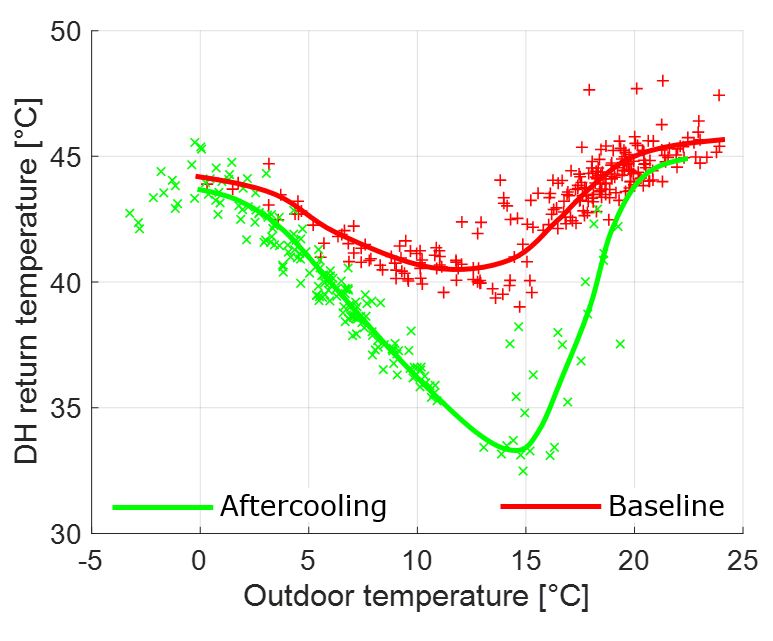
Figure 5. Field test results, aftercooling concept applied in a Danish multi-family building.
What we learned: Cascaded substations can efficiently reduce the district heating return temperature
Our analysis shows that rethinking the heat-exchange process within a building-level substation can efficiently reduce the DH return temperature, without impacting the comfort of the tenants.
Among all the concepts we studied, the midcooling design stands out as the top performer. It delivers return temperature reduction potentials of 2.5 to 9.5°C, depending on climate and building characteristics.
The aftercooling concept follows closely, offering reductions of 1.5-8.5°C. These improvements hold up across different climate zones, from cold Helsinki to warm Rome, with the strongest results appearing in places with long heating seasons and moderate winters.
A key factor influencing performance is the heating system inside the building. Buildings with lower space-heating return temperatures benefit the most, making this an important consideration when planning upgrades.
From a practical standpoint, midcooling is a great match for both new buildings and renovations, particularly when hot water is produced using an instantaneous heat exchanger. In buildings where DHW comes from a storage tank, the aftercooling concept is the preferred option for retrofits, as it can easily integrate into the existing systems.
Both the aftercooling and midcooling concepts are well-suited to both the existing 3GDH and the future 4GDH. In fact, the concepts perform even better under 4GDH temperature conditions, with return temperature reduction potential of 3 to 9.5°C, making them future-proof and non-regret concepts.
Overall, the findings are clear: cascaded substation concepts such as midcooling and aftercooling can significantly reduce district-heating return temperatures at the building level, thereby improving the overall energy efficiency of DH systems.
For further information please contact: Jan Eric Thorsen, at jet@Danfoss.com