Denmark’s district heating sector is rapidly electrifying – offering a clear example of how electricity-based heat can be scaled nationally to support decarbonisation, energy security, and affordable heat.
Original text in Danish by Karen Grønning Mikkelsen, Danish District Heating Association
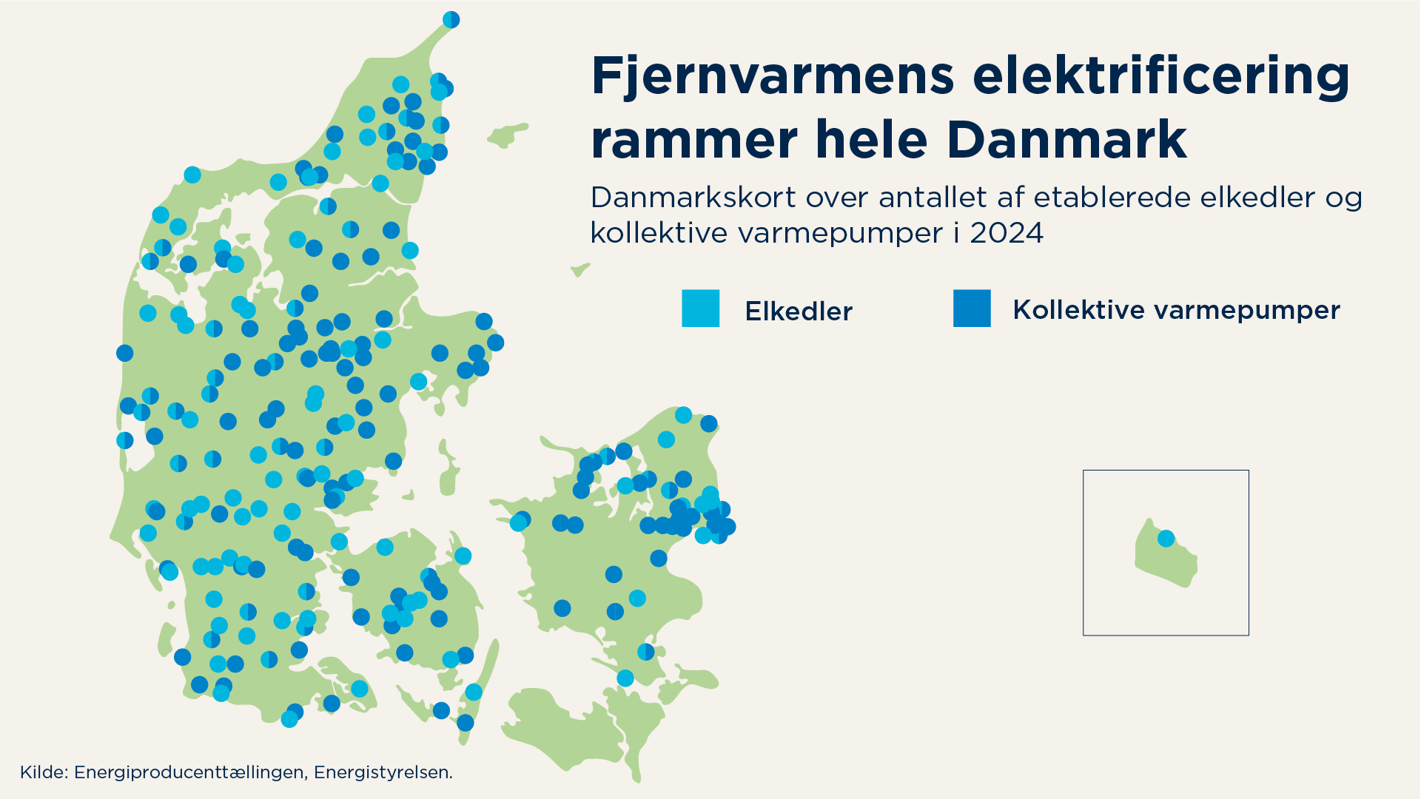
Since 2019, when electrification gained strong momentum, the sector has invested record levels in electricity-based heat production, primarily through large-scale heat pumps and electric boilers. Today, electrified district heating is available nationwide, with installations in almost every municipality.
Source: Energy Producer Census, Danish Energy Agency
Light blue: Electric boilers Dark blue: Large-scale heat pumps
According to the latest energy producer census from the Danish Energy Agency, the number of electricity-based district heating plants increased from 101 in 2019 to 326 in 2024. This represents 225 new installations in just five years, bringing total electricity-based heat production capacity close to 2,600 MW.
The pace of development is striking. Between 2019 and 2024, the district heating sector accounted for 61 percent of Denmark’s total increase in electrification. Over the same period, overall electricity consumption in Denmark rose by 9.3 percent, while electricity use in district heating increased fivefold.
This nationwide rollout demonstrates how district heating can act as a strategic enabler of the energy transition. Electrification allows heat production to shift away from fossil fuels while also providing flexibility to power systems with growing shares of wind and solar energy.
According to Søren Lorenz Rask Søndergaard, Chief Consultant at the Danish District Heating Association, the development delivers multiple benefits simultaneously:
“Electrification supports a greener energy system, improves security of heat supply, and contributes to more affordable heat – while enabling Denmark to reduce its dependence on natural gas.”
Importantly, the expansion is geographically balanced. New plants are being established across the country, demonstrating that electrification of district heating is not limited to a few regions but can be deployed at scale nationwide.
Looking ahead, further growth is expected. The Danish Energy Agency’s analysis assumptions for Energinet 2025 indicate that more projects are already in the pipeline. By 2030, an additional 2,000 MW of heat production capacity from heat pumps and electric boilers is expected to be added – effectively doubling today’s capacity within the next five years.
For countries seeking scalable, system-level solutions to decarbonise heat, Denmark’s experience shows how electrified district heating can play a central role in the transition to climate-neutral energy systems.
Original Danish text translated by DBDH
 Curious to learn more?
You can find all our district energy news here.