A heat tariff can be lawful and still too high. Danish consumer protection therefore reaches the investment, not only the bill: planning and approval beforehand, cost-based tariffs afterwards, local ownership throughout. Germany and the Netherlands now face the same decisions.
By Niels Peter Berg, Chief Legal Adviser, Danish District Heating Association
The article draws on the author’s chapter on Danish district heating regulation in European Energy Law Report XVI (Intersentia, 2026).
Published in Hot Cool, edition no. 6/2026 | ISSN 0904 9681 |
Consumers can face high heating costs even where the district heating undertaking complies with cost-based tariff rules. This is because a network’s costs are largely fixed once it is built. If fewer consumers connect than expected, the same costs are shared among fewer households, and each of them pays more.
The Danish Utility Regulator (Forsyningstilsynet) can examine which costs the undertaking may recover. It cannot, however, repair an investment that should have been smaller or should not have been made.
District heating, which serves close to 70% of Danish households, requires large sunk investments before any heat is sold. No supply area is served by more than one network; the realistic alternative is therefore an individual heating solution. Leaving a network may involve disconnection charges and, where applicable, an exit payment. Consumer protection in Danish heat law consequently begins with the investment and continues with the prices charged afterwards (Figure 1).
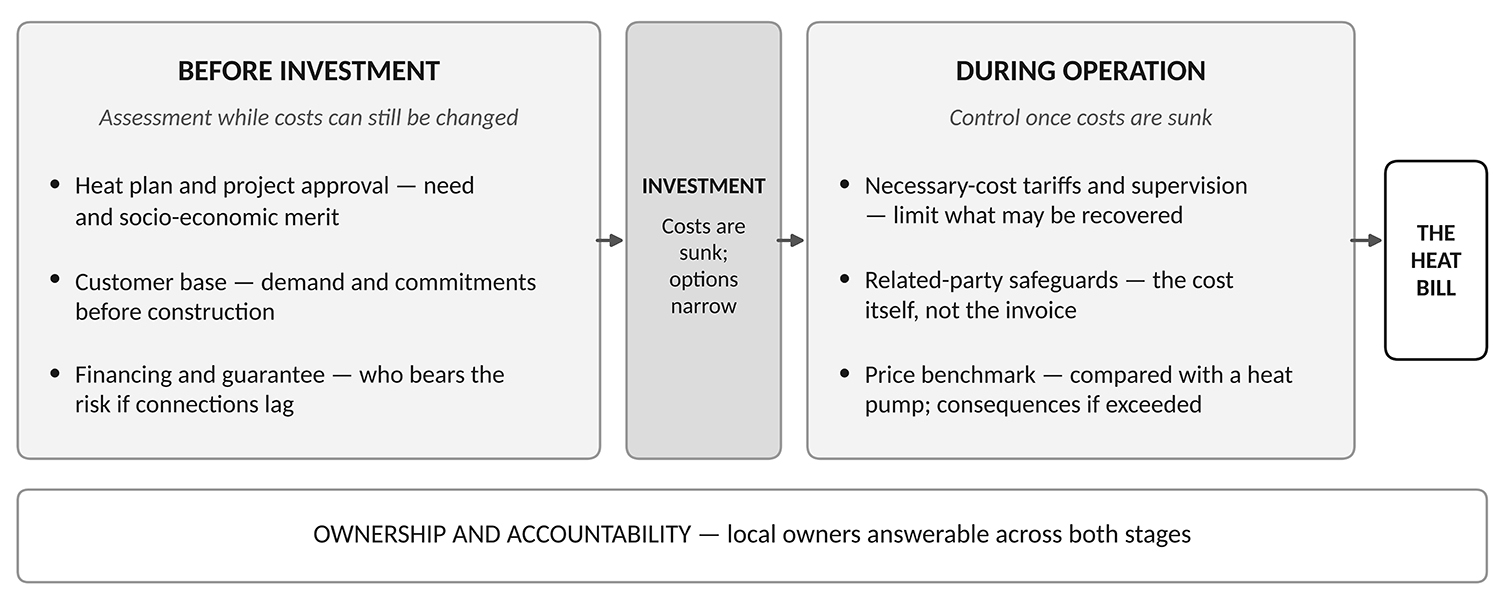 Figure 1. Consumer protection in two stages: assessment while costs can still be changed, then cost control and price comparison; ownership connects them.
From heat plan to investment decision
The sequence begins with planning – in Denmark, a municipal responsibility exercised with the undertakings and other affected parties. That cooperation brings local knowledge; national rules, in turn, provide objectives, assumptions and methods.
A heat plan, however, only coordinates and informs; it does not by itself compel an undertaking to build or consumers to connect. Binding effects arise only through project approval and, where they still apply, connection obligations. A plan is therefore not a project, and a project is not a customer base.
New collective heat systems and major changes require the council’s approval before they are carried out. The council may approve only the solution that is most advantageous in socio-economic terms, unless a specific exception applies.
That socio-economic analysis weighs society’s costs and benefits; company and consumer economics concern the undertaking’s finances and the household’s bill. Because the decisive comparison is the socio-economic one, a project can benefit society without being the cheapest solution for every household. Nor does approval in itself guarantee that demand will match the forecast: where connection is voluntary, households may still choose individual heating.
The consumer’s protection therefore rests on the demand assumptions, which need scrutiny before costs are sunk and the network’s size is fixed. Afterwards, an over-dimensioned network can leave the remaining consumers with stranded costs. Danish approval rules allow a project to be made conditional on a defined heat-demand base, which links construction timing to demand. In my view, they should also state which assumptions require reassessment if connections arrive slowly.
Connection obligations and the customer base
The customer base matters because a broad one spreads fixed network costs over many consumers and thus reduces investment risk. Danish connection obligations (tilslutningspligt) served that purpose: municipalities could require properties to connect or remain connected and to share the system’s costs. They secured contributions to the investment, not heat sales — and heat sales fall as buildings become more efficient.
Since 2019, however, municipalities have been unable to impose new connection obligations. Those imposed before 2019 remain in many supply areas but can now lapse where calculated prices stay high (see box). The default position has thereby changed: new collective heat systems must be attractive to consumers rather than depend on compulsory connection. In 2024, nearly three in four customers cancelling their gas connection said they would switch to district heating.
The same logic extends to related companies. A contract with one of them can move value out of the undertaking before the cost appears in the tariff. The Act therefore requires such agreements in writing and on market terms, with documentation of how prices and terms were set. Supervision can then examine the cost itself, not merely the invoice.
It is not in dispute that these controls protect consumers against unlawful cost recovery. They cannot however, ensure that lawfully recoverable costs are low. Few consumers, old debt, expensive conversion investments or costly fuel can still produce high prices in full compliance with the rules. Because the consumer’s only alternative is an individual solution, Denmark’s price benchmark compares the calculated price with that exact cost.
Ownership and accountability
Tariff supervision addresses which costs may be recovered; ownership, the final element, reaches the decisions that generate them. Ownership is mainly local: cooperatives dominate by number, while municipal undertakings supply most of the heat. Consumers in cooperatives can exercise direct ownership rights, and municipal ownership links control to an elected council.
Ownership protects differently: as a first layer of accountability, it supplements rather than replaces tariff regulation and supervision. Its value lies in connecting those who decide with those who pay, above all where expansion costs are shared. The latter should see, before costs are committed, the expected benefits, their contribution and the consequences if forecasts fail.
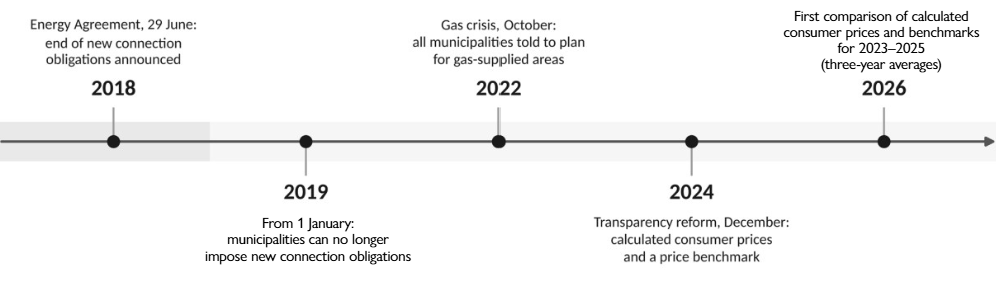
Figure 2. From compulsion to comparison: Denmark’s path since 2018. Darker band, before 2019: new connection obligations possible. Light band, from 2019: no obligations – transparency, comparison, and choice.
Germany and the Netherlands face the same decisions
Germany illustrates the distinction between plan and project drawn above. Its Heat Planning Act has required municipal heat plans since 2024. As in Denmark, a heat plan creates no enforceable duties by itself, and an area designation obliges nobody to connect. Connection obligations can, however, still be imposed under other local powers — a possibility which Danish municipalities lost in 2019.
The Netherlands, in turn, illustrates the questions of control and price. Its Collective Heat Act, adopted in December 2025, gives priority to heat undertakings under majority public control and to heat communities. It also provides a phased move from gas-linked price limits towards cost-based tariffs set by the regulator ACM. As of October 2026, the main changes had not yet taken effect.
Both countries now face the decisions described above: what a plan commits anyone to, who carries the risk, how prices are controlled.
What other countries can learn from this
The lesson, then, is a sequence: demand before investment, financing after demand, tariff control that limits recovery but cannot undo the investment.
A further question arises where systems are built in stages: how should costs and risks be shared between existing and future consumers? One idea is a common city tariff: existing consumers then support later expansion areas but also bear part of the risk. Such a tariff therefore presupposes credible forecasts, accountable governance, and transparent cost allocation.
Another is to reserve lawfully available profits from early phases for later areas. Savings from cheaper finance are not such profits. Savings passed on through lower tariffs cannot also fund expansion. Any provision for future investment must comply with Danish cost-recovery rules.
Over-recovery cannot simply be relabeled as an expansion fund. Neither idea establishes that a later investment is sound; each expansion must still, in my view, be assessed on its own merits.
Consumer protection therefore requires scrutiny before costs are committed and enforceable limits on their recovery afterwards. It starts before the heat bill.
Further reading
Niels Peter Berg, ‘District Heating Regulation in Denmark’, in M.M. Roggenkamp (ed.), European Energy Law Report XVI (Intersentia, 2026). The chapter sets out the Danish rules and sources in full; the volume offers a comparative perspective, including chapters on Germany and the Netherlands.
For further information, please contact: