Hydrogen enables the long-term storage of renewable energy. It can be easily transported. Green hydrogen is indispensable for the decarbonisation of the chemical industry, steel mills, aviation, and other processes where extremely high temperatures are needed. However, hydrogen will not play any role in heating buildings or passenger car transportation.
By Dr.-Ing. Volker Kienzlen, Energy Specialist, Stuttgart Region
Published in Hot Cool, edition no. 4/2026 | ISSN 0904 9681 |
Globally, the share of renewable energy is growing rapidly. As a result, the role of electricity in the energy system is also expanding – mobility and heating are increasingly being electrified. But will our energy system become fully electrified? What will the future role of hydrogen (H2) develop into?
Hydrogen is universally applicable
Hydrogen is an extremely versatile energy carrier and chemical feedstock. It can be used to generate electricity with gas turbines or fuel cells, as a feedstock for marine or aviation fuel, and also in e.g. steel mills for the climate-neutral production of crude steel. In addition, hydrogen can be used directly for heat generation, especially when very high temperatures are required. Hydrogen is also an energy carrier that can be stored long-term without loss.
Transport and storage of hydrogen
For distances under 4,000 km, transporting hydrogen via pipelines is a good option. For longer distances, shipping as ammonia (NH3) is an alternative. Ammonia can be used directly in the production of fertilizers. Hydrogen is typically stored in the same form in which it is transported. For the long-term storage of large volumes of gas, salt caverns—which are already used to store natural gas—can be utilized. In smaller quantities, hydrogen is stored in pressurized cylinders at pressures ranging from 200 to 700 bars.
Types of hydrogen
First, it should be noted that the colorless gas hydrogen will only become a viable component of the future energy system if it is produced entirely from renewable electricity. This is achieved using electrolysers, which currently operate at efficiencies between 70 and 80%. Hydrogen produced in this way is referred to as green hydrogen. If there is a demand for heat at the electrolyser site, the overall efficiency can be further improved by recovering waste heat from hydrogen production.
The “gray hydrogen” currently available on the market is produced from natural gas. The CO₂ generated in this process is released into the atmosphere. If this CO₂ is captured and stored underground, the resulting hydrogen is referred to as “blue hydrogen.” Since technically achievable capture rates range from 80 to 85%, blue hydrogen is considered low-carbon, not carbon-free. As a result, blue hydrogen intended as a bridge technology could become a problematic technology that emits CO2 in the long term.
Hydrogen for building heating
Occasionally, the use of hydrogen for heat generation in buildings is discussed using H₂-boilers that burn hydrogen directly, like a natural gas boiler. Technically, this is possible. Some German gas suppliers promote the idea that the existing natural gas grid could easily be converted to hydrogen in the future.
However, a comparison of overall efficiency shows that the use of hydrogen in residential buildings is far inferior to that of heat pumps. For example, the combustion of hydrogen in H2 boilers achieves an overall efficiency of about 60%, meaning that only 60% of the kWh of renewable electricity used to produce hydrogen is delivered as heat to the buildings (a COP of 0.6!).
At the same time, depending on the heat source, heat pumps typically achieve an annual coefficient of performance (SCOP) of 2.5 to 4, meaning that one kWh of electricity generates up to 4 kWh of heat. This means that supplying heat via hydrogen requires 4 to 6 times more wind power and photovoltaic (PV) systems than heating with heat pumps (see chart). Studies show that heating with hydrogen will also be very expensive.
Hydrogen for District Heating Networks
Centralized heat supply to households via district heating networks is a cost-effective alternative mainly in urban areas. Here, hydrogen can play a role in heat generation as a supplement to other renewable heat sources: In the future, hydrogen will be used in combined heat and power (CHP) systems. This implies that the boiler house still has access to the gas grid. As the future H2-grid will be significantly smaller than today’s natural gas grid, not all DH-networks will have access to hydrogen.
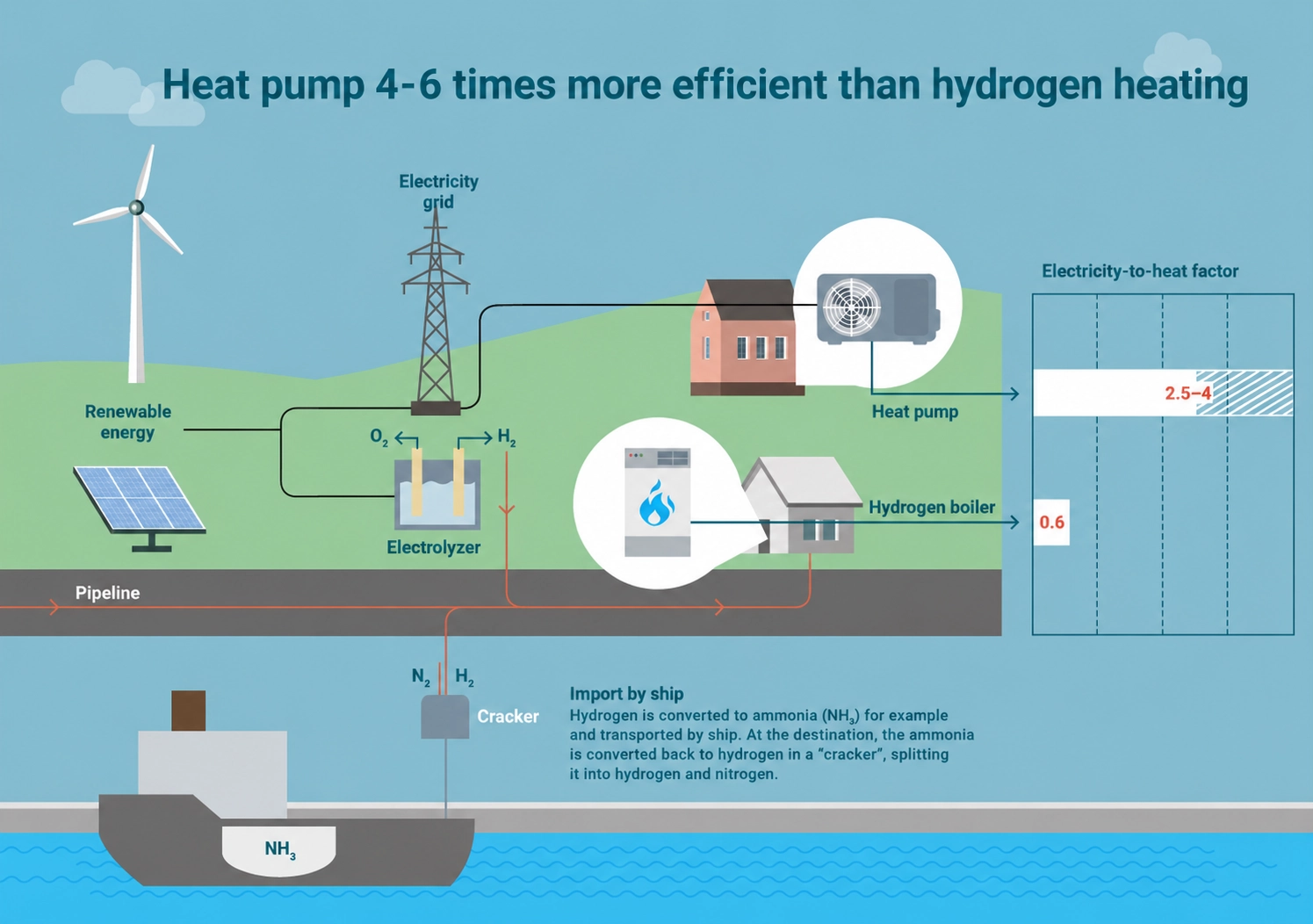 Figure 1. Efficiency advantage of heat pumps over hydrogen (Source: KEA-BW)
Cogeneration is primarily an efficient method to generate electricity in times when PV, wind and other non-storable sources of renewable electricity are unable to supply energy. During the heating season, heat is the valuable by-product of that process.
Hydrogen for industrial process heat
Heat requirements with temperatures up to 200°C can be met technically using heat pumps. For temperatures up to 1,000°C, high-temperature electric generators can be used. However, many industrial manufacturing processes rely on flames and therefore still require fuels. In these cases, green hydrogen is the only alternative.
Hydrogen in the mobility sector
For many years, hydrogen was considered the energy carrier for long-distance transport. At least in road transport, electric propulsion is currently gaining ground—even for truck traffic—due to the rapid development of battery technologies. So far, the use of hydrogen in aviation and shipping appears to have no alternative.
Hydrogen demand and availability
Large quantities of hydrogen are already being consumed today, primarily gray hydrogen. Germany’s current hydrogen demand could be met by a pipeline with a diameter of 1 m. To produce the corresponding amount of green hydrogen, approximately 200 km² of PV capacity and 3,000 wind turbines (5 MW each) are required. For the demand projected for 2045, these figures must be multiplied by a factor of 10. Globally, the expansion of hydrogen production capacity has so far proceeded much more slowly than intended.
Costs
Because electricity is converted into hydrogen, hydrogen production costs are significantly higher than those for electricity.
Current studies report on hydrogen production costs. An analysis from 2023 expects supply costs ranging from 45 to 205 €/MWh. For on-site hydrogen production in Baden-Württemberg, supply costs of 130 to 148 €/MWh are cited for the year 2032. When transportation and distribution costs, profit margins, market effects, and taxes are considered, end-user prices will be significantly higher. These studies reflect the still very wide ranges and, consequently, the uncertainty involved.
Conclusion
Hydrogen produced without CO2 emissions is essential for a greenhouse gas-neutral energy and economic system. In the future, hydrogen will be produced where sufficient renewable electricity and water are available. However, hydrogen will only be used where there are no more economical alternatives. In most cases, there will be electric solutions. Hydrogen for building heating will not be a cost-effective option except maybe in a few extreme cases.
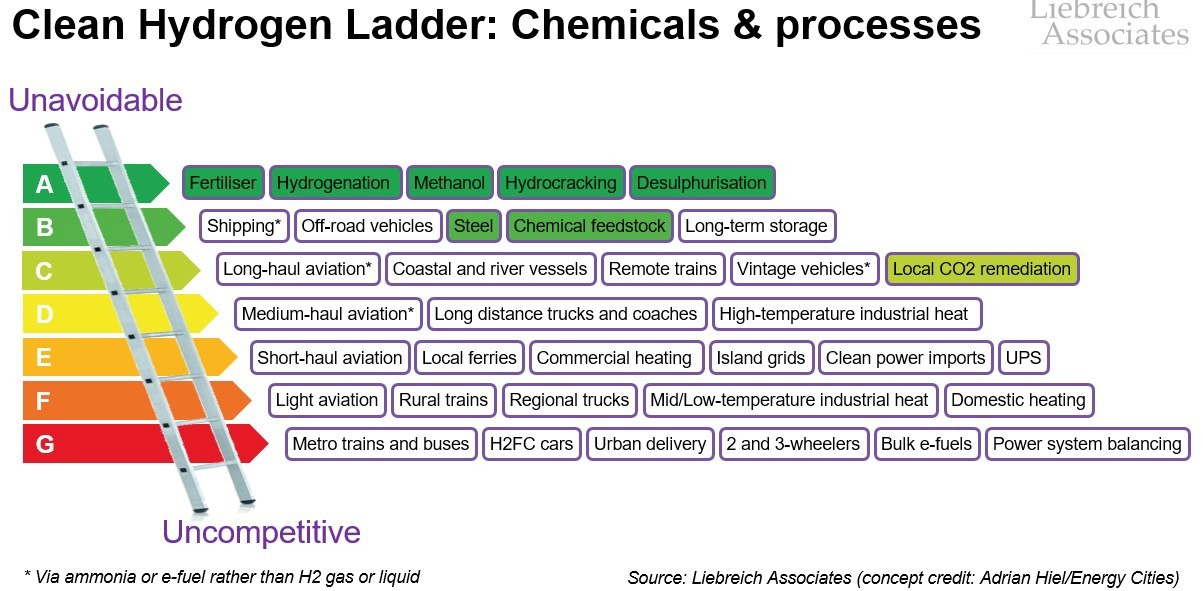
Figure 2. Hydrogen ladder