
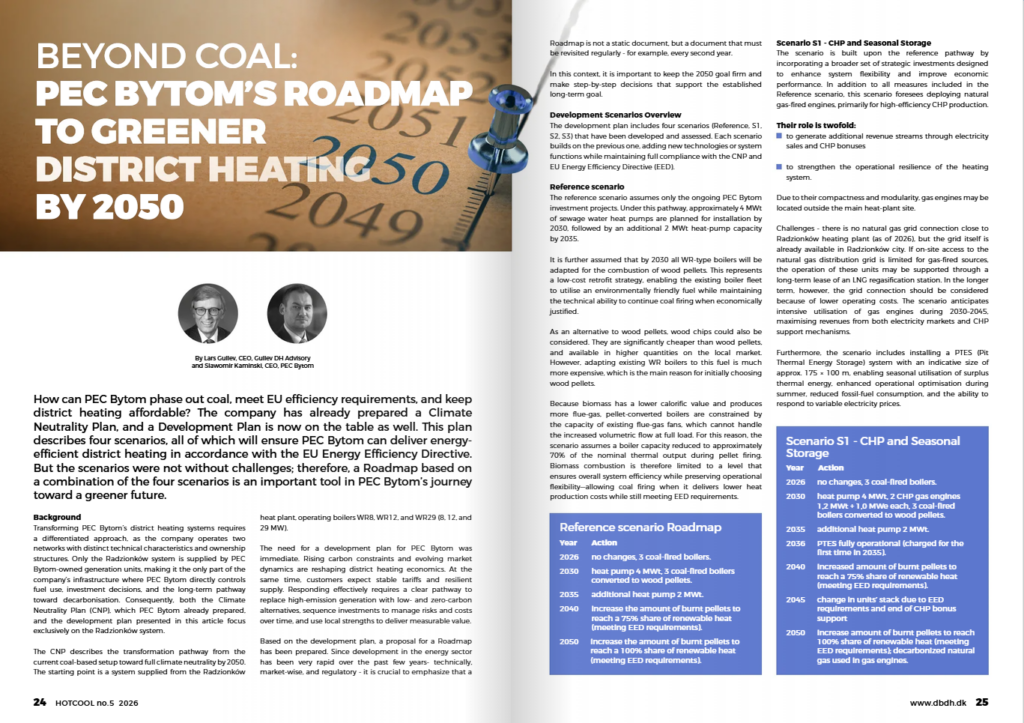
How can PEC Bytom phase out coal, meet EU efficiency requirements, and keep district heating (DH) affordable? The company has already prepared a Climate Neutrality Plan, and a Development Plan is now also on the table. This plan describes four scenarios, all of which will ensure PEC Bytom can deliver energy-efficient DH in accordance with the EU Energy Efficiency Directive. But the scenarios were not without challenges; therefore, a Roadmap based on a combination of the four scenarios is an important tool in PEC Bytom’s journey toward a greener future.
By Lars Gullev, CEO, Gullev DH Advisory and Slawomir Kaminski, CEO, PEC Bytom
Published in Hot Cool, edition no. 5/2026 | ISSN 0904 9681 |
Background
Transforming PEC Bytom’s DH systems requires a differentiated approach, as the company operates two networks with distinct technical characteristics and ownership structures. Only the Radzionków system is supplied by PEC Bytom-owned generation units, making it the only part of the company’s infrastructure where PEC Bytom directly controls fuel use, investment decisions, and the long-term pathway toward decarbonisation. Consequently, both the Climate Neutrality Plan (CNP), which PEC Bytom already prepared, and the development plan presented in this article focus exclusively on the Radzionków system.
The CNP describes the transformation pathway from the current coal-based setup toward full climate neutrality by 2050. The starting point is a system supplied from the Radzionków heat plant, operating boilers WR8, WR12, and WR29 (8, 12, and 29 MW).
The need for a development plan for PEC Bytom was immediate. Rising carbon constraints and evolving market dynamics are reshaping DH economics. At the same time, customers expect stable tariffs and resilient supply. Responding effectively requires a clear pathway to replace high‑emission generation with low‑ and zero‑carbon alternatives, sequence investments to manage risks and costs over time, and use local strengths to deliver measurable value.
Based on the development plan, a proposal for a Roadmap has been prepared. Since development in the energy sector has been very rapid over the past few years- technically, market-wise, and regulatory – it is crucial to emphasize that a Roadmap is not a static document, but a document that must be revisited regularly – for example, every second year.
In this context, it is important to keep the 2050 goal firm and make step-by-step decisions that support the established long-term goal.
Development scenarios overview
The development plan includes four scenarios (Reference, S1, S2, S3) that have been developed and assessed. Each scenario builds on the previous one, adding new technologies or system functions while maintaining full compliance with the CNP and EU Energy Efficiency Directive (EED).
Reference scenario
The reference scenario assumes only the ongoing PEC Bytom investment projects. Under this pathway, approximately 4 MWt of sewage water heat pumps are planned for installation by 2030, followed by an additional 2 MWt heat‑pump capacity by 2035.
It is further assumed that by 2030 all WR‑type boilers will be adapted for the combustion of wood pellets. This represents a low‑cost retrofit strategy, enabling the existing boiler fleet to utilise an environmentally friendly fuel while maintaining the technical ability to continue coal firing when economically justified.
As an alternative to wood pellets, wood chips could also be considered. They are significantly cheaper than wood pellets, and available in higher quantities on the local market. However, adapting existing WR boilers to this fuel is much more expensive, which is the main reason for initially choosing wood pellets.
Because biomass has a lower calorific value and produces more flue‑gas, pellet‑converted boilers are constrained by the capacity of existing flue‑gas fans, which cannot handle the increased volumetric flow at full load. For this reason, the scenario assumes a boiler capacity reduced to approximately 70% of the nominal thermal output during pellet firing. Biomass combustion is therefore limited to a level that ensures overall system efficiency while preserving operational flexibility—allowing coal firing when it delivers lower heat production costs while still meeting EED requirements.
| Year | Action |
|---|---|
| 2026 | No changes; three coal-fired boilers. |
| 2030 | 4 MWt heat pump; three coal-fired boilers converted to wood pellets. |
| 2035 | Additional 2 MWt heat pump. |
| 2040 | Increase pellet use to reach a 75% share of renewable heat (meeting EED requirements). |
| 2050 | Increase pellet use to reach a 100% share of renewable heat (meeting EED requirements). |
Scenario S1 – CHP and Seasonal Storage
The scenario is built upon the reference pathway by incorporating a broader set of strategic investments designed to enhance system flexibility and improve economic performance. In addition to all measures included in the Reference scenario, this scenario foresees deploying natural gas‑fired engines, primarily for high‑efficiency CHP production.
Their role is twofold:
- to generate additional revenue streams through electricity sales and CHP bonuses
- to strengthen the operational resilience of the heating system.
Due to their compactness and modularity, gas engines may be located outside the main heat‑plant site.
Challenges – there is no natural gas grid connection close to Radzionków heating plant (as of 2026), but the grid itself is already available in Radzionków city. If on-site access to the natural gas distribution grid is limited for gas-fired sources, the operation of these units may be supported through a long‑term lease of an LNG regasification station. In the longer term, however, the grid connection should be considered because of lower operating costs. The scenario anticipates intensive utilisation of gas engines during 2030–2045, maximising revenues from both electricity markets and CHP support mechanisms.
Furthermore, the scenario includes installing a PTES (Pit Thermal Energy Storage) system with an indicative size of approx. 175 × 100 m, enabling seasonal utilisation of surplus thermal energy, enhanced operational optimisation during summer, reduced fossil‑fuel consumption, and the ability to respond to variable electricity prices.
The PTES installation is combined with a 1.1 MWp PV plant mounted on top of it. This configuration allows direct power supply to the heat‑pump installation at the nearby sewage water treatment plant via a direct line connection, thereby avoiding network charges and increasing the economic efficiency of both the PV and heat‑pump systems.
| Year | Action |
|---|---|
| 2026 | No changes; three coal-fired boilers. |
| 2030 | 4 MWt heat pump; two CHP gas engines, each with 1.2 MWt and 1.0 MWe capacity; three coal-fired boilers converted to wood pellets. |
| 2035 | Additional 2 MWt heat pump. |
| 2036 | PTES fully operational (charged for the first time in 2035). |
| 2040 | Increase pellet use to reach a 75% share of renewable heat (meeting EED requirements). |
| 2045 | Change in the unit dispatch order due to EED requirements and the end of CHP bonus support. |
| 2050 | Increase pellet use to reach a 100% share of renewable heat (meeting EED requirements); use decarbonised natural gas in the gas engines. |
Scenario S2 – Fuel Mix Diversification
The scenario extends the Reference scenario by adding a set of natural gas-fired boilers, whose primary function is to diversify the heat‑generation portfolio while maintaining low capital expenditure requirements. The strategic rationale behind this investment is to reduce the system’s exposure to volatility in pellet prices, which becomes increasingly relevant as biomass-fired capacity expands in earlier scenarios.
Gas boilers, due to their compactness and modular design, offer considerable locational flexibility. Like natural gas engines in scenario W1, these units may be installed outside the main heat‑plant site, reducing distribution losses by producing heat closer to consumption nodes.
There is no natural gas grid connection close to Radzionków heating plant (as of 2026) – so the same challenge here as in scenario S1.
Overall, the scenario offers a moderate economic benefit with relatively low investment risk. This is a cost‑effective, operationally robust diversification strategy that enhances system reliability, limits exposure to biomass market volatility, and provides a flexible, dispatchable heat source that complements the low-emission technologies deployed under the Reference scenario.
| Year | Action |
|---|---|
| 2026 | No changes; three coal-fired boilers. |
| 2030 | 4 MWt heat pump; three coal-fired boilers converted to wood pellets. |
| 2035 | Additional 2 MWt heat pump. |
| 2040 | Increase pellet use to reach a 75% share of renewable heat; add two new 2.7 MWt gas boilers to diversify the fuel mix. |
| 2050 | Increase pellet use to reach a 100% share of renewable heat (meeting EED requirements); use decarbonised natural gas in the gas boilers. |
Scenario S3 – Electrification and Flexibility
Scenario W3 represents an advanced electrification pathway that builds on the baseline investments of the Reference scenario by integrating additional electric boilers, a large‑scale PTES (Pit Thermal Energy Storage) system of approx. 175 × 100 m, and a 1.1 MWp photovoltaic installation positioned directly on top of PTES.
The scenario aims to maximise the utilization of low‑emission electricity, enhance seasonal flexibility, and enable the system to respond optimally to volatile electricity‑market conditions.
The PTES installation serves multiple strategic functions:
- it allows the system to absorb surplus thermal capacity during summer periods,
- reduces the consumption of other fuels during low‑demand months,
- enables operational optimisation in response to variable electricity prices.
The co‑located PV array, directly connected to the heat pumps at the nearby sewage water treatment plant via a direct line connection, ensures that electricity can be supplied without incurring network charges, thereby improving the economic performance of both assets.
In addition to PTES and PV, the scenario incorporates electric boilers as a low‑CAPEX, high‑flexibility technology capable of taking advantage of market opportunities such as zero or negative electricity prices.
While electrode boilers are commercially available at capacities above 5 MWt, the scale of the Radzionków heating plant implies the use of resistance boilers, which are better suited to smaller installations. When integrated with PTES, these boilers provide a highly flexible and cost‑effective means of converting surplus electricity into stored thermal energy, significantly enhancing system responsiveness and enabling partial decarbonisation of
peak‑load operation.
| Year | Action |
|---|---|
| 2026 | No changes; three coal-fired boilers. |
| 2030 | 4 MWt heat pump; three coal-fired boilers converted to wood pellets. |
| 2035 | Additional 2 MWt heat pump and two 2 MWt electric boilers. |
| 2036 | PTES fully operational (charged for the first time in 2035). |
| 2040 | Increase pellet use to reach a 75% share of renewable heat; add two new 2.7 MWt gas boilers to diversify the fuel mix. |
| 2050 | Increase pellet use to reach a 100% share of renewable heat (meeting EED requirements). |
Recommendation for Roadmap
The four scenarios presented show that it is possible to maintain heat prices broadly lower than individual air source heat pumps, preserving the competitiveness of DH. Across all scenarios, compliance with EED thresholds is achieved at each milestone year, ensuring the long-term regulatory viability of the Radzionków system.
It is possible to carry out a green transition of DH production in the Radzionków system, but not without challenges, as each of the scenarios has its own challenges:
- If the existing coal boilers are converted to biomass, future heating prices will be highly exposed to biomass price developments, which may become scarce.
- If the focus is on establishing gas-fired CHP units to generate income by selling electricity to the grid – sector coupling or system integration between DH and electricity systems – it is a challenge that there is currently no possibility of connection to the gas grid at the Radzionków heating plant. Could the situation be different if it were possible to place gas-fired CHP units decentralized in the distribution network?
- Utilisation of excess heat from the sewage plant by using a heat pump is a future-proof solution – here, the design of the contract between the heat supplier and the DH company is important, as there may be significant upfront investments for the DH company with the connection of the heat source.
- Gas-fired CHP units are the strongest economic driver, generating additional revenue that significantly offsets heat production costs. But gas is not green – but greener than coal, and the CHP units will only run for the next 15 years.
- Gas-fired back-up boilers are cheap to install – if gas is available
- Thermal energy storage enhances system efficiency, but PTES alone does not generate sufficient value unless combined with flexible heat sources and supported by subsidies.
- Electric boilers have limited impact on average heat cost but represent a low-risk option for capturing future revenues from grid balancing and ancillary services.
A DH system that wants to be agile in the future – and the future starts tomorrow – must be characterized by one word:
Flexibility
- when it comes to choice of “fuel” (biomass, gas, electricity, excess heat)
- when it comes to system integration with the power system. Must be able to use electricity (kWh and kW) to produce DH when the electricity market price is low, and sell electricity (kWh and kW) to the grid when the market price is high (gas-fired CHP engine, heat pumps, electric boilers).
- when it comes to enabling decoupling the connection between current production and current consumption (thermal storage)
The recommendation for the Roadmap (see the box) – a combination of the four different scenarios to minimise the challenges – states the necessary action and the beginning of which year the technologies in question must be operational.
| Year | Action |
|---|---|
| 2026 | Begin converting the three coal-fired boilers, with completion before 2029. Start contract negotiations with the sewage plant to purchase surplus heat, to be completed by 2027. |
| 2027 | Design the 6 MWt district heating pipeline from the sewage plant to the existing network. Clarify whether up to two 1.2 MWt gas-fired CHP units can be installed at the Radzionków heating plant or decentralised within the supply area. |
| 2028 | Clarify the size and location of a smaller steel storage tank (5,000–10,000 m³) to increase the flexibility of CHP units, heat pumps, and electric boilers and support integration with the power system. |
| 2028–2029 | Design, tender, and construct the 4 MWt heat pump. If gas-fired CHP is feasible, tender and construct one or two 1.2 MWt units. If gas is not feasible, begin preparing for two 2 MW electric boilers at the Radzionków heating plant. |
| 2029 | Tender for the storage tank. |
| 2030 | Bring the 4 MWt heat pump and the three coal-fired boilers converted to wood pellets into operation. Bring two 1.2 MW gas-fired CHP units into operation, if feasible. If not, install two 2 MW electric boilers. Bring the storage tank into operation. |
| 2033–2034 | Design, tender, and construct an additional 2 MWt heat pump. |
| 2035 | Bring the heat pumps, with a total capacity of 6 MWt, into operation. |
| 2036 | Bring the 67,000 m³ PTES into operation. |
| 2040 | Increase pellet use to reach a 75% share of renewable heat (meeting EED requirements). Install two 2.7 MW peak-load natural gas boilers if gas is available. |
| 2050 | Increase pellet use to reach a 100% share of renewable heat (meeting EED requirements). |
Summary
In the proposed Roadmap, it is important to note that until 2030 the actions described are ro-bust, while for 2030-2040 the actions are indicative and depend entirely on whether natural gas is available.
Therefore, it is necessary in the period until 2030 to revisit – and recalculate by using, for
example EnergyPro – the described Roadmap every year to correct the described activities, while ensuring that the overall framework for the EU’s EED is still respected.
The proposed Roadmap ensures that the requirements of the EU’s EED can be met while keeping the customers’ DH price competitive with alternative heating with individual heat pumps. The Roadmap must also be challenged regarding PEC Bytom’s ability to finance the necessary capital investments.
| Time | Option | Criteria |
|---|---|---|
| ≤ 31 December 2027 | Either | Min. 50% renewable energy sources (RES) Min. 50% waste heat Min. 75% high-efficiency CHP Min. 50% of a combination of RES, waste heat and/or high-efficiency CHP |
| ≥ 1 January 2028 | Either | Min. 50% RES Min. 50% waste heat Min. 50% of RES and waste heat Min. 80% high-efficiency CHP Min. 50% of a combination of RES, waste heat and high-efficiency CHP, including min. 5% RES |
| ≥ 1 January 2035 | Either | Min. 50% RES Min. 50% waste heat Min. 50% of a combination of RES and waste heat Min. 80% of a combination of RES, waste heat and/or high-efficiency CHP, including min. 35% RES |
| ≥ 1 January 2040 | Either | 75% RES 75% waste heat 75% of a combination of RES and waste heat Min. 95% of a combination of RES, waste heat and/or high-efficiency CHP, including min. 35% RES |
| ≥ 1 January 2045 | Either | Min. 75% RES Min. 75% waste heat 75% of a combination of RES and waste heat |
| ≥ 1 January 2050 | Either | 100% RES 100% waste heat 100% of a combination of RES and waste heat |
A municipal district heating company fully owned by the City of Bytom. Its primary objective is therefore not profit maximisation, but a balanced and socially responsible energy transition, including limiting heat price increases for residents.
PEC Bytom operates two independent district heating systems: the Bytom system (181 MW, 120.7 km network) and the Radzionków system (47 MW, 39.5 km network).
Bytom is one of the oldest cities in Upper Silesia, southern Poland, located approximately 7 km northwest of the regional capital, Katowice. The city has approximately 150,000 inhabitants.
Project participants
Fenagy, Aalborg CSP, EMD International, Danish Embassy in Warsaw, Ramboll – Poland , DBDH, Gullev DH Advisory
Financing
EIFO (Export and Investment Fund of Denmark)
For further information, please contact: Lars Gullev, larsgullev55@outlook.com
“Beyond Coal: PEC Bytom’s Roadmap to Greener District Heating by 2050” was published in Hot Cool, edition no. 5/2026. You can download the article here:

Did you find this article useful?
Subscribe to the HOT|COOL newsletters for free and get insightful articles on a variety of topics delivered to your inbox twice a month!