A new approach is emerging in which district heating (DH), and the process industry (PI) can both benefit from closer collaboration. To make this a reality, both sides need to make investment decisions. This is the story of the analyses and methodology behind those investment decisions.
By Mathias Terp Munck and Ole Andreassen Kofoed, Artelia A/S, and Hanne Kortegaard Støchkel, DBDH
Published in Hot Cool, edition no. 5/2026 | ISSN 0904 9681 |
Beyond electrification
Worldwide, process industries rely heavily on natural gas and oil to generate process heat. These industries include food production, chemicals, pharmaceuticals, and other manufacturing sectors where a reliable heat supply is essential for daily operations.
Reducing emissions from these sectors is often more complex than decarbonising buildings or electricity generation. Industrial processes require stable energy supplies, competitive costs, proven technologies, and an understanding of linked subprocesses.
Many companies therefore focus primarily on electrification – or simply postpone addressing the issue. However, electrification is not always the most practical or cost-effective solution. In some cases, it may not even be feasible due to limitations in the local power grid. Alternative approaches are needed to accelerate emission reductions while maintaining industrial competitiveness – here DH can play a significant role. This is demonstrated by cases in operation in Europe and practical experience from Artelia’s work as a technical consultant to both industry and DH. The next step is to move from pioneering cases to a standardised methodology to support better decisions.
Two current answers
When an industrial company starts planning for solutions to become more sustainable, two solutions usually come up first.
The first is electrification. Fossil-fuel boilers are replaced with heat pumps or electric boilers, installed on site. The company provides its own heat supply, powered by electricity.
The second approach is to continue using fossil fuel locally but recover the surplus heat instead of wasting it. The surplus heat can be applied either internally or supplied to external users. This is typically low-temperature heat. but a heat pump can upgrade it to a suitable temperature level, allowing it, for example, to be utilised in a DH network to heat buildings in the surrounding urban area.
New answers emerging
Both approaches require the company to organise and implement the solution largely on its own. That is already an obstacle, but there are other major concerns too. For electrification, the uncertainty is future electricity prices, connection costs, and security of supply. For surplus heat recovery, the underlying problem remains if fossil fuels are still being burned on site.
A third option is emerging, though still rarely seen in practice: a tailor-made mix of technologies and energy carriers, combining electricity, DH, and sometimes other solutions, matched to what each company needs. The Hot|Cool article “District Heating brings value to the process industry” lists benefits for both sides and gives examples of cases in operations across five countries.
Instead of solving the challenge alone, the company can draw on the energy infrastructure already around it, such as the power grid and a DH grid. DH can supply heat to the company, not only receive it. It becomes part of a flexible, tailored solution for that specific site. The available DH supply may not always meet the required temperature levels at a given site. However, several technologies can be applied to increase the temperature to the desired level. Although this requires additional equipment and investment, it can still be economically attractive in many cases.
DH also brings something else to the table: a track record. Many DH utilities have steadily reduced the carbon content of their heat supply for years, and have a demonstrated record of continuous supply, with a low risk of failure — a quality highly valued by industrial customers.
Broaden the perspective to see new solutions
This is relevant for companies located near an existing DH network. But it is just as relevant when a DH system is being planned — in that case, industrial heat supply and demand should be designed into the network from the very start.
Electrification and reuse of surplus heat remain valuable solutions, but they should not always be seen as the only options. In some cases, they can stand on their own; in others, they can form part of a tailor-made energy mix for industrial companies or areas. The shift in mindset is toward combined solutions that improve affordability and flexibility — and toward remembering that DH could be a key component of that mix.
Seeing the whole picture
An industrial production line rarely needs just one type of energy. It needs heat and electricity, at different times of the day, at different temperatures, across many connected sub-processes.
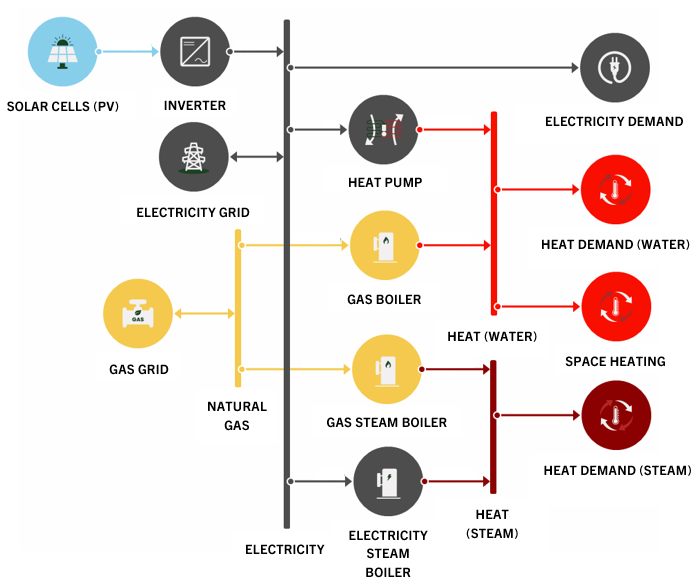
Figure 1: An example model of an industrial site’s energy system — the reference case before any integration with a DH system. Solar power, the electricity grid, and the gas grid feed a heat pump and boilers, which supply the site’s electricity demand and its water- and steam-based heat demand. The same type of model can then test alternative setups, including how district heating could supply part of this heat.
Modelling the entire process this way gives an overview that few companies have today. Instead of asking “can we replace this one boiler,” the model demonstrates and documents the combined, total need across the whole site. The model includes both the industrial site and the DH system, and Figure 1 shows an example for the industrial site alone. Behind this overview are technical specifications for every component and connection in the production process.
The model can be simple or detailed, and it is built through collaboration between external engineers and technical staff at the industrial company, who provide crucial insight into internal processes. Setting up and discussing this overview alone often reveals energy efficiency gains before any new investment in supply is even considered. In Denmark, models like this are already used for business cases and planning in the DH sector, so once the industrial model is built, the combined system of industry and DH can be analysed and optimised.
Comparing apples and oranges
Once the total energy need is mapped, you can quantify and compare very different solutions on equal terms: economy, CO2 emissions, and other factors, such as water use. This is perhaps the greatest value of a model-based approach — the ability to quantify impact and compare solutions directly.
Figure 2 illustrates some of the solutions that can be compared this way, from the two current solutions described above to variations that integrate a DH system. Comparing solutions 1, 2, and 3 can guide which options to investigate further; comparing solutions 3 and 4 can support decisions on the speed of carbon reduction. More solutions can be added, and every one of them can, of course, be compared against the current situation — the reference case – or any other considered scenario that has been modelled.
The examples in Figure 2 are simply to illustrate that many types of solutions can be analysed and compared. Solution #1 is pure electrification at the industrial site with no integration with DH. Solution #2 is selling surplus heat to the DH system at a price that can be modelled.
Solution #3 replaces heat production at the industrial site with more sustainable heat from the DH system, and to keep the transition manageable for the industrial company, the existing gas boiler will run for much fewer hours but continue to operate to boost the temperature. Solution #4 takes it one step further, and the existing gas-boiler is now only kept as a back-up unit for security of supply, while the boosting of temperatures is managed by a new electric boiler.
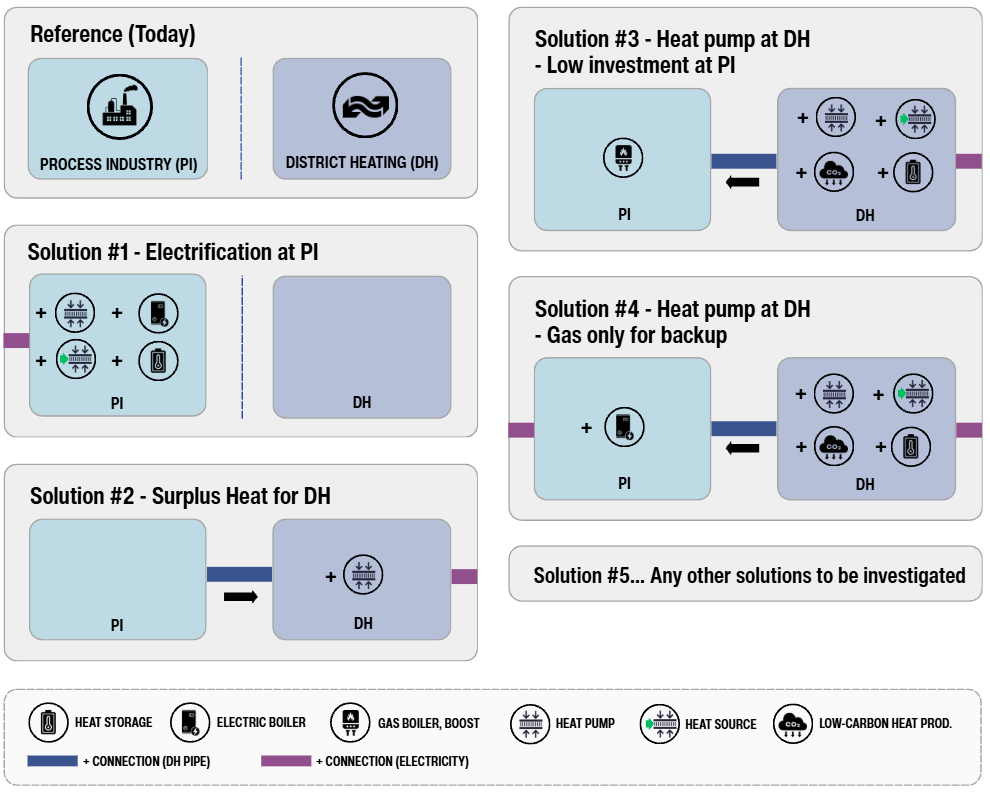
Figure 2: A model-based approach starts by modelling the reference situation, then adapting that model to represent different potential solutions — perhaps adding new production units, new energy infrastructure, or making other adjustments to the system.
Engineers and models, together
Testing every possible combination is not realistic. This is why the approach relies on two things simultaneously: experienced engineers, and a model of both the industrial site and the DH system.
Engineers first narrow down the handful of solution that based on experience could make sense for a specific case. The model then quantifies and compares them. Detailed design and sizing follow only after that.
Stress-testing the future
A comparison to today’s situation is not enough. Investment decisions look years or decades ahead, so results need to hold up under different and uncertain scenarios of future.
This is where sensitivity analysis becomes important. Electricity and fuel prices, investment costs, interest rates, and other assumptions can all be varied, showing how each solution performs under each scenario. Which parameters to test is often decided together with management on both sides. Each party knows its own biggest risks and concerns, and the analysis can be tailored to address them directly.
A shared foundation for agreement
The model results are not only technical output. They become the shared, factual basis for collaboration and negotiations between the two parties.
A common description of the situation and the options helps both sides discuss value, risk, and responsibility on equal footing. Who takes on which risk, and how are the benefits shared?
This same foundation also speeds up decision-making. It helps reach agreement faster or shows early on when a case is not viable, thus preventing wasting resources on the wrong solutions.