Why successful district heating depends on councils, communities, public institutions and investors shaping the system together — not being invited after decisions are made.
By Paul Steen, Steen Engine Limited, with contributions by Dr Roddy Yarr, Roddy Yarr Consulting
Published in Hot Cool, edition no. 4/2026 | ISSN 0904 9681 |
Heat networks as civic infrastructure
Heat networks are too often discussed as a solution that is widely available and ready to connect. Discussion is framed principally in technical terms: find the heat source, lay the pipes, connect the buildings. That is too narrow – heat networks are civic infrastructure. They come with financial and non-financial costs: altering streets, buildings, bills, investment flows, public expectations and local accountability. They rely on multiple stakeholders to accept the cost and disruption and to make a positive choice all at the same time. Influential stakeholders must be involved in decision-making from planning through to operation.
Many countries, including the UK, have made immense, laudable efforts to establish a zoning approach. These zones have been conceived between central and local government institutions but framed to address a narrow objective of climate mitigation.
They have been drawn up in isolation from wider systems thinking and designed through a procurement lens to meet the funding criteria of asset owners and investors. They inherit the weaknesses of that narrow room.
Heat networks can only succeed when they are the predominant solution for any area. If they cannot supply heat to the majority of consumers, then their economy of scale fails. But where they succeed, they can generate a series of outcomes that other heat technologies will struggle to compete with. They can make efficient use of local waste heat sources; they can provide flexibility benefits to the electricity system; they generate jobs and develop skills that must be delivered locally. Outside Denmark there are vanishingly few examples of heat networks where the market has driven high levels of customer acceptance. However, replicating Denmark requires an unrealistic change in society to accept government intervention and mandation.
So, the UK needs a different paradigm. The hypothesis is simple: heat networks deliver social outcomes, and the organisations expected to enable these must be treated as partners in design, not invited in later as delivery agents for objectives defined by others. Development and design must bring together a wider ecosystem of councils, community energy organisations, universities, housing providers, utilities, developers, investors and consumers¹. Where that happens, they stand a much better chance of becoming durable public assets rather than another contested utility product.
Community energy must enter earlier
The community energy sector is particularly exposed to being invited into the room far too late. It is regularly asked to bring trust, local knowledge, volunteer time, customer engagement and legitimacy. Yet it is frequently absent from the rooms where investment strategies, risk allocation, funding mechanisms and delivery expectations are settled. By the time the invitation arrives, the real choices have already been made. The request is then to bid, absorb risk, mobilise communities and deliver outcomes against someone else’s architecture.
The UK has reached the point where that habit is no longer good enough. Heat network zoning, stronger regulation and public funding are beginning to create the conditions for expansion. Cities are exploring strategic energy partnerships to accelerate investment across heat, retrofit, power and transport.
The investment requirement is enormous, including building heat networks, insulating buildings, installing solar, and rolling out electric vehicle infrastructure. Local and Combined Authorities are right to recognise that municipal capacity alone cannot fund or deliver that transition. But if the answer is simply to replace a resource-constrained public sector with a dominant private concessionaire, the opportunity will be missed.
What Denmark shows about trust and governance
Denmark offers a useful corrective, not because it can be copied, but because it shows what heat networks become when they are treated as long-term institutions. Danish district heating did not begin as a climate branding exercise. It started in 1903 and grew from the energy security shock of the 1970s – at that time 30% of Denmark’s heat demand was covered by district heating, when dependence on imported oil forced a fundamental reconsideration of heat supply.
The state created a framework through the Heat Supply Act, but municipalities carried out heat planning, assessed socio-economic value and shaped collective heat supply areas. Mandatory connection was not used as a casual imposition. It was led by evidence that a collective solution delivered wider public benefit compared with alternatives.
That institutional sequencing matters. Denmark created planning confidence before expecting large-scale delivery. Local authorities had defined roles. Utilities operated within regulated local monopolies. Consumer protection and transparent pricing were embedded. Cooperative and municipal ownership traditions meant that district heating was understood less as a commodity and more as collective infrastructure.
Most heat companies operated on non-profit principles, reinvesting surpluses into networks or returning them through lower prices. This financial and governance architecture helped sustain public acceptance, including for connection obligations that would be politically difficult in a weaker trust environment.
Roles must be clear, shared and adaptable
The lesson for the UK is not that every city needs Danish-style municipal utilities or that community ownership alone can carry the transition. It is that the roles of the many organisations critical to success must be explicit, recognised by all, collaborative and capable of changing over time.
A local authority may have the convening power, planning powers and risk appetite to bring early projects into being. It can map demand, use planning policy, coordinate public estates, support early feasibility work and reduce uncertainty. But it may not be able to carry the financial burden of scaling a city-wide network. At that point, private enterprise can be useful, even essential, if it enters a project that has been properly shaped, de-risked and governed in the public interest.
Community energy creates a trusted not-for-profit partner to secure sustained asset development and can transition to democratic customer representation. Universities and hospitals are vital to anchor investment but must accept that their role changes over time. In some places a university may be the original driver: commissioning modelling, using its estate as anchor demand, providing technical capability and giving credibility to early development. Later, as the network grows, that same institution must be willing to shift to become one consumer among many.
Bristol’s lesson: scale changes the conversation
Bristol is the UK case study from which others should take both encouragement and caution. Bristol City Leap brought together Bristol City Council, Ameresco and Vattenfall in a long-term public-private partnership intended to unlock more than £1 billion of investment into the city’s energy system. Its heat network has moved from municipally initiated assets towards an expanding city-scale utility. It also includes social value commitments, local supply chain ambitions and a Community Energy Fund.
The important point is not that Bristol has found the perfect model. It has not abolished the need for hard contract management, strong public client capability or sustained community scrutiny. The value of Bristol is that it demonstrates how aggregation of responsibility changes the investment conversation. A portfolio of heat, power, buildings and infrastructure projects attracted capital and expertise that individual schemes probably could not. Bristol negotiated social value commitments at a scale that isolated procurements rarely achieve.
Has the pace and scale of that growth matched original intentions? Have the profitable, lower-risk projects helped support harder projects and delivered social value outcomes? Are community energy organisations engaged or are they peripheral? It is too early to have answers to all of these questions. Organisations that follow this, or any other, delivery model must be open to the negatives and learn from these as much as the positive lessons.
Regional capacity for long-term delivery
Creating bespoke delivery models for every council across the UK is a monumental task. But we are in a period of devolution that frames an opportunity. Bringing councils together into Regional Energy Organisations that can form shared institutional capacity: a place where councils, community energy groups, universities, housing providers and investors can pool expertise, develop pipelines, standardise governance, reduce transaction costs and hold long-term objectives steady.
It can employ the commercial, legal, technical and engagement capability that no single community group or smaller Local Authority can sustain alone. Beneath it, local joint ventures can own and operate specific networks or assets, with community development structures ensuring that neighbourhood knowledge and legitimacy are not an afterthought.
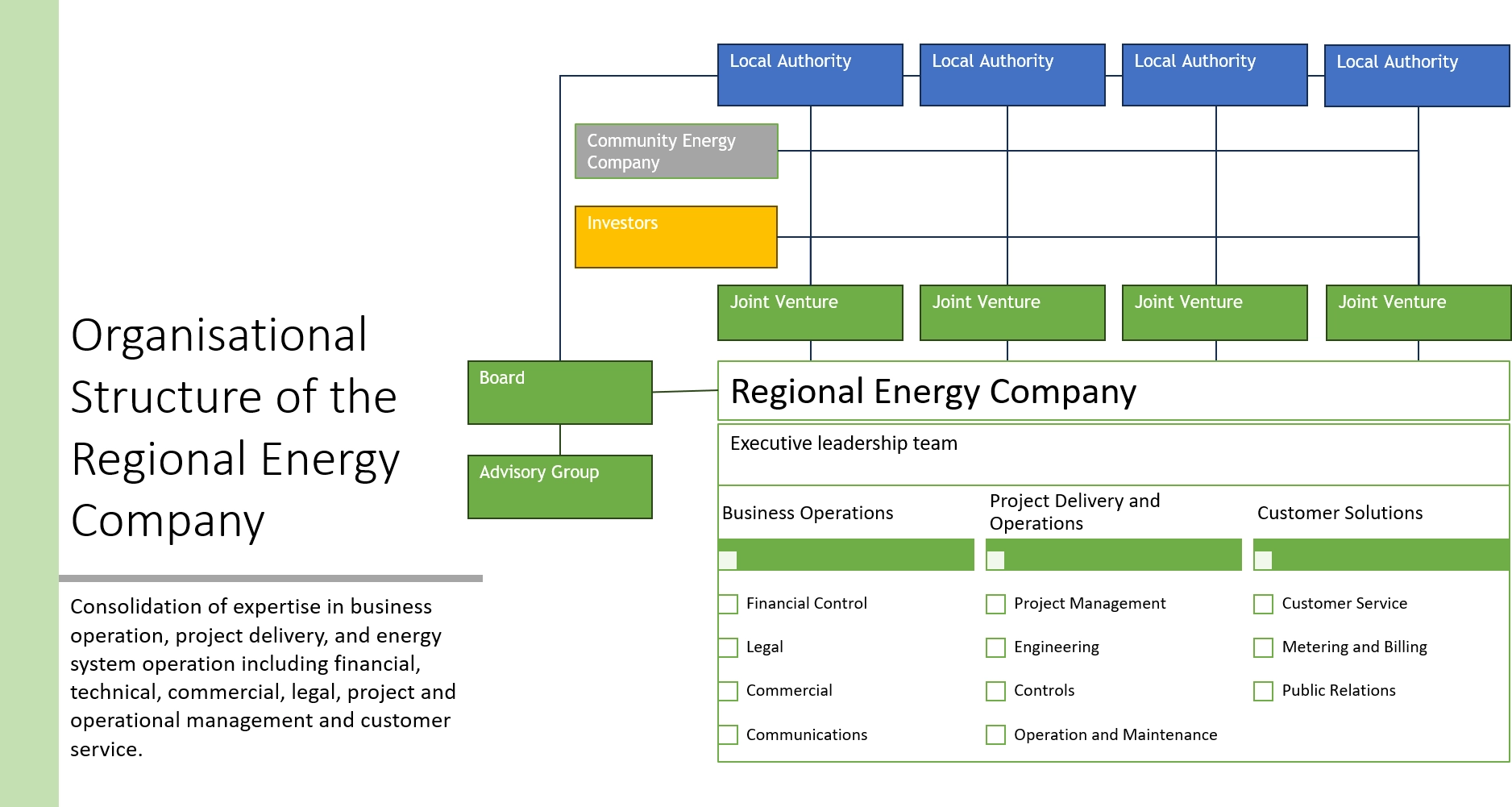
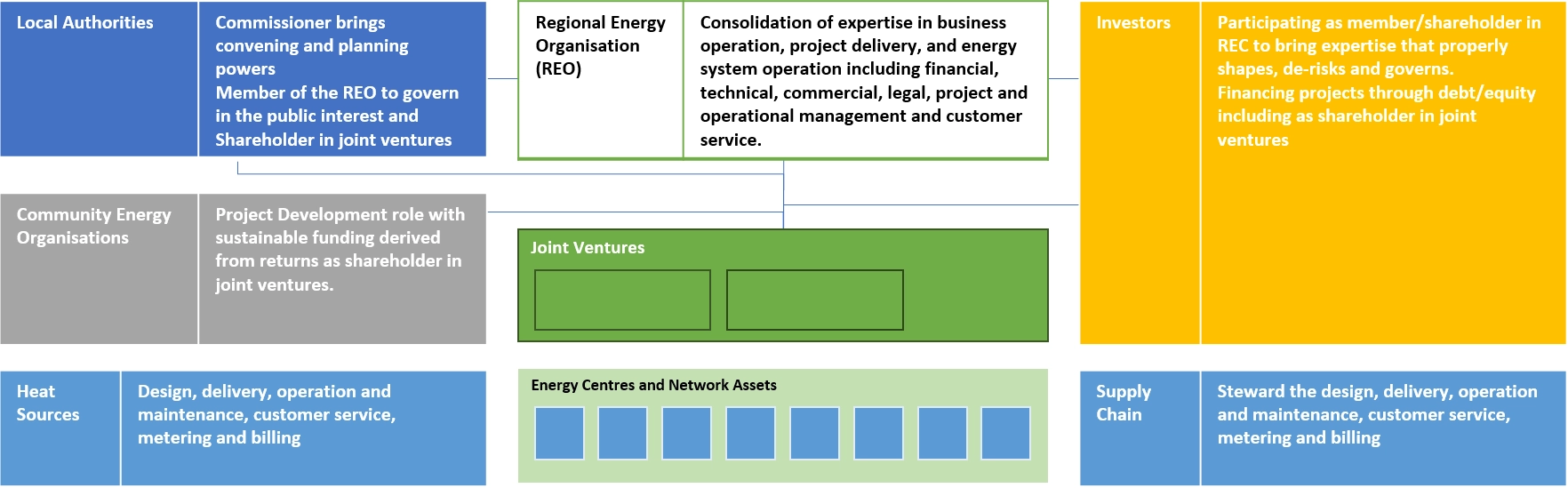
The right allocation of risk across the partners in the Regional Energy Organisation should reflect their powers, expertise and competence. Community organisations should be rewarded for taking development risk that large public and private actors are unwilling to carry. Councils should not be expected to underwrite indefinite scaling of assets on their balance sheet. The right model uses each party where it is strongest. Councils convene, plan, regulate locally and use public assets intelligently.
Community energy organisations build trust, originate local ideas, challenge unfair assumptions and help keep value rooted in place. Universities and colleges contribute knowledge and workforce development while their estates anchor projects. Private partners bring capital, delivery discipline and operating expertise. Consumers are not passive endpoints; they must be represented in pricing, service standards and accountability through community energy organisations.
Shared accountability is the hard part
The harder truth is that collaboration has to be enduring. If community energy has no governance seat, no funded capacity and no route to long-term income in return for development, it will dwindle. If Councils do not retain intelligent client capability, public interest will depend too heavily on contract clauses, without the capacity to manage and enforce them. If investors are treated as villains rather than necessary partners, schemes will remain undercapitalised. If consumers are ignored until connection, public support will fracture.
This applies to the UK’s emerging zoning regime. Heat network zones should not become maps drawn up and handed to communities as destiny. They should be the beginning of a structured civic process: where heat density, anchor loads, affordability, carbon value, consumer protection, road disruption, local jobs and ownership options are debated together. Zoning can create investable demand, but legitimacy will depend on whether affected communities believe the system has been designed with them rather than imposed on them.
Strategy first, institutions second, projects third
The international lesson is therefore not a single ownership model. It is a discipline: strategy first, institutions second, projects third. Set the regional vision. Build the organisation capable of holding that vision. Then deliver schemes through roles that are clear, fair and adaptable. Heat networks will fail if they are reduced to engineering packages or investment products. They will succeed where they are treated as long-term civic infrastructure, built by ecosystems of organisations that understand their own strengths and respect the strengths of others.
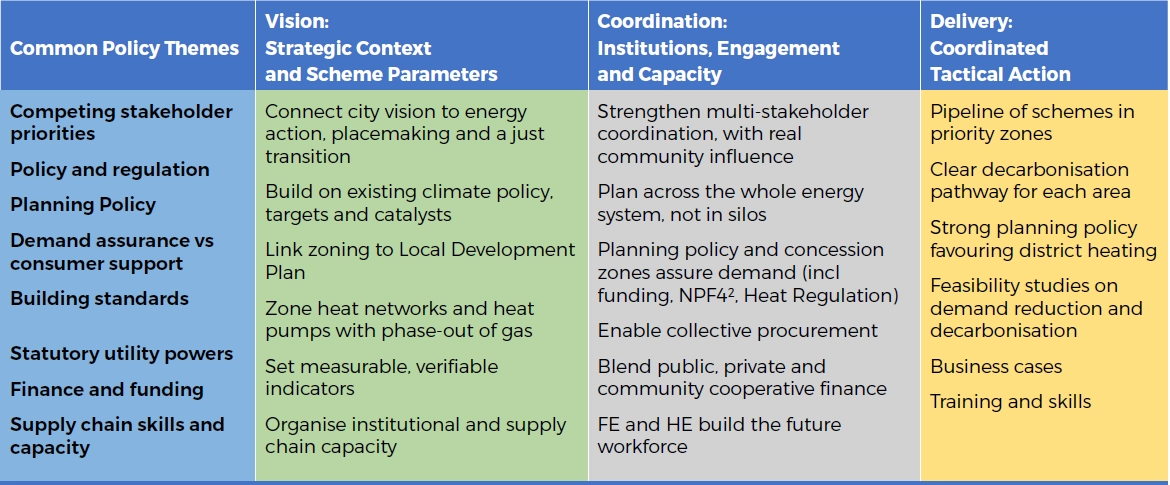
For the UK, that means being bolder about public planning, more serious about community representation and more pragmatic about private capital. For Danish observers, it is a reminder that the exportable value of Denmark’s experience lies less in any one technology than in the patient institutional settlement that made technology useful. For cities everywhere, the conclusion is blunt: do not invite communities to bless a finished deal. Bring them into the room where the deal is shaped. Heat networks need partners, not passengers.
Footnotes:
¹ Communities are referenced frequently throughout this paper. Community refers to individuals that are either energy consumers or are impacted by the disruption caused by energy projects. Community Energy refers to organisations that can be a partner in design and ownership and represents these communities.
² Scotland’s National Planning Framework 4 (NPF4)
For further information, please contact: paul@steenengine.com