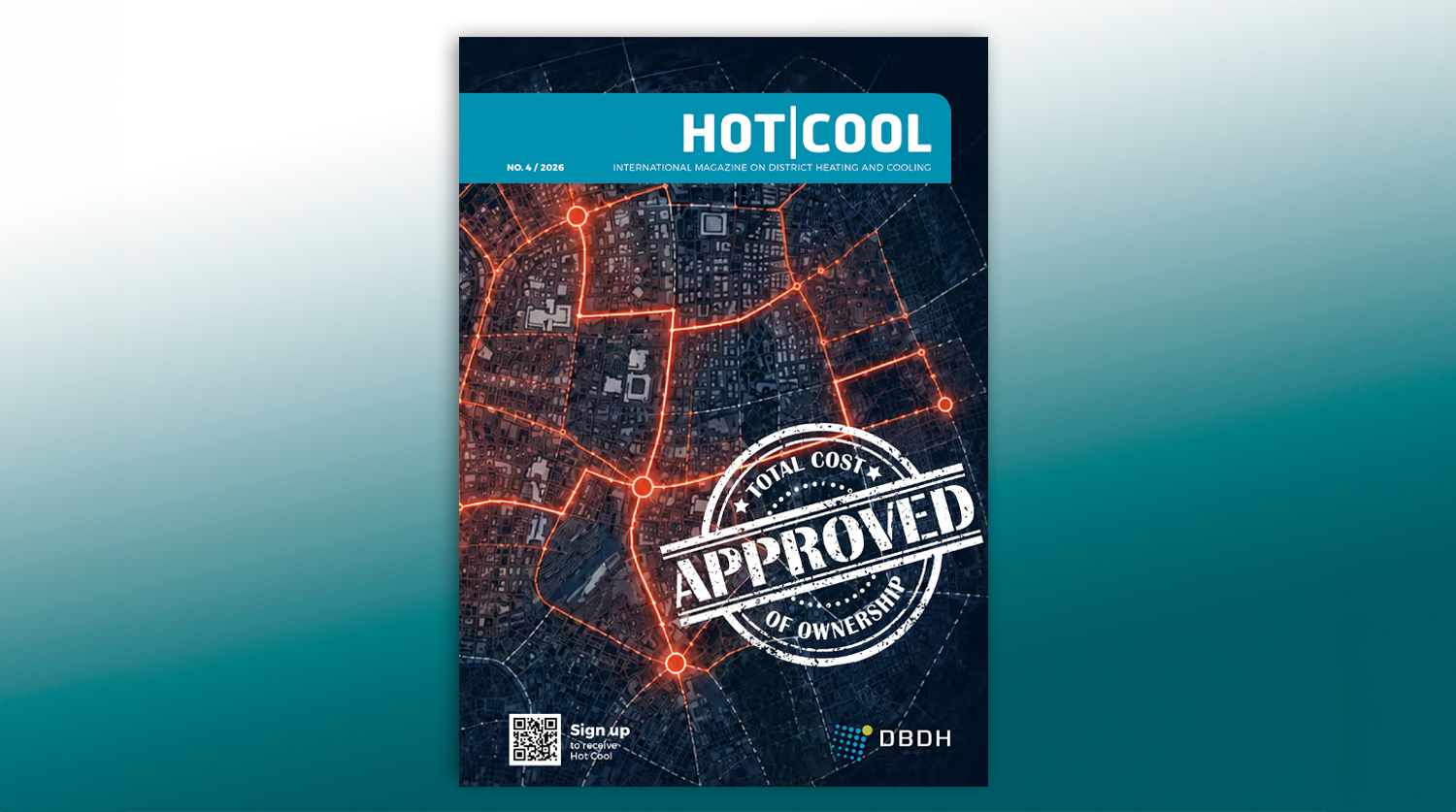
If you’d like to receive the HOT|COOL magazines for free, sign up for our Hot|Cool newsletter, which will be delivered to your inbox.
You can also visit us here on our website, where we frequently publish all the articles in a mobile-friendly format.
Total Cost of Ownership:
The price you do not see could be the one that matters most
In district heating, the cheapest solution is rarely the least expensive one. That contradiction is what this Hot Cool magazine is all about.
Total Cost of Ownership is not just a financial model or a procurement tool. It is a way of thinking — one that asks utilities, planners, technology providers and decision-makers to look carefully beyond the first investment and consider what an investment choice will cost, deliver and enable over the full lifetime of the system.
Across this issue, TCO is explored from several angles. In Frederiksberg, a data-driven renewal strategy challenges the idea that ageing pipes must automatically be replaced after a fixed number of years. By extending the expected network lifetime from 50 to 65 years, the utility can avoid premature replacement and create long-term value for customers, the climate and the economy. Read how smarter renewal planning can save millions →
The true cost of ownership
The same lifecycle logic is at the heart of the article “Master the Total Cost of Ownership in District Energy?” on pumping systems. Here, the purchase price represents only a fraction of the total cost, while energy consumption, maintenance, downtime and operational performance determine the real cost over time. It is a clear reminder that procurement decisions made to save money today can become expensive during operation — and that long-term reliability must be designed, built, monitored and maintained. Discover where 95% of the cost comes from →
Green Therma’s company profile adds another important perspective: the value of renewable heat must also be judged by how efficiently it uses electricity. Green Therma’s geothermal concept points to a possible pathway for delivering stable, renewable heat with very low electrical input — a reminder that TCO is also about how technologies perform within the wider energy system. Explore the geothermal approach →
When replacement becomes waste
Materials and installation choices are also part of the equation. Plastic pipe systems may reduce installation costs, but lower upfront costs create real value only if lifetime, heat-loss performance, diffusion barriers, surveillance systems, and documented testing are addressed with equal seriousness. In long-lived infrastructure, lifetime should be proven, not promised. See what utilities should demand →
Good planning has value
Other articles widen the perspective. The Netherlands’ new heat planning standard shows how common calculation methods can make heating choices more transparent, comparable and credible. See what the Dutch learned from Denmark →
The article “If You Want Heat Networks to Work, Change Who’s in the Room” on regional integration reminds us that heat networks are not only engineering projects, but civic infrastructure shaped by councils, communities, institutions, investors and consumers. See why governance matters →
The wrong technology is also a cost
And the article on hydrogen underlines a key TCO principle: the most expensive solutions are often those used in the wrong place. Green hydrogen will be essential in parts of industry and transport, but rarely makes sense for ordinary building heat when more efficient alternatives are available. Find hydrogen’s right role →
Together, the articles point to one conclusion: TCO is not about spending less at all costs. It is about understanding value over time — and making investment decisions that keep delivering long after the first invoice has been paid.
Tag Your Peers
Tag your colleagues, share it with your network, and let’s build a community dedicated to sustainable energy practices.
The HOT|COOL district energy magazine is not just a passport for staying informed; it’s an invitation to share, discuss, and contribute to the ongoing dialogue about the challenges and opportunities that lie ahead.
Thank you for being a part of this exciting journey!