Most district heating networks at energy companies are built today with pre-insulated bonded steel pipe systems for distribution networks. In general, the district heating sector aims to move toward 4th-generation district heating systems, where temperatures are lowered, increasing the potential to use renewable energy sources. Lower temperatures in district heating networks make it possible to use plastic service pipes instead of steel service pipes in distribution networks. Energy companies will soon see new systems with plastic service pipes, and they must be prepared for what to require from suppliers to ensure the expected lifetime of the pipe network.
By Peter Jorsal, Director Product Application & Documentation, Kingspan LOGSTOR
Published in Hot Cool, edition no. 4/2026 | ISSN 0904 9681 |
When can plastic service pipes be used in district heating networks?
Pre-insulated flexible pipes with plastic service pipes for district heating networks are described in two different European standards:
- EN15632-2: District heating pipes – Factory-made flexible pipe systems – Part 2: Bonded systems with plastic service pipes, requirements and test methods
- EN17878-2: District heating pipes – Factory-made flexible pipe systems with a lower temperature profile – Part 2: Requirements and test methods for bonded systems with plastic service pipes
EN15632-2 describes a lifetime of at least 30 years for different service pipes, such as PE-X, PB-H, and multilayer pipes. The lifetime will be for a temperature profile described below:
Temperature profile EN 15632-2, 30 years lifetime – PE-X, PE, Multilayer
| Temperatures | Duration | |
|---|---|---|
| Operating Temperature | 80 °C | 29 years |
| Maximum operating temperature | 90 °C 95 °C | 7760 hours 1000 hours |
| Malfunction temperature | 100 °C | 100 hours |
EN 17878-2 describes a lifetime of at least 50 years for the same materials as EN15632-2, but also describes another plastic material, PE-RT Type II. The lifetime will be for a temperature profile described below:
Temperature profile EN 17878-2, 50 years lifetime – PE-RT Type II
| Temperatures | Duration | |
|---|---|---|
| Operating Temperature | 70 °C | 49 years |
| Maximum operating temperature | 80 °C | 1 year |
| Malfunction temperature | 95 °C | 100 hours |
It is possible to calculate lifetime at other temperature profiles and pressure using Miner’s rule according to EN15632/EN17878.
Reference to the EU development project – CoolDH
In 2017, LOGSTOR joined the EU development project CoolDH together with other partners in the sector. LOGSTOR’s scope was to develop a new, innovative low-temperature district heating grid using non-conventional pipe materials.
For LOGSTOR, the CoolDH project resulted in the development of a pre-insulated flexible pipe system for low-temperature district heating, launched as PertFlextra SDR7.4 (10 bar) with a PE-RT service pipe. PE-RT = Poly Ethylene Raised Temperature.
In the CoolDH project, 2 km of PertFlextra SDR7.4 were installed in Lund, Sweden, and Høje Taastrup, Denmark, and have operated flawlessly for more than 5 years, monitored by a surveillance system.
The features of this newly developed flexible pipe system for low-temperature district heating systems are:
- PE-RT is weldable (fusion welding)
- The aluminium diffusion barrier on the service pipe prevents oxygen from diffusing into the water and ensures that water vapor will not diffuse through the plastic pipe into the PUR insulation, thereby preventing the PUR foam from becoming wet over its lifetime
- The HDPE casing contains a diffusion barrier, EVOH, to prevent insulation gases from diffusing out of the PUR foam to ensure that the heat loss property shall not deteriorate over the lifetime
- Easy to bend due to the corrugated shape of the casing
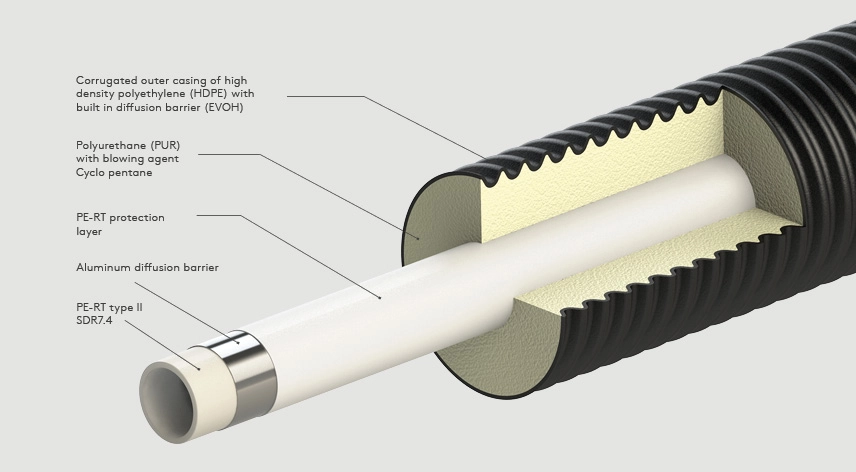
PertFlextra SDR7.4 has been used in distribution networks, including service pipelines to consumers, for large projects in residential areas around Copenhagen. See pictures below:
The second spin-off of the plastic systems for distribution networks with the new PE-RT media pipe is a pre-insulated TwinPipe system with a surveillance system with four copper wires to detect moisture in the PUR foam during its lifetime.
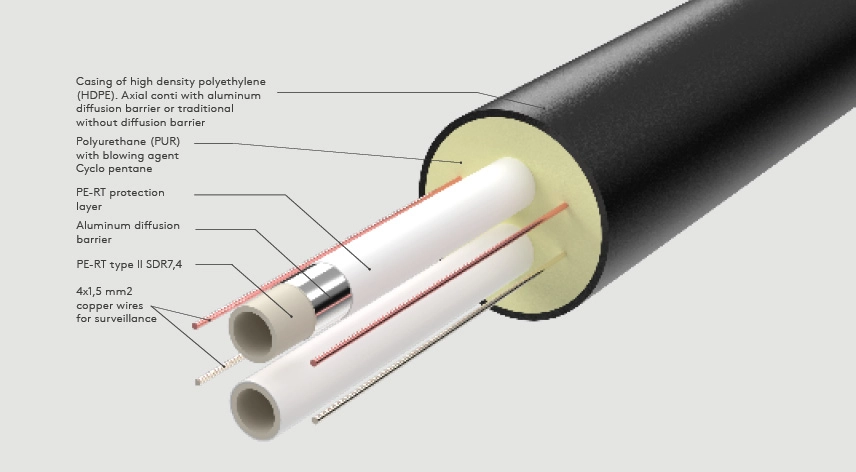
The LOGSTOR PertPipe SDR7.4 TwinPipe system is available in 12 m lengths, service pipe dimensions 32–110 mm. PertPipe will be used as the distribution pipeline, while PertFlextra SDR7.4 will be used for house connections.
For the most used casing dimensions, there will also be a diffusion barrier for insulation gases in the PertPipe SDR7.4 system.
When does it make sense to change from a pre-insulated steel pipe system to a pre-insulated plastic pipe system?
The key question is why energy companies should switch from the well-known pre-insulated steel pipe system to a pre-insulated plastic pipe system, especially if they have no experience building complete distribution systems.
It only makes sense to switch from pre-insulated steel pipe systems if TCI is lower for the plastic pipe system and the heat-loss performance is the same as or better than that of pre-insulated steel pipe systems.
Speed of installation must be faster.
Pre-insulated plastic pipe systems must be able to achieve the same low heat loss as pre-insulated steel pipe systems, such as the TwinPipe steel pipe system series 3.
All in all, leading to lower TCI and TCO.
When these prerequisites are fulfilled, it makes sense to switch to pre-insulated plastic pipe systems.
What is the experience from old plastic pipe systems in Denmark
In the 1970s–1990s, many energy companies used pre-insulated PEX flexible pipes as service pipelines to one-family houses.
The service pipe in these pipes was PEXa. The media pipe has a diffusion barrier to prevent oxygen diffusion, but it cannot prevent water vapor diffusion into the insulation, which can condense into water.
Danish Technological Institute has published more reports on water vapor diffusion in pre-insulated plastic pipe systems in 1991, 1998, 2000, and 2015.
In the 2015 report, old PEX flexible pipes from four energy companies were investigated. After drying these pipes in an oven, the tendency is clear: the foam is wet because water vapor diffuses into the insulation and condenses as water. See the picture where the foam clearly is wet:
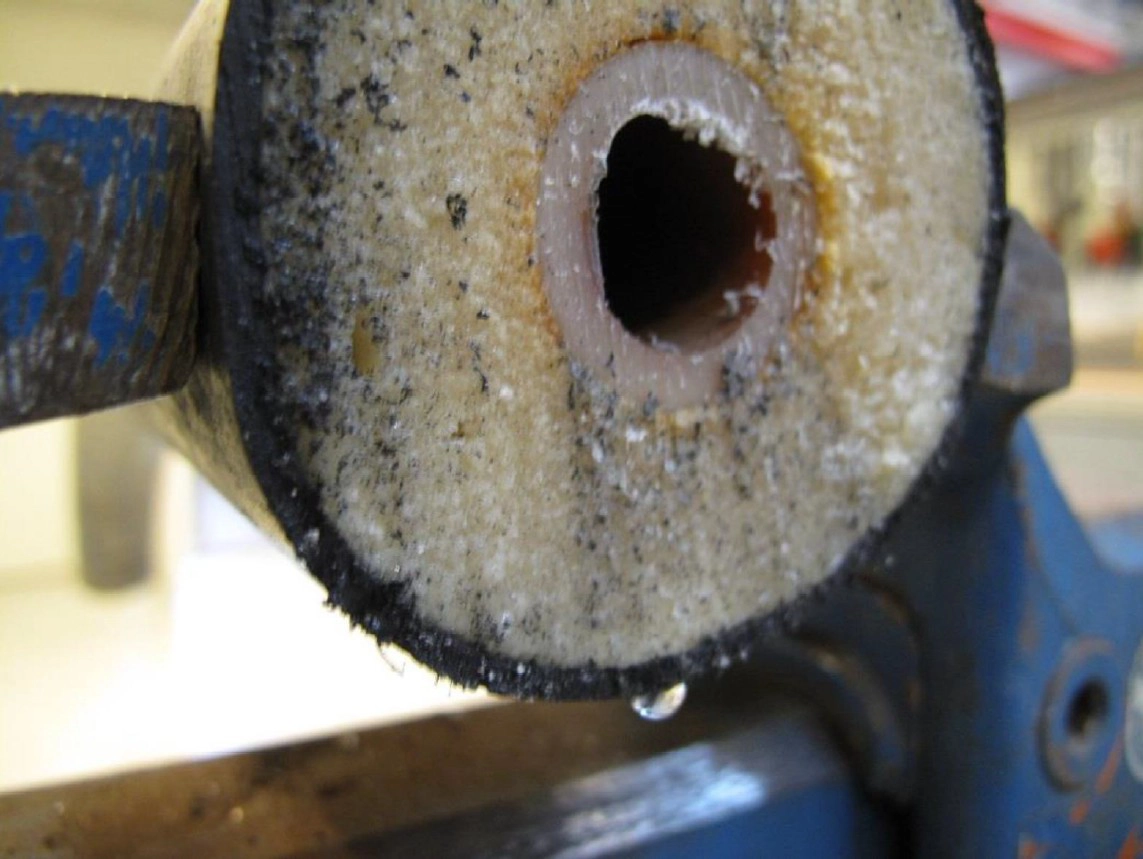
This phenomenon is not specifically related to PEX. It is related to plastic pipes without a diffusion barrier to water vapor.
Plastic is not diffusion-tight for water vapour. The amount of water vapor diffusion depends on temperature. The higher the temperature, the more water vapor will diffuse into the insulation.
This is confirmed in several tests.
This is also confirmed by many Danish energy companies using PEX flexible systems in their networks.
So, without a diffusion barrier, water vapor might condense as water in the insulation, leading to higher heat loss over the lifetime.
Below are the results of measurements by the Danish Technological Institute on water vapor diffusion from different service pipes, with or without a diffusion barrier.
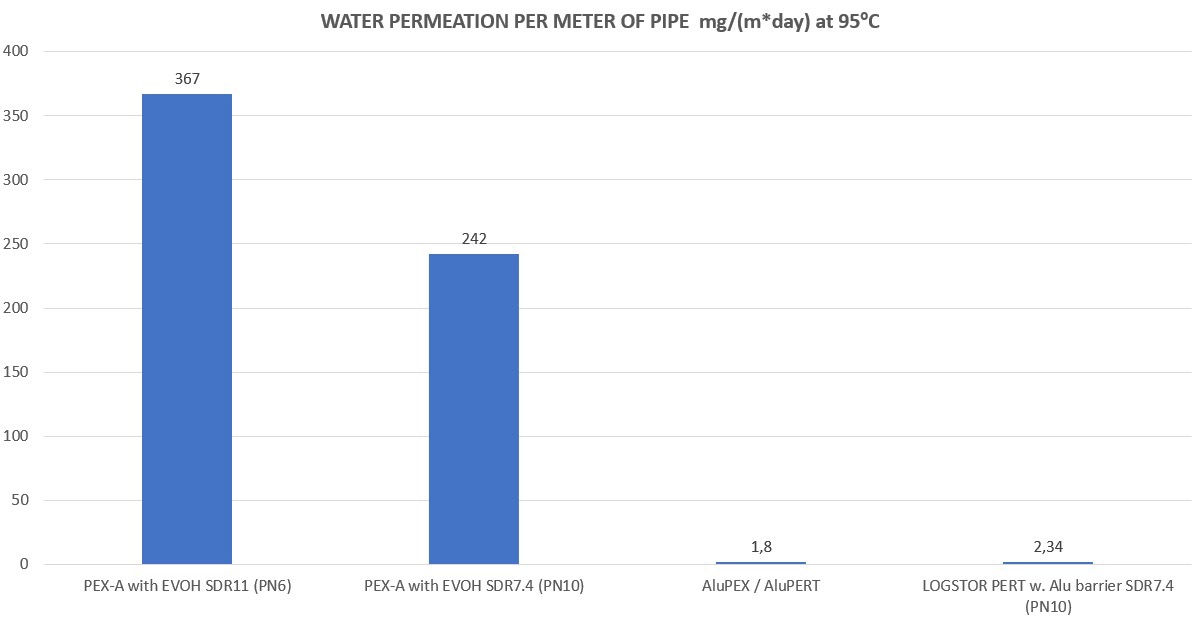
- PEXa SDR11 and SDR7.4, no barrier for water vapor
- Multilayer Alupex/AluPERT, the aluminum core is diffusion-tight for water vapor
- PE-RT with an aluminum diffusion barrier for water vapor
PEXa has high water vapor diffusion without a diffusion barrier.
LOGSTOR PE-RT with aluminum diffusion barrier is diffusion-tight for water vapor.
Secure the same heat loss performance as the pre-insulated steel pipe systems
Requirement for the heat loss property from the pre-insulated plastic pipe system should be the following:
- Same lambda value on the PUR insulation. Documentation by more external test reports according to EN253
- If there is no diffusion barrier for water vapor on the service pipe, EN15632/EN17878 describe that the declared lambda value from a supplier shall be multiplied with a factor 1,1 to achieve the design lambda value
- If there is no diffusion barrier in the casing for insulation gases in the insulation material, EN15632/EN17878 describes that the declared lambda value from a supplier shall be multiplied with a factor 1,25 to achieve the design lambda value
- Require that it shall be possible with pre-insulated plastic pipe systems with insulation series 2 and series 3 according to EN15698-1
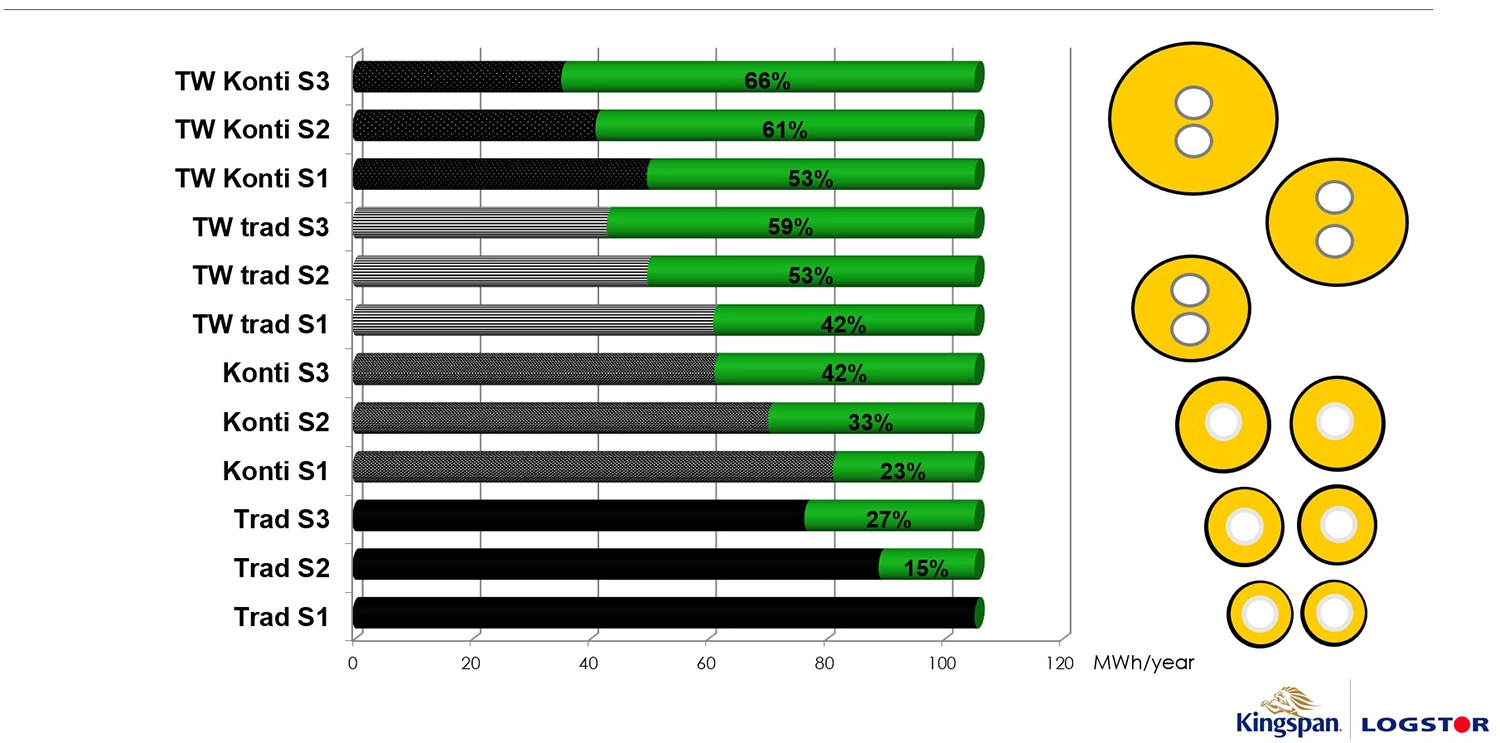
Do not compromise the heat-loss performance of the pre-insulated pipe system, as lifetime heat loss has a huge impact on TCO. For example, see the comparison of energy loss over 30 years for different types of pipe systems for a 1000 m DN80 service pipe. Green bars are the savings.
Assembly of the plastic service pipes
For PEX and multilayer pipe systems, the typical assembly method is press couplings. PEX and multilayer pipes are not supposed to be fusion welded.
PE-RT is weldable (fusion welding), so the service pipe can be assembled with electrofusion sockets for fusion welding as well as press couplings.
Press couplings are assembled by using a pressure tool from the suppliers.
Electrofusion sockets in the PE-RT system are installed using welding machines similar to those used for electrofusion sockets on HDPE water pipelines, which certified fitters have used for many years.
A bar code on the electrofusion socket is scanned, and all needed information for the welding process is automatically entered into the welding machine; the welding process is also documented in the machine.
With the PE-RT media pipe, it is also possible to squeeze off the media pipe for connection to the system while in operation – This is not possible with the multilayer pipe. See picture below:
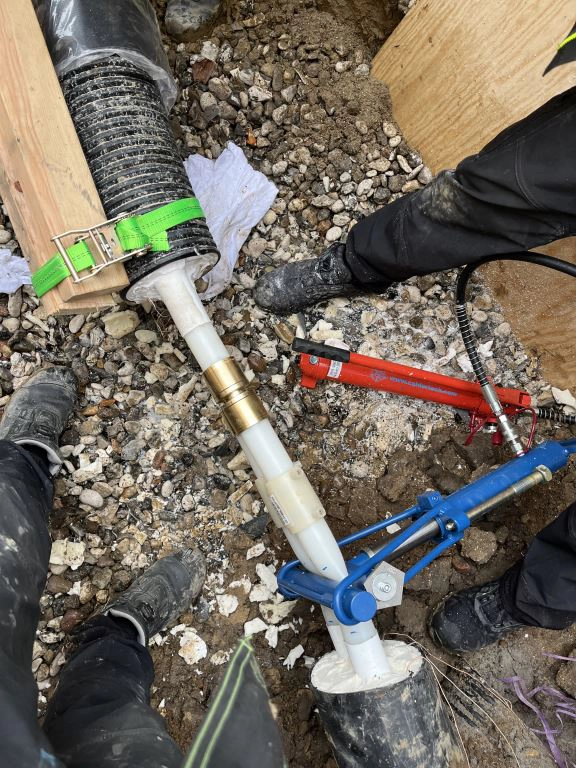
Over the squeezed area, an electrofusion socket shall be installed to secure the service pipe’s lifetime in this location.
Why can TCI be lower with a plastic pipe system than a steel pipe system?
Reasons why it is possible to achieve lower TCI and higher speed of installation are the following:
- Reduce the size of the trench according to instructions
- Easier handling due to lower weight
- No X-ray on the assembly
- No need for static design and handling movements in the ground as the plastic pipe system is self-compensating
- It is possible to use alternative labour groups for assembly of the plastic pipes
- No need for specific friction material around the pipes. The backfilling material around the pipes shall not contain stones that can damage the outer casing. Excavated material can be used according to local rules
- The contractor shall learn to work differently than when they work with steel pipe systems
The above points are lessons learned from installing the first large PertPipe SDR7.4 and PertFlextra SDR7.4 projects.
How can the energy company be sure about the lifetime of the plastic service pipe?
Energy companies have experience with pre-insulated steel pipe systems whose lifetime will be more than 30–50 years if designed, installed, and operated correctly.
But energy companies do not have experience with the new plastic pipe systems coming to the market in this period – like plastic pipe systems with a media pipe of PEX, Multilayer, PE-RT or other.
Assurance of the lifetime shall be that the supplier has tested the service pipe and couplings according to the requirements in EN 15632/EN 17878.
Some of the requirements that shall be documented by tests at accredited test institutes are described below:
- Thermal stability test
- 15,000 hours at 110 °C and 2,4 MPa stress
- Coupling test
- Test of the coupling installed on the pipe
- Thermal cycling test with change of temperature 10°C -> 90°C -> 10°C
- 5000 cycles
- Test piece as shown below
- The test shall be done per dimension and per type of coupling
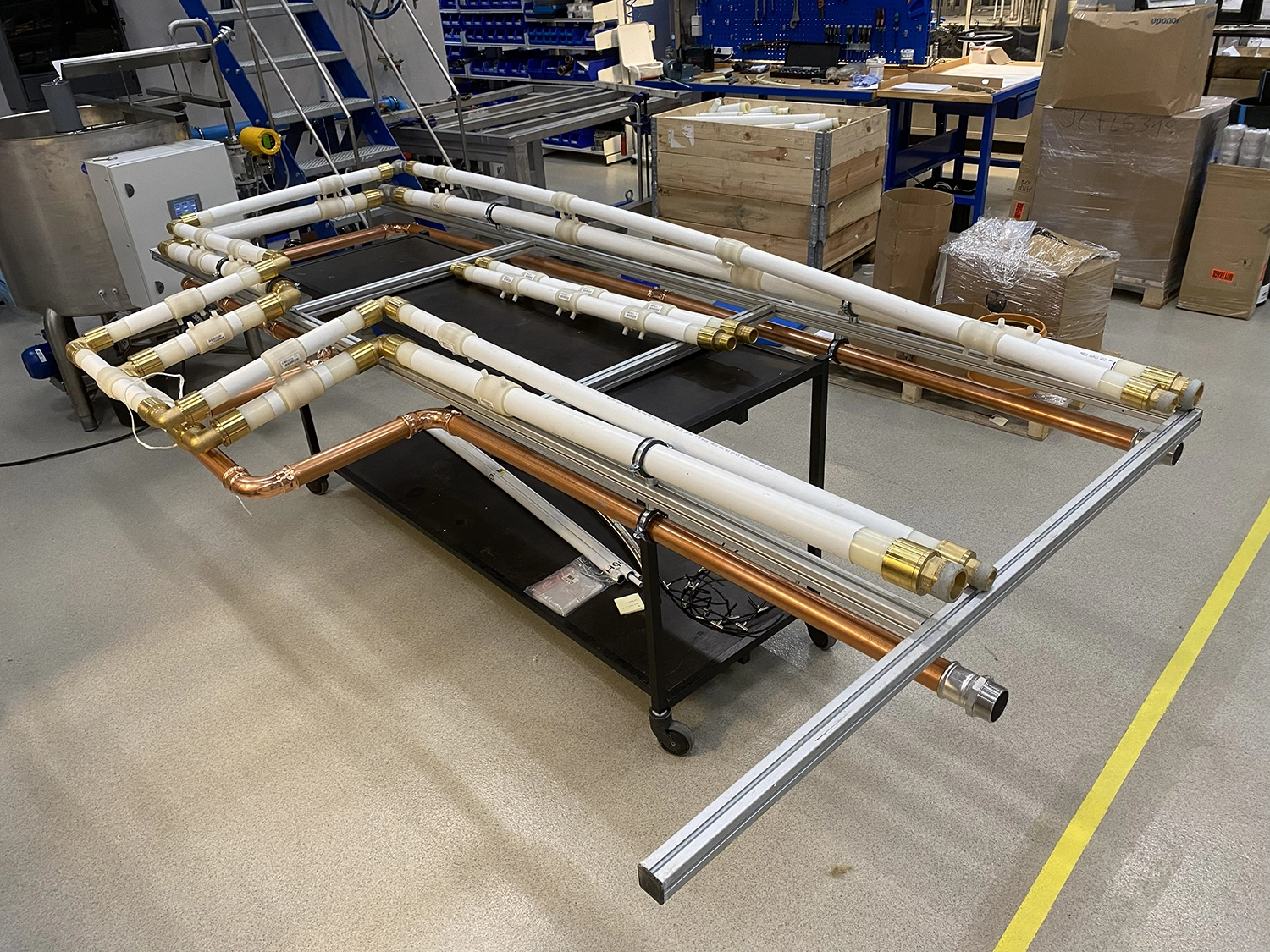
Other tests include internal pressure testing, bending tests, pull-out tests, and pressure cycling tests.
Energy companies should require suppliers to document that all tests, according to relevant standards, are completed.
A long lifetime should be proven, not promised.
Surveillance system in pre-insulated plastic pipe systems – asset management
A surveillance system in pre-insulated pipe systems is important for network asset management. The energy company will be informed if moisture reaches the foam, and they can make repairs in time, so the lifetime is not affected.
The energy company should require that the distribution network include a surveillance system.
That said, a surveillance system only makes sense in pre-insulated plastic pipe systems if the service pipe is diffusion-tight to water vapor in the complete system, so the PUR foam will not get wet due to water vapor diffusion.
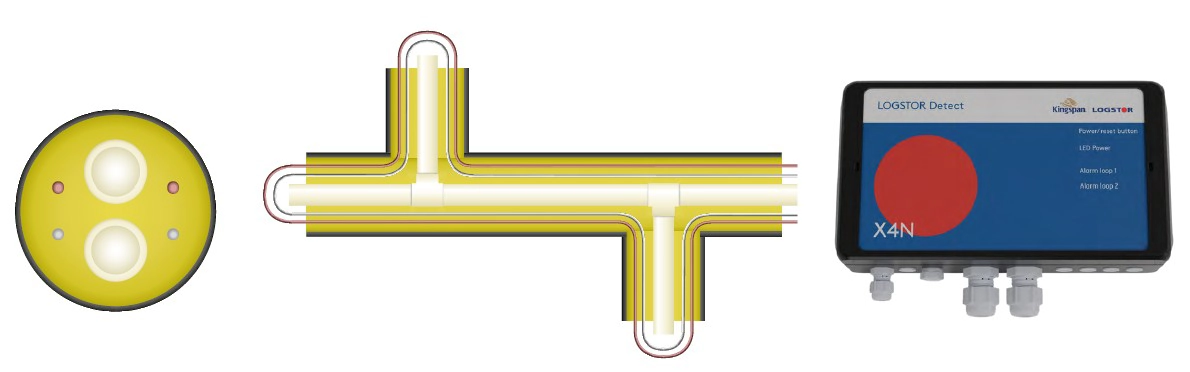
LOGSTOR PertPipe SDR7.4 is a completely diffusion-tight system, and therefore this system is equipped with a surveillance system of 4 x 1,5 mm2 copper wires, where the two wires are clean copper wires serving as the measurement wires and two wires are tinned copper wires serving as the reference wires. See illustrations below:
This surveillance system is built on the same principles and design rules known from pre-insulated steel pipe systems and can be connected to a detector for active surveillance principles based on resistance measurement.
For further information please contact: Peter Jorsal, Peter.Jorsal@kingspan.com
“Plastic Pipe Systems in District Heating” was published in Hot Cool, edition no. 4/2026. You can download the article here:
Did you find this article useful?
Subscribe to the HOT|COOL newsletters for free and get insightful articles on a variety of topics delivered to your inbox twice a month!