Operators must shift focus from upfront capital costs to long-term efficiency. Managing the Total Cost of Ownership enhances profitability and sustainability. This strategy turns operational risks into a distinct competitive advantage. For a pump, only 5% of the Total Cost of Ownership relates to the upfront investment – the remaining 95% of the costs are related to the operation of the pump.
By Kim Krusell Hansen, Global Lead Sales Development Manager – District Energy, Grundfos
Published in Hot Cool, edition no. 4/2026 | ISSN 0904 9681 |
District energy (DE) is becoming an essential part of the transition towards sustainable, resilient, and net-zero cities. By connecting buildings across urban areas, these systems aggregate heating and cooling demand and create the scale needed to use energy more efficiently.
Modern networks can deliver substantial efficiency gains compared with individual building systems. They can integrate surplus heat from industry and datacenters, draw on geothermal and solar thermal energy, and enable cities to reduce emissions without compromising comfort or security of supply.
The Wall of Challenges
Yet the potential of district energy is matched by a demanding business reality. Networks are capital-intensive payback periods can be long, and investment decisions made today will influence operational performance for decades.
Many networks also depend on legacy infrastructure that is ageing, inefficient, and increasingly exposed to failure. At the same time, operators are expected to improve efficiency, reduce emissions, maintain affordability, and secure uninterrupted service for customers.
To break this cycle, the industry must move beyond a narrow focus on initial investment and adopt a model that actively manages total lifetime operating cost.
The central question therefore changes from: “How do we pay for it?”
to: “How do we secure long-term performance, reliability and value?”
The answer lies in mastering Total Cost of Ownership (TCO).
Uncovering the TCO Iceberg
The main financial challenge is often not the district energy concept itself, but the operating model behind it. If assets are selected, installed, and maintained only from a short-term cost perspective, hidden expenses can accumulate throughout the lifecycle.
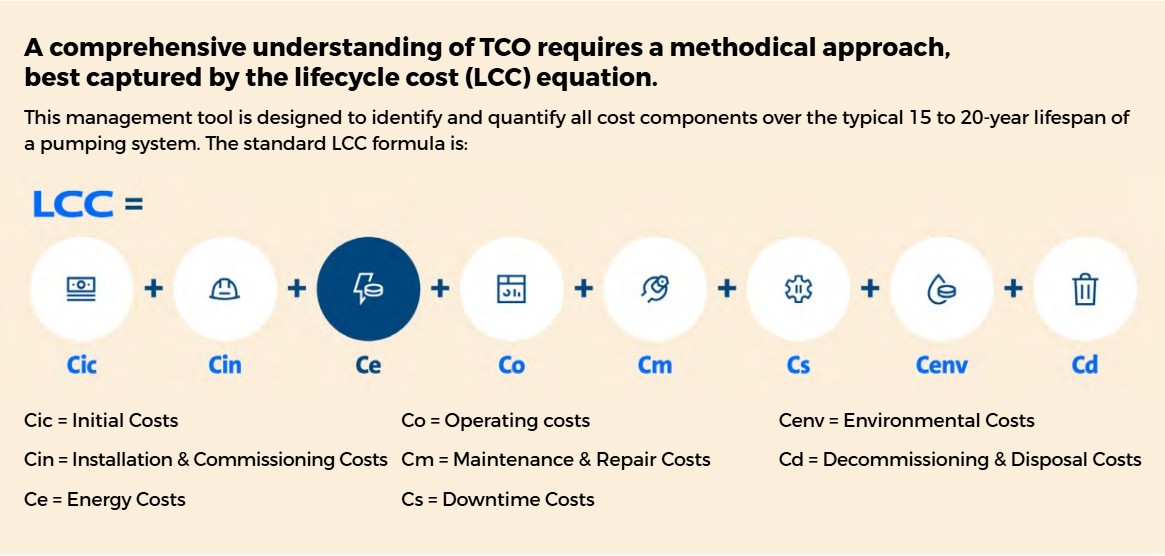
For critical infrastructure such as pumping systems, the visible purchase price can be misleading. The initial capital cost may represent only a small part of the total lifetime cost, while the far larger share is hidden in energy consumption, maintenance, service interventions, and downtime exposure.
Figure 1: The TCO iceberg. Initial purchase and installation costs represent only a tiny fraction of lifetime expenses. Energy, maintenance, and downtime constitute most of the financial output.
The Domino Effect of Initial Choices
TCO is not a static mathematical calculation; it is a highly dynamic system of interconnected operational risks. Reducing costs in one area often creates a dangerous cascading effect.
Consider a scenario where an operator cuts upfront capital spending by selecting a pump based strictly on the lowest purchase price and opting for in-house installation without professional laser alignment. The financial consequences are immediate and severe.
A misaligned pump shaft creates excess vibration and mechanical friction, forcing the motor to work significantly harder and instantly increasing the daily energy consumption of the plant. This constant vibration accelerates physical wear on bearings, damages mechanical seals, and degrades pump couplings. Consequently, maintenance labor and spare parts costs rise sharply.
Eventually, this over-stressed pump suffers a catastrophic failure, triggering a massive, network-wide shutdown. The ensuing costs of sudden downtime—lost revenue, customer penalties, and emergency repair fees—completely dwarf any initial savings achieved during procurement.
A Framework for End-to-End Value
Operators require a structured framework to manage these complex challenges. A lifecycle partnership model addresses every component of the TCO equation. It transforms operational challenges into enhanced efficiency and reliability.
This framework operates across five distinct but interconnected technical phases.
Figure 2: The asset lifecycle framework. Continuous optimization spans across five phases: Plan, Build, Operate, Maintain and Optimize, and End of Life.

The most effective way to control costs is by preventing built-in inefficiencies. Significant lifetime costs are locked in during the initial design phase. This often happens because of incorrect equipment selection or improper setup.
Engineers must avoid common errors like miscalculated pump curves. Incorrect curves force pumps to operate outside their Best Efficiency Point. Proper sizing matches equipment to real-world duty points perfectly. This prevents massive energy waste and hydraulic stress on bearings.
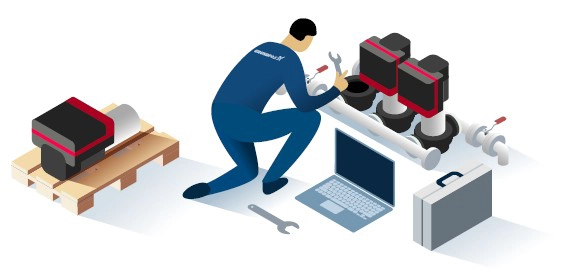
The building phase requires exacting standards to ensure long-term reliability. Professional installation and precise commissioning are absolute technical prerequisites.
Precision laser alignment is critical for all pumps. Technicians must align pumps and motor shafts to a fraction of a millimeter. This specific action drastically reduces “something” through avoiding friction, damaging vibration, and energy consumption.
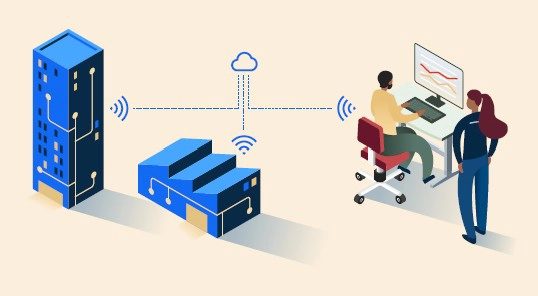
Once operational, the focus shifts to maximizing daily performance securely. Loads fluctuate constantly, and system conditions drift significantly over time. Proactive optimization controls energy costs in this highly dynamic environment. Modern operators are increasingly relying on cloud-based digital monitoring solutions. These systems provide continuous, real-time visibility into overall pumping performance.
Operators can access intuitive digital dashboards from mobile devices anywhere. This immediate data access drastically simplifies daily network management tasks. It ensures teams always maintain a clear view of asset health. Remote control capabilities help mitigate unexpected technical breakdowns very rapidly.
The maintenance phase is where operators secure long-term financial stability. It requires shifting from reactive repairs to predictive maintenance strategies. Systematic energy audits provide precise evaluations using actual system measurements. These diagnostic tests generate a data-driven investment roadmap for critical upgrades.
Auditors use attached measuring equipment to clearly identify specific inefficiencies. Comprehensive health checks assess the condition and criticality of every asset. This system-wide view transforms maintenance planning from guesswork into strategy.
Operators must continuously re-evaluate system curves as urban networks expand. Connecting new buildings fundamentally alters the hydraulic balance of the grid. Regular performance reviews ensure pumps continue operating near optimal efficiency. Engineers can adjust variable speed drives to match new load profiles. This ongoing tuning process prevents massive energy waste as seasons change.
Advanced condition monitoring is becoming increasingly important for modern plants. Wireless sensors can continuously monitor parameters such as vibration and temperature, detecting early fault indications before mechanical failures occur.
Predictive insights allow technicians to schedule condition-based maintenance interventions, reducing the risk of catastrophic downtime in critical heating and cooling networks. Complementary diagnostic services, including thermal scanning and vibration measurement, help protect electrical components and verify that pumping equipment continues to meet relevant performance standards.
Standardised service agreements further support reliability for public utilities. Fixed-price maintenance contracts provide predictable budgets and expert oversight, while planned preventive interventions are typically more cost-effective than emergency repairs. By entrusting maintenance to trained specialists, operators can extend equipment life and allow internal teams to focus on core strategic priorities.
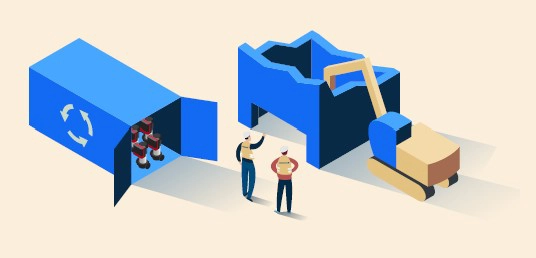
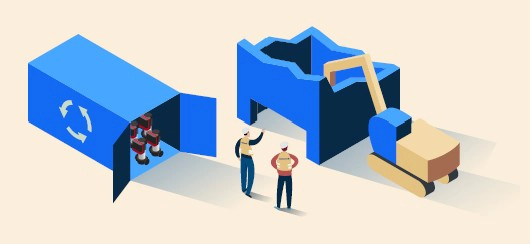
At the end of an asset’s lifecycle, responsible decommissioning is essential. Operators must manage component recycling safely and efficiently to ensure that industrial systems are disposed of in an environmentally responsible manner. Equipment partners may also support dedicated recycling and hardware take-back programs, helping to reduce environmental impact and close the lifecycle loop.
After decommissioning, the asset lifecycle returns to the planning phase. Engineers can assess whether a new installation, targeted upgrade or broader system renewal will deliver the strongest long-term value. In this way, strategic renewal becomes integral to mastering total cost of ownership.
Forging a Resilient Future
The future of district energy, a sector essential to global decarbonisation, depends on a fundamental shift in perspective.
The traditional focus on the 5% of cost visible at the point of purchase must give way to disciplined management of the 95% that accumulates over an asset’s multi-decade lifecycle, particularly the energy consumption that dominates lifetime expenditure.
The path to profitability, reliability and sustainability is not paved by minimising initial capital outlay alone, but by mastering total cost of ownership across the full lifecycle of the asset.
For further information, please contact: Kim Krusell Hansen at kihansen@grundfos.com
“Master the Total Cost of Ownership in District Heating ” was published in Hot Cool, edition no. 4/2026. You can download the article here:
Did you find this article useful?
Subscribe to the HOT|COOL newsletters for free and get insightful articles on a variety of topics delivered to your inbox twice a month!