What if aging district heating networks do not always need to be replaced as early as expected? In Frederiksberg, a long-term, data-driven renewal strategy shows how strong asset records, low heat losses, and targeted reinvestments can extend network lifetime, avoid premature replacement, and create greater value for customers, the climate, and the bottom line. Extending the service life of the pipelines from 50 to 65 years and implementing the planned renewal program, rather than replacing assets based on a standard 50-year service life, generates a net present value benefit of approximately € 57 million.
By Anders Hahn Kristensen, Market Director, Niras, and Jacob Alstrup Engvang, Business Developer, Frederiksberg Utility
Published in Hot Cool, edition no. 4/2026 | ISSN 0904 9681 |
Long-term renewal planning leads to better decisions
Frederiksberg Utility (FF), in collaboration with NIRAS – an energy consulting company -, has developed a long-term renewal strategy for the aging district heating pipe network in Frederiksberg, Denmark. The strategy is based on analyses of the network’s condition and an overall assessment of economic, environmental, and social considerations. The point is simple: When renovation is planned long-term and prioritized on an informed basis, we get more out of the investments, reduce unnecessary heat loss, and at the same time strengthen security of supply for customers. This approach aligns with FF’s goal of a safe, efficient district heating system with minimal CO2e emissions and few consumer interruption minutes
“A strong renewal strategy is not about choosing between technical reliability, financial prudence, and environmental performance. It is about making them reinforce each other.”
The analysis was initiated because FF faced a strategic decision in 2024. Should FF launch a major renewal program for the district heating network immediately because of the aging infrastructure, or would it be more technically and financially prudent to postpone the rehabilitation effort?
To provide a sound basis for this decision, a comprehensive assessment was conducted of the network’s current condition, its expected future development, and the implications of different asset renewal rates. In short, the pipes FF operates today now have an extended 15-year expected lifetime at nearly no cost. One of the better investments FF has made in a long time!
A key finding of the study is that environmental and economic considerations should not be viewed as conflicting objectives in a network renewal strategy. On the contrary, the analysis demonstrates that long-term, data-driven planning makes it possible to balance investments, heat losses, CO₂ emissions, occupational health and safety, and customer impact, resulting in a more robust overall solution than would have been achieved through a one-sided prioritisation of any single objective.
Fact box: Frederiksberg Utility
- Frederiksberg Municipality (the owner of FF) is home to 106,000 residents, and 99.5% of the building stock is connected to the district heating network operated by Frederiksberg Utility.
- Operates 189 km of district heating pipelines.
- Has supplied district heating for nearly 125 years, dating back to 1903 when Frederiksberg established Denmark’s first district heating plant.
Figure 1 – Projection of remaining life
A Robust Network with a Long Service Life
The district heating network in Frederiksberg, in its current form, was primarily established during the 1980s and 1990s. A large share of the network consists of pre-insulated bonded (sliding) pipe systems installed during this period, which are traditionally assumed to have a service life of around 50 years. However, a review of network asset records, as well as operation and maintenance data, indicates that FF’s network is generally in good condition.
This largely reflects the high quality of the materials used, a strong focus on inspection and quality assurance during construction, low and stable heat losses, low make-up water consumption, and a limited number of recorded faults and pipe failures. In addition, experience from excavated pipeline sections shows that the pipes generally remain in near-new condition, while any deterioration is typically confined to the outer casing rather than the pipe system itself.
“The key assumption is not that the network should simply last longer, but that its actual condition justifies a smarter renewal strategy—one that replaces pipes when it creates value, not just when they reach a conventional age.”
Based on these findings, the service life of FF’s district heating network is considered to be extendable from the conventional 50 years to as much as 60–70 years. For the purposes of the analysis, the expected service life was therefore set at 65 years. This is a key assumption, as the extended service life enables FF to adopt a strategy that avoids premature replacement of well-functioning assets and instead targets reinvestments where they deliver the greatest overall benefit.
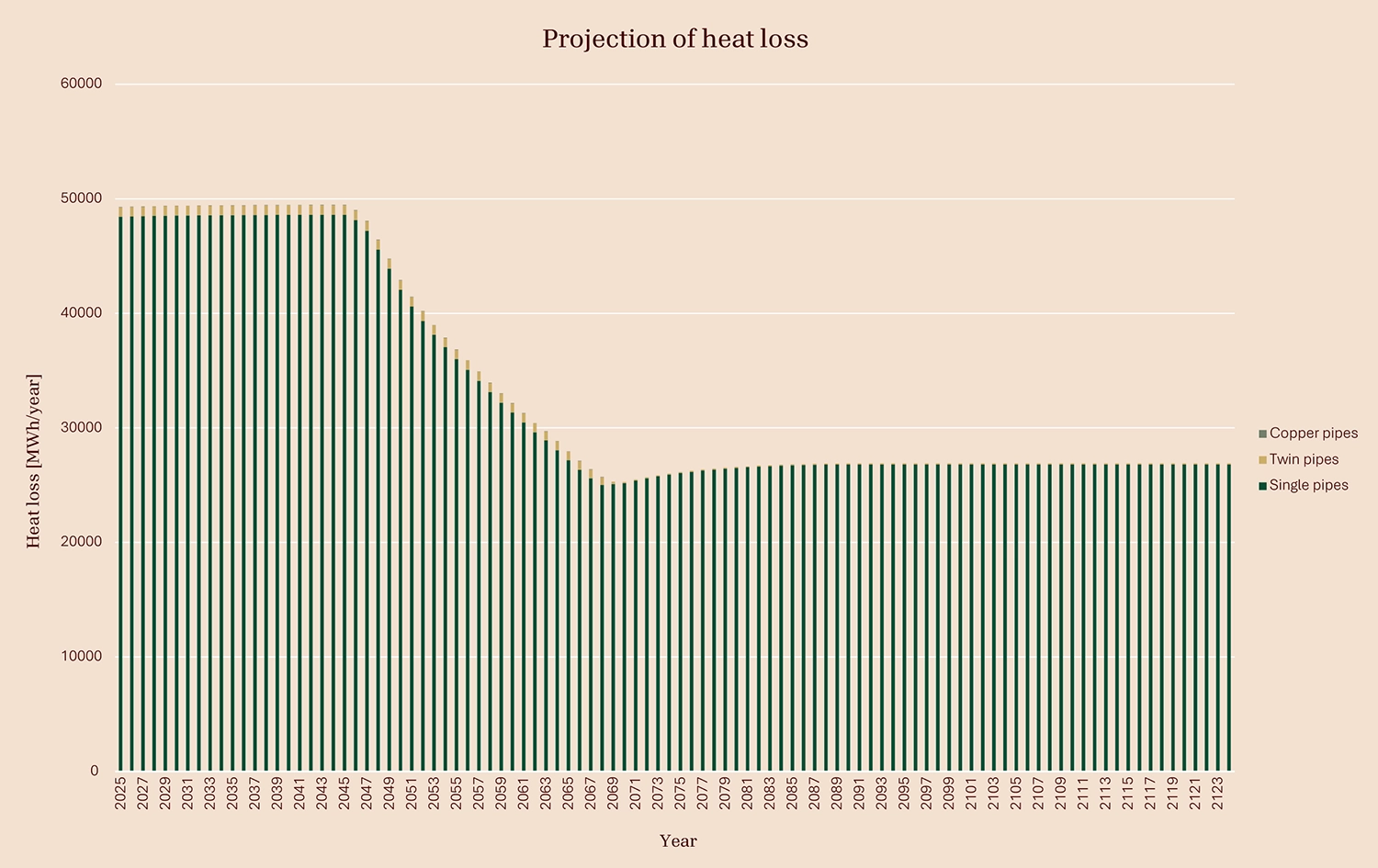
Figure 2 – Projection of heat loss
Integrating environmental and economic considerations
One of the most important insights from the project is that network renewal planning becomes significantly more effective when environmental sustainability and life-cycle economics are assessed together. Focusing solely on asset age may lead to premature pipeline replacement, while focusing only on short-term capital costs risks underestimating the value of lower heat losses, fewer failures, and more reliable operation over time.
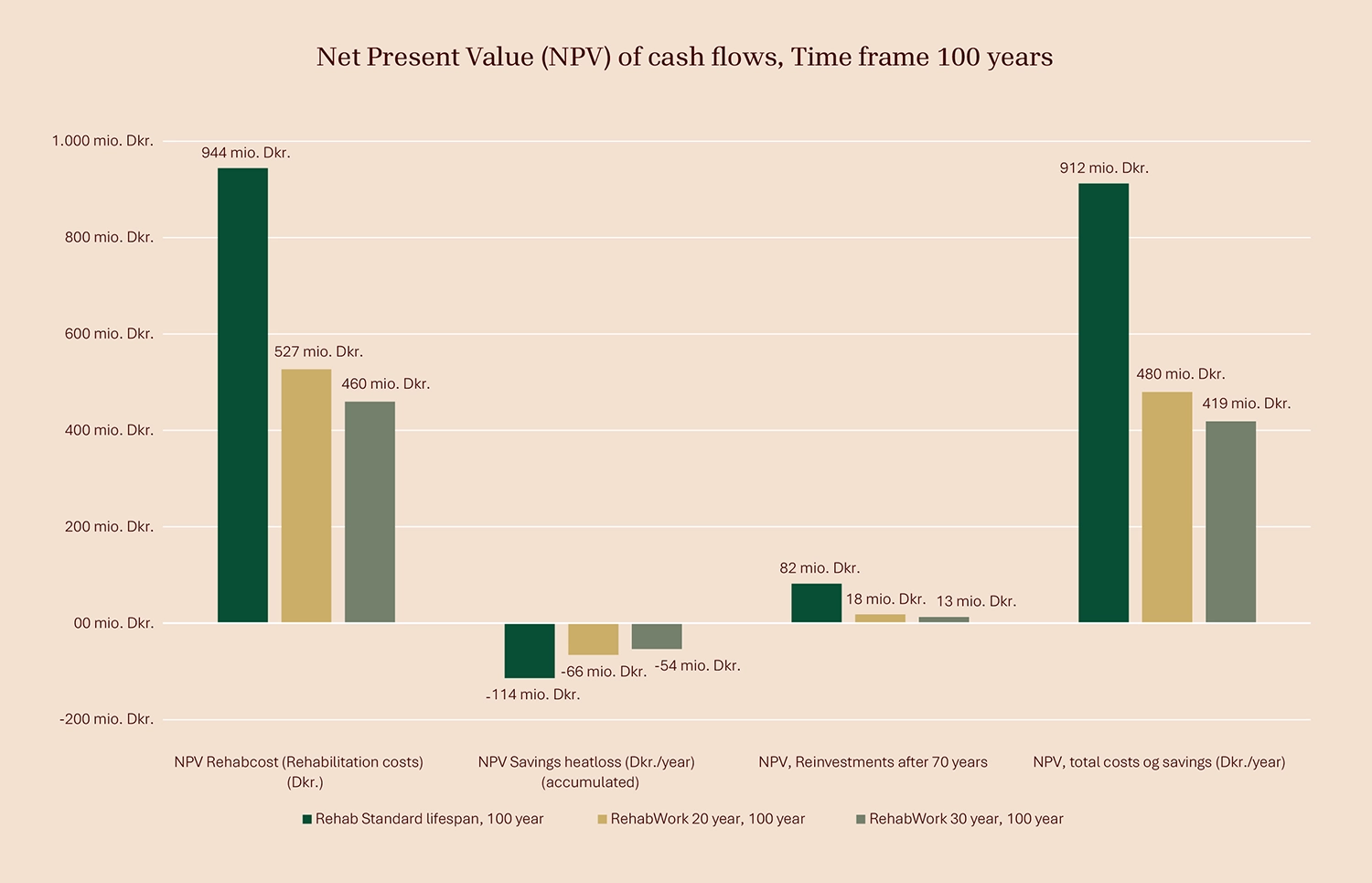
The scenario analysis demonstrates that substantial benefits can be achieved by adopting a longer-term perspective and considering multiple performance objectives simultaneously. For example, a 20-year renewal program results in a younger network throughout the implementation period than a 30-year program, thereby reducing the risk of individual pipeline sections reaching a very advanced age.
At the same time, the analysis shows that the difference in cumulative costs related to heat losses and capital investments between a 20-year and a 30-year program is only around 3%, while the faster renewal pace delivers the benefits of reduced heat losses earlier.
From an environmental perspective, the analysis indicates that the differences between the scenarios are not determined solely by the speed of network renewal, but also by when and where renewal activities generate a tangible reduction in heat losses.
This means that climate benefits are not simply a question of replacing as much infrastructure as possible as quickly as possible. Rather, they depend on selecting the right timing and the right network sections for intervention. This is precisely why integrating environmental and economic considerations is highly important: it enables utility companies to prioritise investments that deliver value in both climate performance and financial outcomes.
A risk model as the basis for a service-level approach
As part of the project, FF also sought to take the first step towards a more systematic approach to district heating network resilience. To support this effort, FF developed a security-of-supply risk model that incorporates the potential number of consumer interruption minutes as a key performance indicator.
This is significant because the model enables a more structured approach to defining a service level for district heating customers, measured in terms of supply interruption minutes. The approach draws clear inspiration from the Danish water sector, where security of supply and customer impact are increasingly used as key management parameters. Applied to district heating, this means FF assesses pipeline sections not only by age and technical condition, but also by the consequences for customers if a section fails.
This provides a stronger foundation for decision-making. Pipeline sections with a high risk of affecting a large number of customer connections can be prioritised for renewal earlier, even if they are not necessarily the oldest assets in the network. In this way, the renewal strategy becomes more than a technical replacement plan; it becomes a tool for balancing security of supply, customer considerations, financial performance, and environmental objectives.
Four themes shaping the long-term plan
The strategy development also considered several factors that may influence the network’s future development. These include the future role of district heating in the Greater Copenhagen area, changes in technical supply requirements, developments in customer-side installations, and the overall level of security of supply.
The conclusion is that the renewal plan can serve effectively as a reference plan. It has been developed based on current operating temperature levels and existing technical requirements, while also providing a common baseline against which future changes can be assessed. This makes the plan robust, even as regulatory conditions, technologies, and customer needs evolve over time.
The Selected Scenario
The preferred solution combines a 20-year network renewal program with a five-year ramp-up period and annual investment of approximately DKK 75 million from 2050–2070.
The scenario places the greatest weight on pipeline age while maintaining a balanced focus on the other key performance objectives.
Key outcomes
- 53 years — Maximum average age of the entire district heating network
- 75 years — Age of the oldest pipeline when the ramp-up period begins in 2045
- No premature write-downs — Pipeline sections are only decommissioned when they are ready for renewal
- ~50% lower heat losses — Reduced from around 7% in 2023 to 3.5% by 2069–2070
- ~5.5 km renewed annually — Average pipeline network renewal rate[
The economic implications are significant. The analysis shows that extending the service life of the pipelines from 50 to 65 years and implementing the planned renewal program, rather than replacing assets based on a standard 50-year service life, generates a net present value benefit of approximately DKK 430 million. This finding underlines that a long-term strategy is not about postponing necessary investments. Rather, it is about investing more precisely and creating greater value.
A strategy that can be adapted over time
The strategy also calls for the coming years to be used actively to strengthen the data foundation. This includes enhanced monitoring, digitalisation, and improved recording of events and KPIs such as water losses, heat losses, asset condition, and failure statistics. This is important because a long-term renewal plan should not be static. It should be validated and adjusted as FF gains new knowledge about the network and about external requirements.
At the same time, the analysis indicates that the coming years should be used for continued maintenance and for reducing supply temperatures where this is technically, operationally, and economically justified. Here, too, the key message is the same: value is created when technical, economic, and environmental considerations are addressed together rather than separately.
Conclusion
The long-term renewal strategy demonstrates that better decisions can be made regarding the district heating network when environmental, economic, occupational health and safety, and security-of-supply considerations are assessed as a whole. The key prerequisite is that, based on its current condition, the network is considered capable of lasting longer than the standard assumption. This provides both a significant economic benefit and a more balanced environmental profile.
At the same time, the risk model makes it possible to adopt a more systematic approach to defining the service level for district heating consumers. By incorporating consumer interruption minutes as a management parameter, inspired by practices in the Danish water sector, FF gains a more nuanced basis for prioritising network renewals, not only according to age but also according to the consequences for customers.
Overall, the strategy points to a clear direction: when we plan for the long term and integrate environmental and economic considerations, we can derive greater value from the district heating network, strengthen security of supply, and create greater value for customers, the climate, and the bottom line.
For further information please contact: Hans Martin Bayer Kühl, haku@frb-forsyning.dk
“From Age-based Replacement to Value-based Renewal” was published in Hot Cool, edition no. 4/2026. You can download the article here:
Did you find this article useful?
Subscribe to the HOT|COOL newsletters for free and get insightful articles on a variety of topics delivered to your inbox twice a month!