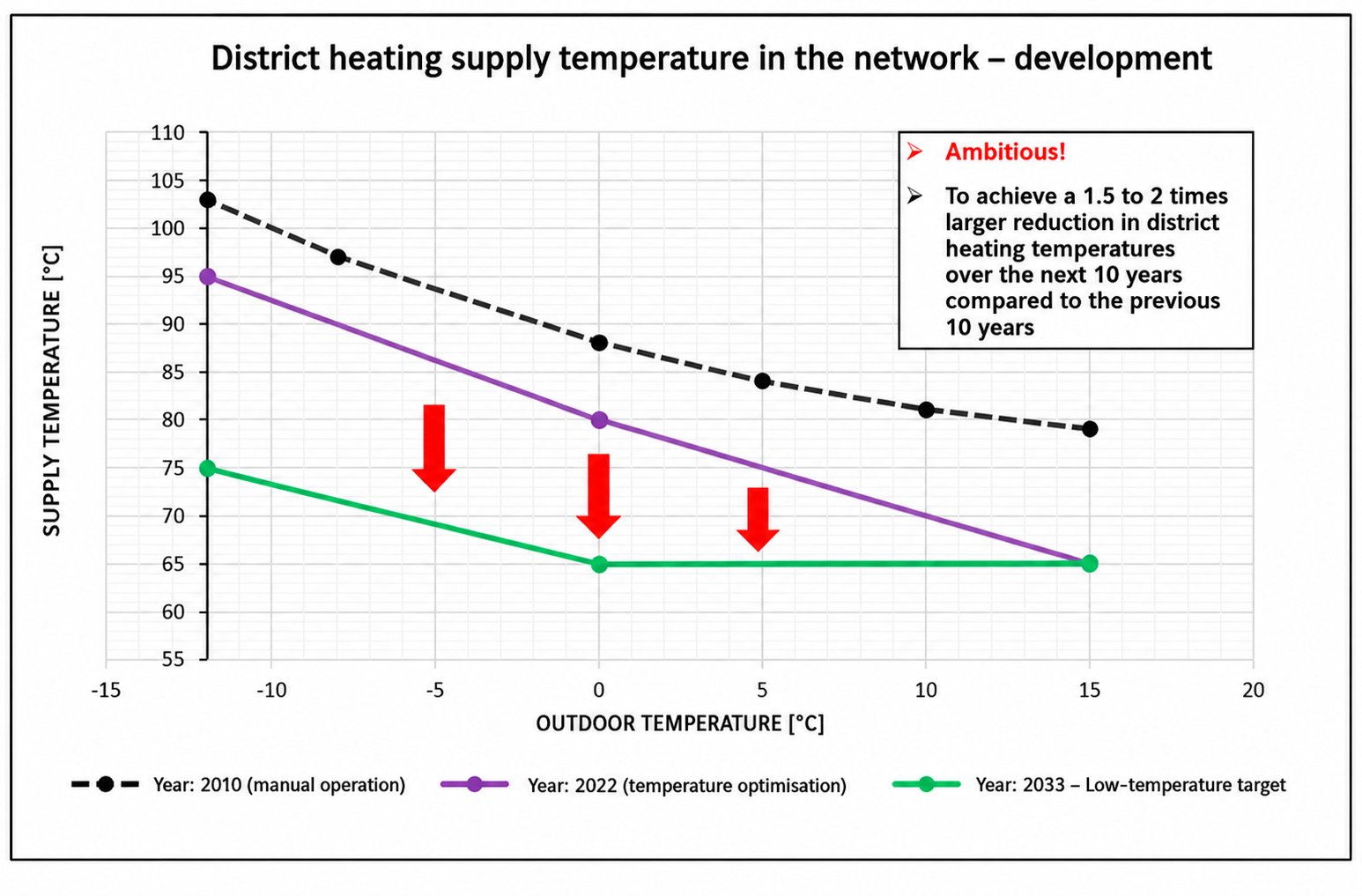
By 2033, HOFOR plans to reduce temperatures across its district heating network to an annual average of 65°C. Lower network temperatures will support the electrification of heat production in Copenhagen, where the system supplies around 670,000 residents.
3 August 2026 | Original article in Danish by Joel Goodstein, the Danish District Heating Association
HOFOR’s district heating network covers approximately 3,000 kilometres, roughly equivalent to the distance from Copenhagen to Rome and back. The utility now aims to reduce the network’s average temperature to 65°C.
“Over the years, we have gradually reduced average winter supply temperatures from around 90°C to below 80°C today. Our goal is to reach an annual average of 65°C for all customers,” says Kim Kanstrup, Head of Section at HOFOR.
In addition to being Denmark’s largest district heating network, HOFOR’s system is also one of the country’s oldest. Until 2021, parts of the network were still steam-based.
“We have completed a major conversion from steam to water-based district heating. As a result, parts of the network in the historic city centre are relatively new, which will benefit us as we begin lowering temperatures,” he explains.
Despite this advantage, HOFOR still faces a major task.
Copenhagen’s building stock is highly diverse. The system includes 35,000 heat meters and supplies approximately 670,000 residents. The target is to complete the transition to lower temperatures by 2033.
“This is the first time we have undertaken such a broad initiative on this scale. Lower temperatures cannot be achieved simply by investing in new infrastructure. It requires a combination of measures, including customer dialogue and advice, updated supply conditions, incentive-based tariffs, appropriate technical solutions and a network that is ready for the transition. Many professional disciplines are involved, so the project also places significant demands on internal cooperation,” says Kim Kanstrup.
15 local heating networks
In daily operation, HOFOR’s district heating system is divided into 15 local networks with different temperature and pressure conditions. Temperatures can vary considerably between them – in some cases by 5–10°C.
“Some of our networks are very large, and in certain areas there is a considerable distance between heat production and the final customer. Higher temperatures or pressures are therefore required in parts of the network to ensure that every customer receives sufficient heat. Consequently, temperatures will not be lowered across the entire system at once. The transition will take place gradually, one local network at a time,” says Kim Kanstrup.
HOFOR’s temperature-reduction program is closely connected to the planned electrification of heat production. By 2035, the utility expects to establish up to 850 MW of new capacity, primarily based on heat pumps and electric boilers, supported by increased thermal storage capacity.
“Formally, temperature reduction and the electrification program are two separate initiatives. In practice, however, there is a clear connection between efficient heat production using heat pumps and lower network temperatures. Ultimately, both programs contribute to the same objective: a more sustainable and efficient heat supply with lower distribution losses,” says Kim Kanstrup.
Are Copenhagen’s buildings ready for lower temperatures?
- 70% will operate effectively at lower district heating temperatures.
This applies particularly to newer and renovated buildings. - 25% are in a grey area.
Many will be ready, while others will need to invest in more expensive components, such as a new heat exchanger or the replacement of one or more radiators. - 5% will require major upgrades.
This applies particularly to buildings constructed before 1950 with one-pipe heating systems, narrow radiators, poor insulation, and heating systems designed for supply temperatures above 70°C. The group includes several hundred older buildings in central Copenhagen.
Source: HOFOR
Above: HOFOR aims to reduce district heating supply temperatures by 2033. Source: City of Copenhagen.
Testing lower temperatures on Amager
In one part of the network on the island of Amager, HOFOR tested what actually happens in customers’ buildings when district heating temperatures are reduced.
“We tested how far we could push the system to gain insight into unexpected situations that might occur in the network or in customers’ installations. The area includes a large amount of new construction that, on paper, complies with the latest energy-performance requirements. However, this was not the case for every customer. In fact, we found examples where temperature differential performance was up to 50% below the required level,” says Kim Kanstrup.
The Amager test demonstrated that actual building performance does not always match expectations. It also showed that lowering temperatures is not solely a communication challenge. Some customers will need to adjust their heating systems or replace individual components.
“On the one hand, the results were very disappointing. On the other hand, it was extremely valuable to gain this experience. We now have a better understanding of the problems that can arise and are therefore better prepared with suitable solutions.”
“The broader lesson for the district heating sector is that we must not assume that new buildings automatically perform as intended. We encounter incorrectly sized systems as well as large and complex installations that are difficult to balance and control. We advise customers as effectively as possible, but ultimately, it is their responsibility to ensure that their systems are operating correctly,” he adds.
Overall, HOFOR’s figures indicate that approximately 70% of customers are ready for lower temperatures, 25% will need adjustments to their installations, and 5% will need to replace components or complete heating systems.
In most cases, however, the issues are relatively manageable. A building may simply need a valve, heat exchanger, storage tank, or control system to be replaced before it is ready for lower district heating temperatures.
“The City of Copenhagen has provided valuable support through the Heating Plant Room Fund, which offers grants for professional advice and necessary technical improvements. As a heating utility, we cannot provide customers with direct financial support. We are therefore very pleased that the municipality offers this funding, which should also be viewed in the context of its wider climate targets. HOFOR must similarly support the climate targets of all its owner municipalities,” says Kim Kanstrup.
Support for optimising building heating systems
Through the Varmekælderpuljen (Fund), property owners in the City of Copenhagen can apply for financial support for professional advice, system inspections, replacements and optimisation of heating installations.
The municipal fund is aimed at cooperative housing associations, condominium associations and privately owned rental properties with communal heating systems.
Support is available for:
- Professional advice and inspection of heating systems: Up to 50% of the cost, with a maximum grant of DKK 10,000 including VAT.
- Replacement or optimisation of outdated components in the building’s heating plant room: Up to 50% of the cost, with a maximum grant of DKK 40,000 including VAT.
Funding is allocated on a first-come, first-served basis.
Source: City of Copenhagen, kk.dk
________________________________________
This article was translated into English by DBDH with the assistance of AI tools. The content has been reviewed and edited by the editorial team.
Read the latest industry news on dbdh.org here.