How a 7.5-million-liter thermal storage beneath Toronto’s The Well expands district energy and reduces pressure on the electricity grid.
By Carson Gemmill, VP Solutions and Innovations, and Sarah Bertollo, Director, Energy Evolution
Published in Hot Cool, edition no. 6/2026 | ISSN 0904 9681 |
A 7.5-million-litre thermal storage beneath The Well
Hidden below one of Toronto’s largest mixed-use developments, the underground tank acts like a giant thermal storage, storing heating or cooling for use when energy demand is highest. In doing so, it can help reduce peak electricity demand and is designed to support the expansion of Enwave’s district energy.
Beyond serving The Well itself, the thermal energy storage tank is designed to have the capacity to serve thermal energy to approximately 17 million square feet (approx. 1.7 million m2) of additional mixed-use development, beyond the 3 million square feet (approx. 279,000 m2) at The Well.
As cities electrify buildings and transportation, many are discovering that the challenge is no longer only reducing emissions. It is also finding enough electricity infrastructure to support growth. Thermal energy storage offers a way to address both challenges simultaneously.
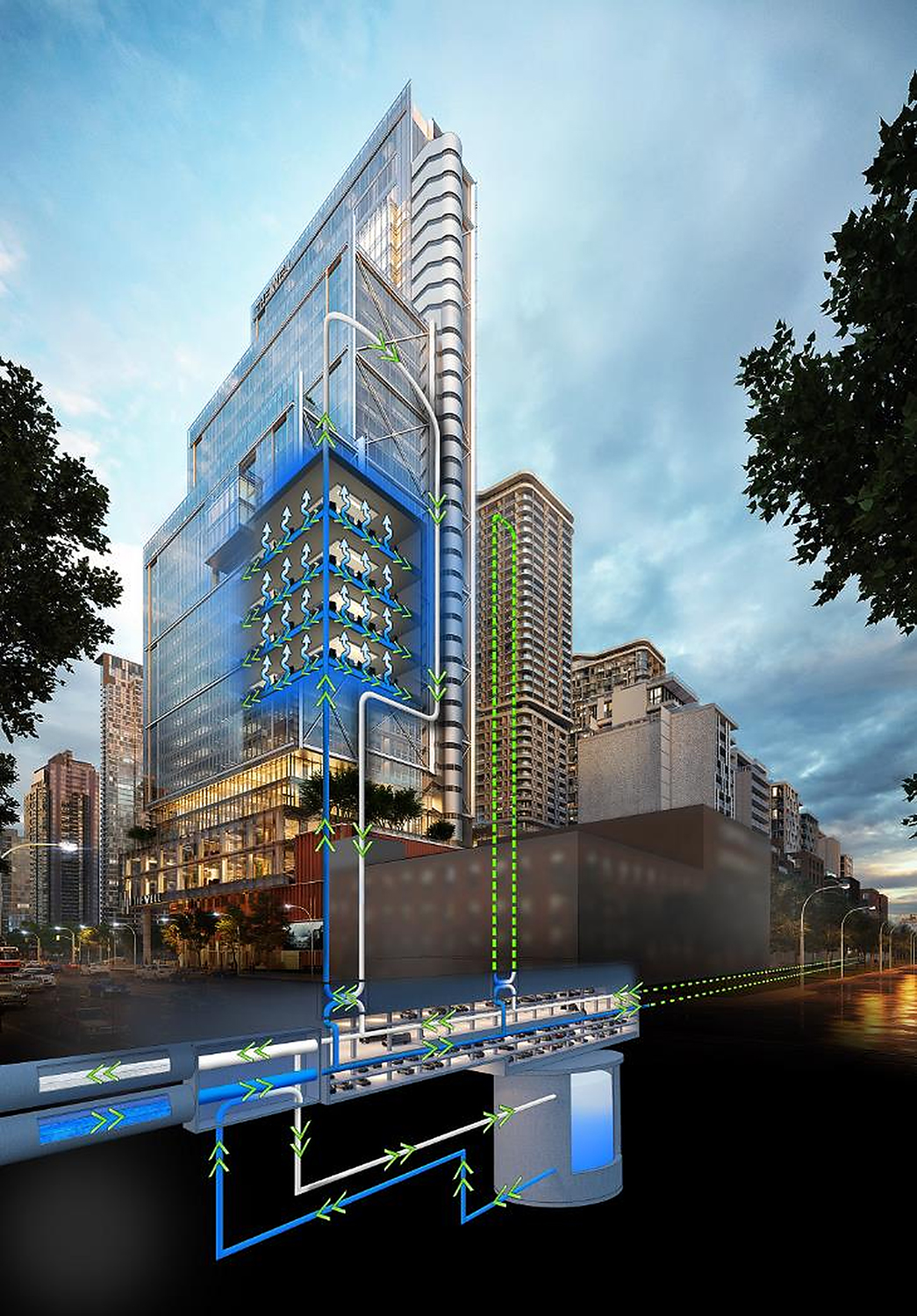
Rather than continuously expanding infrastructure to meet new peak loads, thermal storage helps unlock additional value by using existing energy assets more effectively. The large water storage tank acts as a thermal battery, storing chilled water in summer and hot water in winter, which can then be deployed to thermal-district-connected customers during peak demand.
The thermally stratified tank changes operating modes during shoulder seasons over a few weeks, slowly bringing the temperature to the required discharge level using heat exchangers and Enwave’s chilled and hot water distribution network.
Building low-carbon cities requires more than electrification
Cities are increasingly electrifying buildings and transportation as part of their efforts to reduce emissions. But electrification also creates another challenge: meeting growing demand for electricity infrastructure.
In dense urban centres such as Toronto, expanding generation, transmission and distribution infrastructure can be costly and complex. Peak demand is particularly challenging because infrastructure must have enough capacity to serve the system when demand is at its highest, even if those peaks occur for relatively limited periods.
District energy is one of those solutions. By producing heating and cooling centrally and distributing thermal energy through underground piping networks, district energy systems can serve many buildings from shared infrastructure.
Add thermal energy storage, and the system gains another capability: peak shaving.
Heating or cooling can be produced and stored when demand is lower, then delivered when demand rises. This shift in energy consumption away from peak periods can support more effective use of customer and district electricity-system infrastructure.

Location: The Well, Toronto, Canada
Development size: Approximately three million square feet (approx. 280,000 m2)
Storage volume: 7.5 million litres (8,000 m3)
Tank dimensions: 55 feet wide, 150 feet deep, and three feet thick (approx. 17 m wide, 46 m deep, and 1 m thick)
Summer peak reduction: Approximately 5 MW compared to a conventional chiller plant
Winter peak reduction: Approximately 22 MW compared to a conventional boiler
Future growth capacity: Approximately 17 million additional square feet (approx. 1.6 million m2)
How the thermal storage works
The thermal storage system at The Well is designed to support both cooling and heating.
In summer, the tank stores chilled thermal energy, typically during periods when electricity demand is lower. When cooling demand rises, the stored energy can be discharged into the district cooling system, reducing the electrical load associated with producing cooling at that moment. Additionally, the tank contains a treated solution that can store water below the normal freezing point, which increases storage capacity and energy transfer.
In winter, the process is reversed: thermal energy is stored as heat and released when heating demand increases.
This dual-season operation allows the tank to provide value throughout the year rather than serving only the summer cooling season.
The storage system is also integrated with Enwave’s Deep Lake Water Cooling network, which uses cold water from Lake Ontario as part of a district cooling system serving downtown Toronto.
Unlocking low-carbon heating at scale
The Well also provides an important connection point for the expansion of Enwave’s hot water district energy network.
Through its connection to Enwave’s Pearl Street Energy Centre, the network can access heat produced by the Enwave Green Heat® plant, which recovers thermal energy from the cooling system and upgrades it for use in building heating.
That creates a pathway to provide lower-carbon heating in Enwave’s thermal district, which is connected to The Well and other connected buildings.
It also illustrates one of the advantages of district energy: the energy source can evolve over time without requiring every connected building to independently replace its heating or cooling infrastructure. New technologies and energy sources can instead be introduced centrally and shared across the network.
One example in the evolving world of waste heat is with data centres. Repurposing waste heat from data centre cooling is an innovative way to create a value-add product rather than dissipating this heat to the environment using water-intensive cooling towers.
The more heat recovered from data centre cooling and processes, the less water is required for heat rejection. With recent growth in urban data centre buildouts, the more these facilities can connect to districts, particularly those deploying large-scale energy storage mechanisms, the more we can continue to solve multiple energy problems at once.
Turning thermal storage into grid flexibility
The electricity system benefit becomes particularly clear during peak periods.
By shifting when thermal energy is generated and stored, the system is designed to draw up to 5 MW less electricity than if the buildings were using conventional chillers during summer cooling peaks when operating at high capacity-mode, and up to 22 MW less during heating-season peaks.
For electricity planners, that flexibility matters. Reducing demand during peak periods can help make better use of existing infrastructure and create additional capacity as buildings and transportation electrify.
For building owners, connecting to a district system can also reduce the amount of heating and cooling equipment required on site, potentially freeing valuable building space for other uses.
Why peak shifting matters
Produce at a better time: Heating or cooling can be produced when system demand is lower.
Store the output: The tank holds thermal energy until customers need it.
Discharge during peaks: Stored energy reduces concurrent electrical demand during high-load periods.
Support new connections: Existing production and network assets can serve more development.
The Well provides a western connection point for future low-carbon heating and cooling customers across downtown Toronto.
A practical example of sector coupling
The Well illustrates a concept gaining attention across the energy industry: sector coupling, or system integration.
Traditionally, heating, cooling, and electricity systems have been planned separately. Thermal energy storage bridges those systems by allowing buildings to shift energy demand away from peak electricity periods while maintaining comfort and reliability.
Thermal storage can help reduce peak demand, improve asset utilization, and support urban growth without proportional increases in electrical infrastructure.
For cities facing simultaneous pressures to decarbonize and expand, these interactions are becoming increasingly valuable.
As cities continue to electrify, projects like this show that some of the most effective solutions may come not from generating more electricity, but from using energy more intelligently across both thermal and electrical systems.
District energy as an urban growth platform
The Well is more than a single customer project. It extends Enwave’s district energy network west of its established downtown infrastructure, creating opportunities for new developments and existing buildings along the route. As more buildings connect, centralized energy infrastructure can serve a larger customer base rather than requiring every property to duplicate major heating and cooling equipment.
The Well demonstrates how thermal energy storage can do more than improve building efficiency. By reducing peak demand, expanding district energy capacity, and creating flexibility within the electricity system, thermal storage can help cities accommodate growth while advancing decarbonization goals. As electrification accelerates, solutions that connect thermal and electrical infrastructure are likely to become an increasingly important part of the urban energy toolkit.
For further information, please contact Carlyle.Coutinho@enwave.com or
Sarah.Bertollo@enwave.com
“Thermal Energy Storage Unlocks Urban Growth and Grid Flexibility” was published in Hot Cool, edition no. 6/2026. You can download the article here:
Did you find this article useful?
Subscribe to the HOT|COOL newsletters for free and get insightful articles on a variety of topics delivered to your inbox twice a month!