HOFOR has scaled down a project, and several district heating utilities are looking at the same future after Energinet warned that capacity in the electricity grid is under pressure. This affects the green transition and the business models of district heating companies, which have been investing billions in electrification over the past few years.
Original article in Danish by Emma Gelbjerg-Hansen and Christian Østergaard, Børsen
2 February 2026
As the Danish district heating sector tries to switch parts of its heat production to electricity, major delays in expanding Denmark’s power grid risk putting the brakes on progress.
Several district heating companies are already experiencing challenges due to insufficient grid capacity and long waiting times to receive confirmation that their electric-based plants can be connected to the grid.
And according to the state-owned company Energinet, which is responsible for expanding Denmark’s electricity grid, this is not a problem that will be solved tomorrow. It will continue for “a number of years,” Energinet recently stated.
At the Greater Copenhagen utility HOFOR, limitations in the electricity grid have already led to one project being scaled down, says Gorm Elikofer, Director of Energy.
“We had to install a 29 MW plant instead of 32 MW. It’s only a small adjustment, so it doesn’t ruin the business case, but of course a larger plant would have been better,” he says.
HOFOR is facing the replacement of around one third of the plants supplying Copenhageners with district heating with electric heat—via heat pumps and electric boilers—by 2033, an effort expected to cost the company up to DKK 5 billion. Individual projects may cost anywhere from DKK 200 million to DKK 1.5 billion.
Among all potential barriers for projects of that size, the electricity grid is the biggest concern, Elikofer assesses.
“The electricity grid is what we think about the most. The technology is known, we know the need and the business case, and we know where we want to build,” he says, adding that the challenge becomes more concrete and visible as projects mature.
Even when projects succeed and receive approvals, they still put pressure on the grid in the areas where HOFOR installs them, he explains.
The challenge is that both the local distribution grids – owned by distribution network operators – and the national transmission grid – owned by the state company Energinet – are increasingly under strain due to electrification. Last week, Energinet acknowledged that companies in several parts of the country are being told that their electrified production, heat pumps, batteries, or solar plants cannot yet be connected to the grid.
This is due to insufficient expansion of Energinet’s network – often described as the “motorways” of the electricity grid.
Want to go deeper on this topic?
Meet the district energy community at Branchemøde 2026 on 25 March in Aarhus. Explore the full programme and register here.
Hitting multiple locations
Today, grid access is one of three factors HOFOR considers when siting new district heating projects. There must be access to the district heating network; ideally the site should be close to seawater used in heat pumps; and there must be sufficient electricity grid capacity to supply the project.
At present, it is the last factor proving most difficult, Elikofer points out.
“We’ve experienced that there was no capacity left once we had secured the electricity we needed. After our project at Kløvermarken, for example, there is no more electricity available at Christianshavn. The lights won’t go out in apartments—but no one else will be allowed to expand there either,” he says.
FACTS: Denmark’s electricity grid
- Denmark’s electricity grid is divided into a transmission grid and a distribution grid. The transmission grid is owned by the public company Energinet.
- The transmission grid transports electricity from generation sites to the distribution grid and to/from abroad. The distribution grid is owned and operated by 44 distribution network companies.
- Since December 2022, the Danish government has approved electricity-grid investments of DKK 6.1 billion. Energinet expects investments of around DKK 41 billion in the transmission grid from 2023 to 2026.
Even when grid capacity is available for a project, the company is not guaranteed electricity, Elikofer notes. Due to the size of the projects, HOFOR is typically offered so-called interruptible contracts, meaning the heat pump only receives electricity when grid loading is not too high.
“It’s necessary because grid capacity is so limited, and the societal prioritisation is that you must not cut power to hospitals and private customers—but you can cut it to district heating,” he says.
In practice, this can mean electricity is prioritised for apartments in Copenhagen at the expense of heat supply, he adds.
The issue is recognised by the district heating sector’s interest organisation Danish District Heating Association. Its CEO, Kim Mortensen, says HOFOR is not alone.
“We know the sector is experiencing challenges with insufficient capacity and long waiting times for connection confirmations, and that projects are in a holding pattern or have been postponed,” Mortensen says.
The Danish District Heating Association does not yet have figures for how many members are affected, but a larger mapping exercise is underway, Mortensen explains.
A major consumer of electricity
A well-developed electricity grid is crucial for the district heating sector, which in recent years has been – and still is – undergoing a major transition towards using electricity in heat production. This means more large heat pumps and electric boilers, and therefore a significantly greater demand for electricity.
In 2024, according to figures from the Danish District Heating Association, 33 new electric-based plants were established in the sector. Towards 2028, the Danish Energy Agency estimates that 98% of all new plant projects in the district heating industry will be based on electricity.
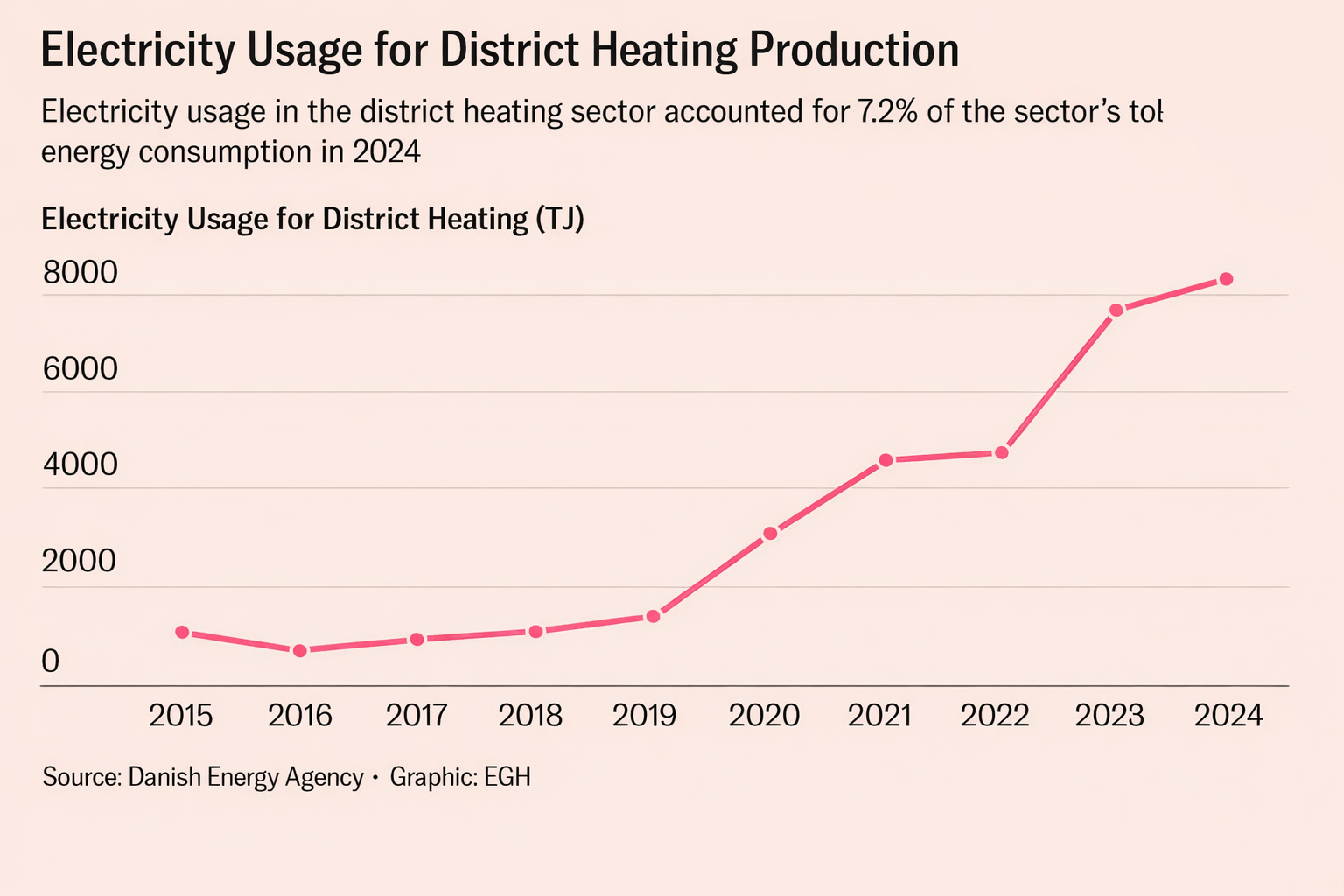
The transition requires long-term, large investments from district heating companies, Mortensen says. Therefore, it is decisive that the electricity grid can ultimately deliver the power needed.
“It has to move in step. A large heat pump project can be several years in planning. So there must be confidence that the grid can deliver the required capacity when a district heating company makes an investment,” he says.
“We could risk companies having to postpone new heat pump projects – or perhaps find a completely different heat source – if they are not confident that future grid capacity can support their investments.”
Planning must anticipate demand
At HOFOR, Elikofer acknowledges that grid planning also requires input from district heating companies.
“We are also going through a maturity process internally, to become clearer in our dialogue with Energinet and better at recognising where we expect which needs,” he says.
Kim Mortensen says the Danish District Heating Association has “full respect” for the challenges Energinet faces. Solving delays and capacity shortages, he says, requires cooperation between all involved actors—and a shared plan to increase speed.
“If it’s to go faster, Energinet also needs to know where the need is greatest and where to prioritise expansion—and we can only map that through collaboration. We would also very much like to see whether there are regulatory barriers that currently stand in the way of faster expansion,” he says.
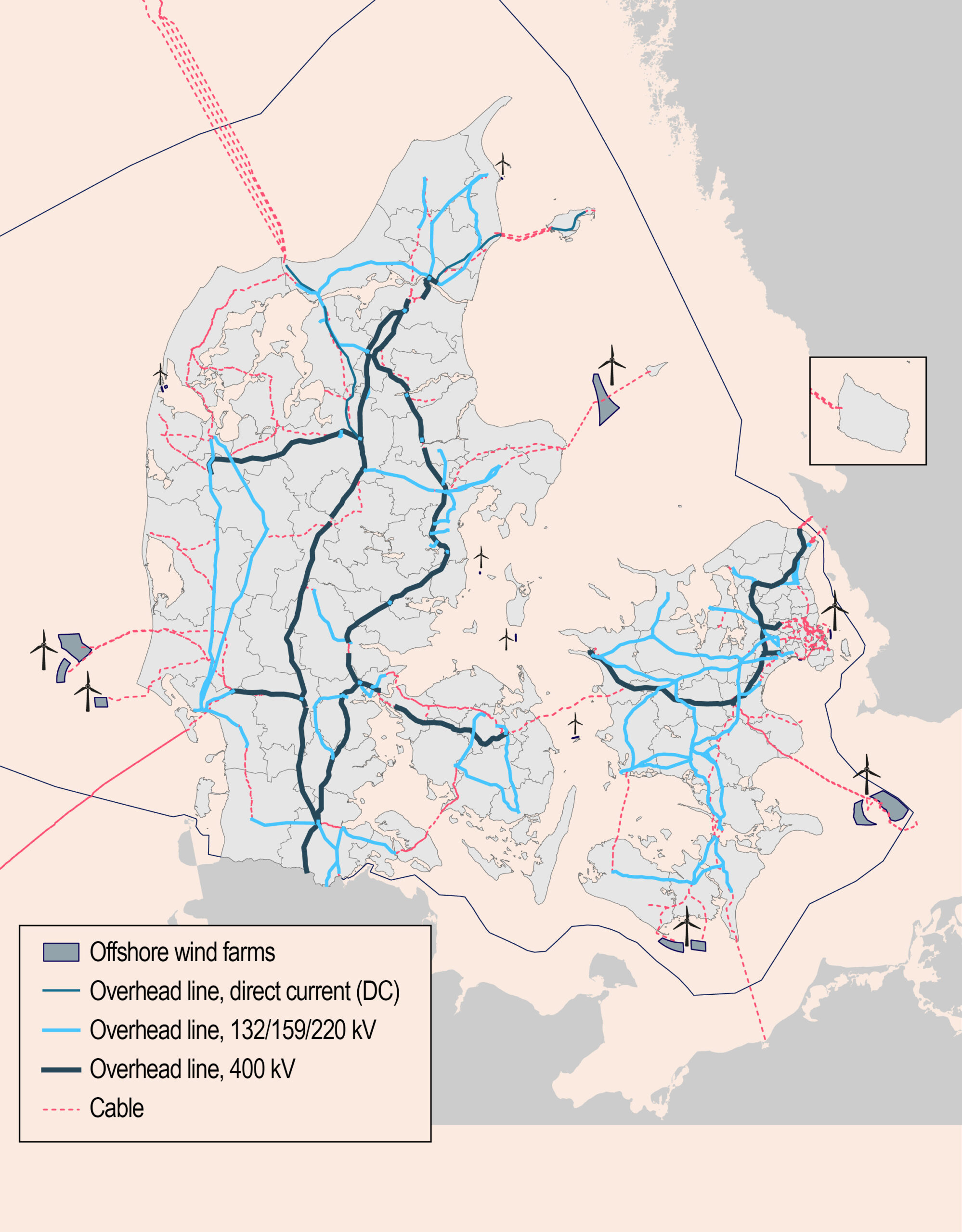
Denmark’s electricity grid (explainer)
The electricity grid consists of the lines that transport electricity around Denmark and out to private consumers and companies. The transmission grid—often referred to as the “motorways” (dark blue lines)—is owned by Energinet. The distribution grid—the “country roads”—is owned and operated by 44 distribution network companies, delivering electricity all the way to consumers.
Source: Danish Energy Agency (2022) – Graphic: JAG
Elikofer makes a similar point, highlighting that Energinet today is only allowed to expand the grid based on proven demand – and not to anticipate demand from, for example, district heating utilities. In his view, this framework needs to change.
“Denmark will undergo very substantial electrification over the next ten years. That requires us to start now, and that the grid is not only built for current demand, but for sharply rising demand,” he says.
He adds that HOFOR is among the utilities ready to locate projects in the areas of the capital where the grid is expanded – rather than waiting for the grid to be expanded precisely where HOFOR had originally planned to build.
________________________________________
This article was translated into English by DBDH with the assistance of AI tools. The content has been reviewed and edited by the editorial team.
Read the latest industry news on dbdh.org here.