Pioneers have done it because it just made sense, industrial companies are starting to notice potential solutions, and doors are beginning to open when district heating companies knock on industrial doors. Struggling with competitiveness and uncertainty, the process industry is seeking affordability and robustness to go hand in hand with reduced carbon emissions. These new industrial DH customers will require additional efforts to connect, but with the potential rewards, there is no reason not to try.
By Hanne Kortegaard Støchkel, Project Development Manager and
Florian Kirchmann, Student Assistant, DBDH
Published in Hot Cool, edition no. 3/2026 | ISSN 0904 9681 |
1. Why process heat based on district heating matters
Process heat is the energy needed to drive industrial processes, and it is often based on natural gas or coal. In the future, process heat can be supplied by a mix of electricity, local DH, biogas, and certified biomass, as many manufacturers seek more competitive and sustainable alternatives.
Today, the notion of just electrifying everything is no longer so appealing. It is likewise unlikely that DH will meet the full demand for process heat at an industrial site. Instead, technical consultants are helping to rethink internal processes to improve energy efficiency and to combine different technical options and energy systems.
As approximately half of the energy demand in the European industry is used for process heat, and as the competitiveness of the process industry (PI) and district heating (DH) is a top priority, the integration of PI and DH should be a rising star.
There is no official assessment of the full potential. It is safe to say it could be huge, but it is still early days for this new form of sector coupling, and society needs to develop screening at the national and city levels. In the meantime, experienced consultants are starting to include this opportunity in the discussions with DH companies and industrial customers. This is paying off, and business cases benefiting both the DH company and industry are emerging at an increasing rate.
Nothing is more convincing than seeing things work and making money. Therefore, the INTREPIDH project, funded by the Danish Energy Agency, has collected experiences and descriptions from twelve cases across five countries. Seeing a variety of industries and DH systems form successful business collaborations is part of the journey towards a breakthrough on much larger scales.
1.1 What is “process heat based on district heating”?
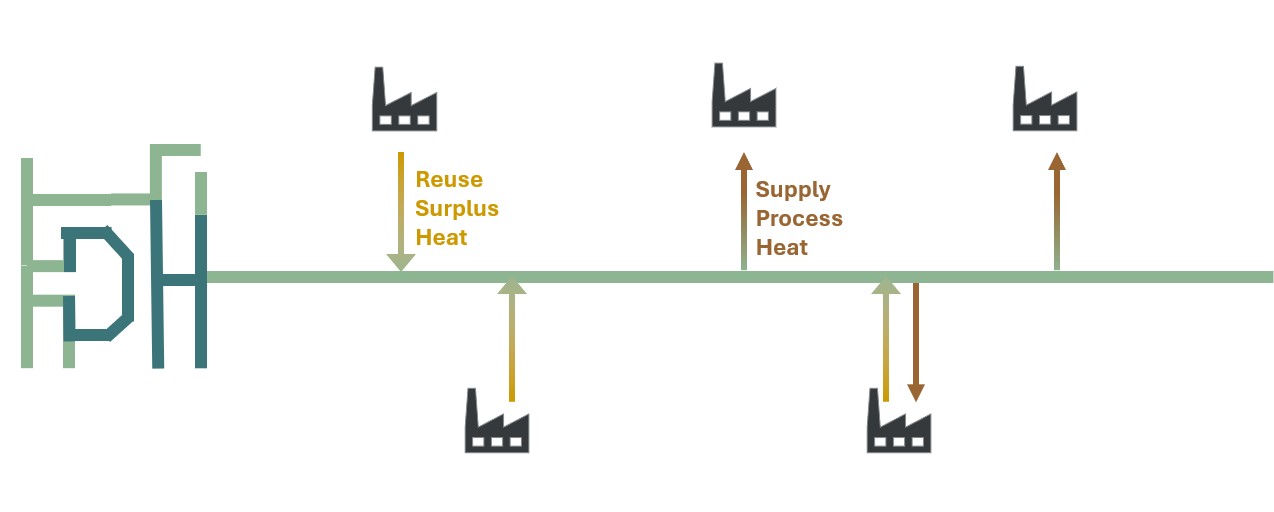
- Process heat is the energy needed to drive industrial processes. Examples at moderate temperature include drying, food processing, cleaning, and chemical reactions. Whereas metal-processing requires much higher temperatures.
- Process heat should not be confused with surplus heat (also labelled waste or excess heat), which is residual heat from industrial processes that can be reused, often in a district heating system.
1.2 Successful implementation of process heat based on DH: The learnings from the INTREPIDH best practice catalog:
- The food and beverages sector is particularly well-suited to use district heating to replace natural gas.
- The business case for new district heating areas can improve when the heat supply to the process industry is included.
- The concept has stood the test of time, with projects being in successful operation for many years.
- It pays off for district heating companies to reach out to and establish a good dialogue with the local industry.
- The cases show that the initial dialogue was often focused on the reuse of surplus heat but ended up bringing a valuable solution for process heat instead.
- The combination of district heating and high-temperature heat pumps can be a very strong solution as it expands the temperature range. Making it possible to deliver heat at temperatures above 200 °C as well. The development of high-temperature heat pumps is a hot research topic, with operating temperature ranges and efficiencies increasing.
2. Win-Win-Win
Using DH for process heat is a win-win-win situation for the industrial sector, the district heating provider, and society. The industry can benefit from stable and potentially lower heat prices while reducing CO2 emissions. The district heating providers increase their systems utilisation and anchor load – and thereby their economy.
Municipalities can include process heat in their holistic heat planning to align industrial decarbonisation with DH grid expansions, local job creation, and reduced carbon emissions.
The co-transition of the process industry and the heating sector holds considerable win-win-win potential but depends on awareness, planning, and strong collaboration to scale up quickly and bring impact at the national level. At the case level, just reach out and start exploring the opportunities!
The first step is for the parties involved to align their goals and investigate together, with municipalities emerging as a core facilitator in connecting all stakeholders.
Municipalities can include local industry systematically in heat planning, use ports or other industrial clusters as hubs for sector integration, and support the creation of dedicated entities to own and operate shared infrastructure. Also, DH companies can initiate the dialogue after mapping large industrial heat consumers near the DH grid.
During the collaboration process, many topics will appear: heat demand profile, business model, access to electricity, distance to the grid, temperatures needed, steam needed or not, available space on site, energy efficiency, investment costs, heat price, heat price fluctuations, carbon emissions from district heating, and reliability of energy supply – just to highlight a few.
The conclusion is quite straightforward: Drink a lot of coffee together and talk with each other. The cases highlight multiple ways to use DH as a heat source for industrial processes, and even more ways are just waiting to be discovered. Collaboration and curiosity are key factors in finding the best solution for the situation at hand.
3. Temperatures are important
Industrial processes span a wide temperature spectrum. The feasibility of DH-based process heat depends on the difference between the temperatures required by industrial processes and those available in DH systems. Additional temperature boosting and combinations with, for example, high-temperature heat pumps, storage, and electric boilers could be integrated as part of a hybrid system.
For hot-water processes (~60–110 °C), DH is a strong match as a heat source.
Many industrial processes fall within the hot water range that modern DH networks can supply. Examples include food & beverages, agri-food, paper & printing, low-temperature-demanding chemical industries, and pharmaceutical industries. They often fit well into the DH temperature window, and DH could potentially supply a substantial part of the heat demand.
Hybrid and boosted high-temperature processes also benefit from district heating.
Where process steps require steam or temperatures that exceed standard DH supply levels, hybrid solutions can combine multiple heat-production and storage methods. The catalog includes cases that demonstrate that DH can serve as a base heat source within a broader integrated system, especially when supported by heat pumps or industrial boilers.
In Zagreb, a brewery is based in a dense urban area, which limits the possibility of placing carbon-neutral heat production on site. Instead, the district heating company uses a heat pump located elsewhere to supply high-pressure steam at 260 °C for the production of beer. In Norway, steam at 184 °C is produced by a high-temperature heat pump that uses DH hot water as its heat source. Such cases signal the technical feasibility of meeting higher temperature needs in industrial processes.
The required standard components are already available; they just need to be combined to meet the needs of each case. There is no reason to wait!
Temperature optimisation in grid design and operation
An important part of increasing the energy efficiency of DH systems is to lower the temperatures in the grid, as it reduces the energy losses in the grid and increases the COP factor of heat pumps. On the other hand, higher grid temperatures are more likely to match industrial process temperatures or require a lower temperature lift, thereby improving the energy efficiency of high-temperature heat pumps.
This trade-off needs to be addressed in grid planning and when setting parameters in daily operation. Operational decisions and feasibility assessments for different grid configurations can be supported by modelling tools that account for this.
4. Process heat based on DH helps an affordable transition
Across Europe, the process industry is under intense pressure to decarbonise. At the same time, the heating sector is transforming. Many countries are expanding and modernising DH and positioning it as the backbone for affordable, low carbon heat supply in urban areas. When industrial demand is integrated into district heating systems, both sectors can benefit.
When an industrial company is comparing different solutions for decarbonising its process heat demand, economic assessments will help determine feasibility and sensitivity to various risks.
Adding DH to the list of building blocks will provide new options and more flexibility when tailoring solutions for industrial customers. The cases in the INTREPIDH catalog demonstrate that including DH in the mix can reduce carbon emissions while maintaining attractive and stable heat prices.
From the viewpoint of the DH company, connecting industrial customers that require large volumes of process heat can improve cost-effectiveness and accelerate investments in low-carbon heat production.
One explanation is an increase in operational hours for heat production units, as demand for process heat is more evenly distributed throughout the year than space heating, which varies significantly from summer to winter.
As with all large investments, feasibility and risks must be thoroughly investigated. DH may not be part of the best solution in all cases, but it should be part of the planning as it benefits the DH company, the industry, and society as a whole.
Things like long connection distances, the need for higher temperatures, or a low total energy demand matter, but simply need to be investigated and attempted to be overcome.
Experience from implementing the reuse of industrial waste heat in DH systems points to open dialogue, joint analyses, and a collaborative approach to win-win-win agreements as key to building trust and success. The experiences with process heat described in the catalogue point in the same direction.
5. Awareness is lacking
The cases in the best practice catalogue demonstrate that DH can successfully deliver process heat to a variety of industrial companies, and that both sides recommend the solution and offer advice to others who are motivated to explore the possibilities.
Another conclusion is that these types of solutions are still largely unknown. Process heat based on district heating has the potential to supply a significant amount of carbon-neutral heat to the process industry and thus presents an overlooked solution. Therefore, awareness needs to increase before society will benefit from this type of sector integration.
Though not directly involved in the contractual details between the industrial and DH partners, the municipalities can help build local value in two ways. They can include process heat in their heat planning and organise events and meetings to initiate and sustain local dialogue until self-propelled collaboration between industry and DH takes over.
For more information, please contact: hks@dbdh.dk
“District Heating Brings Value to the Process Industry” was published in Hot Cool, edition no. 3/2026. You can download the article here:
Did you find this article useful?
Subscribe to the HOT|COOL newsletters for free and get insightful articles on a variety of topics delivered to your inbox twice a month!