Lessons from the electricity sector indicate that shifting from a fixed to a dynamic pricing structure can unlock demand response and help reduce peak loads. We are researchers at the Technical University of Denmark, and we explore the impacts of dynamic pricing on residents and district heating operators. Our studies of residential buildings in Sønderborg, Denmark, showed significant potential for heat cost reduction (46%) and peak load reduction (84%) by shifting to dynamic pricing.
By Reza Mokhtari, Postdoctoral Researcher, Technical University of Denmark, and Rongling Li, Associate Professor, Technical University of Denmark
Published in Hot Cool, edition no. 1/2026 | ISSN 0904 9681 |
Demand and supply mismatches
Demand and supply in district heating often pull in different directions. Heat demand peaks on cold winter mornings and evenings, while the most climate-friendly and cost-effective supply is closely tied to variable fuel and electricity prices, as well as the availability of surplus and waste heat.
The mismatch between demand and supply leads to oversized equipment, reliance on fossil-fuel plants, higher heating prices, and reduced efficiency. Many district heating networks still rely on fossil peak boilers to cover short, sharp load peaks.
There is substantial but largely hidden potential for flexibility within the buildings themselves. Walls, floors, concrete structures, and water in radiators and storage tanks act as thermal batteries that can store heat for hours without noticeably affecting comfort.
Dynamic heat price: The right signal
District heating prices are typically composed of a fixed part and a variable part. The variable part is related to consumption and remains static for most district heating systems. The variable part could be dynamic, acting as a signal for network conditions, much like electricity prices in Denmark.
The variation can be based on changes in production costs, CO₂ intensity of the network, or system load. The basic idea is straightforward: when low-carbon heat is available, the price is low; when fossil-fuel units or very high temperatures are required, the price is high.
In most current district heating systems, demand is passive, meaning it does not play a role in energy planning and is treated as a fixed constraint value. Dynamic pricing tries to change this by sending a clear economic signal that reflects when the system is green and cheap, and when it is not. However, heat demand differs from electricity demand, and buildings would respond differently to price changes. Figure 1 illustrates an example of how dynamic pricing helped electricity grids reduce peak loads.
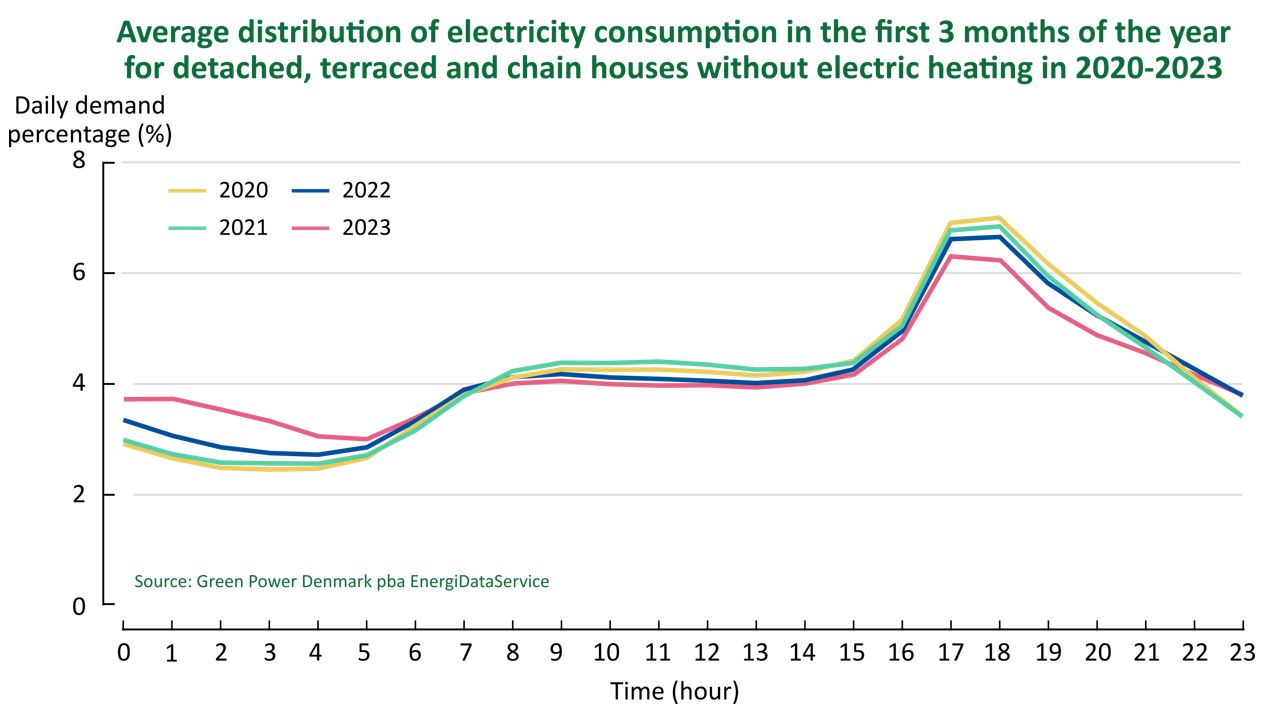
The interesting thing about this figure is that electricity consumption during peak hours declined from 2020 to 2023 because consumers shifted their consumption in response to dynamic electricity prices. This demonstrates the effectiveness of this solution in reducing peak loads.
How buildings react to dynamic prices
Buildings possess an inherent hidden feature, known as thermal inertia, that allows them to store heat in their elements and release it slowly. This potential allows for changing heat load patterns without significantly affecting the indoor conditions. Here, dynamic prices serve as a bridge between the supply conditions and building heat demand. Ideally, the building can adjust its heat demand according to the dynamic price to regulate demand and supply while maintaining a comfortable indoor environment. In practice, buildings can use price signals to:
- Pre-heat slightly before high-price hours.
- Reduce temperature set-points during expensive hours.
- Shift domestic hot water charging away from peak hours.
Control of indoor thermostats in response to dynamic prices can be manual or automated. Manual control represents engaged customers who tend to follow price signals and manually adjust their thermostat setpoints. Automation can help replace human control with intelligent controllers that change setpoints automatically based on price signals, weather conditions, and other factors, so that residents do not need to worry about them.
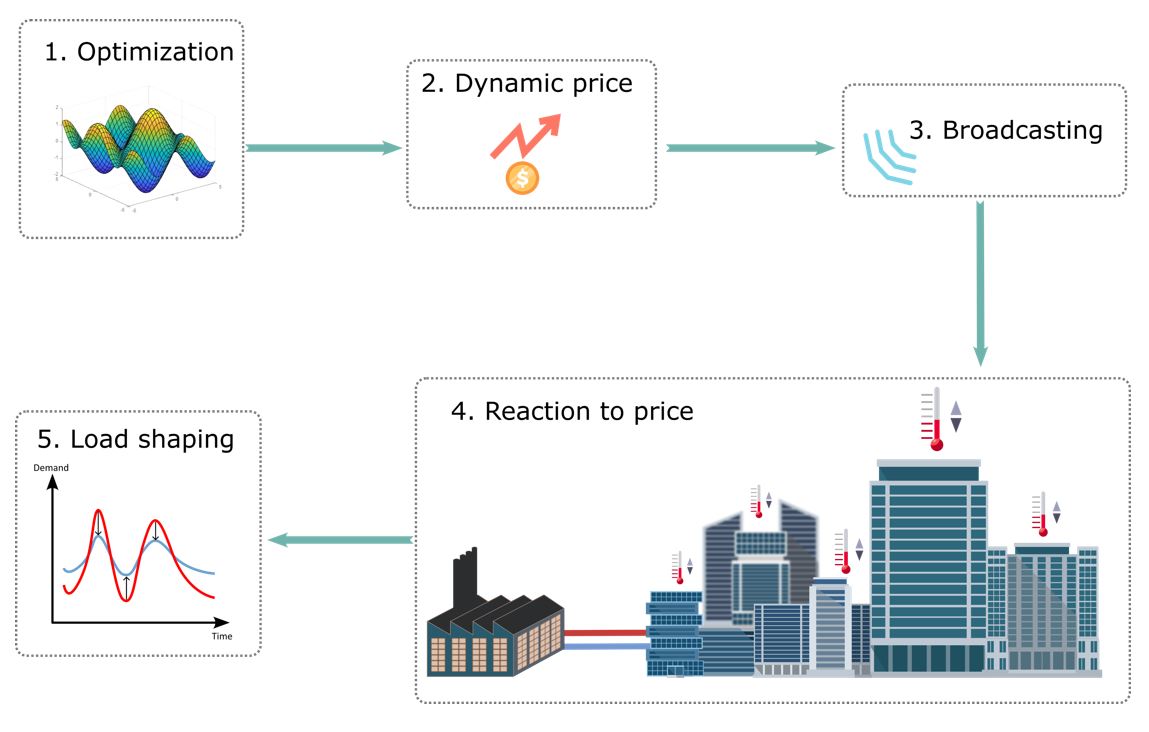
Our real-world experiment, which utilized a reinforcement-learning thermostat controller in a campus building in Dubendorf, Switzerland, demonstrated a 79% reduction in heating costs compared to a traditional rule-based controller [2]. The steps for achieving load shaping through dynamic pricing design are illustrated in Figure 2.
Benefits for district heating utilities and residents
From the utility’s perspective, dynamic pricing can solve many issues by modifying the demand profile, such as:
Reduced use of peak boilers: By providing the right price profile and increasing awareness among residents, peak loads can be significantly reduced, thereby minimizing the use of peak backup boilers. This will immediately decrease CO₂ emissions and fuel costs.
Reduced congestion in networks: The operational conditions of complex, long district heating networks are often constrained by critical residents. To meet the heat demand of critical residents during certain hours, increasing the flow temperature is often the preferred choice due to network limitations, resulting in unwanted heat losses. Dynamic heat prices can be designed to reflect network conditions as well, by having higher prices during highly congested hours, leading to lower overall forward and return temperatures.
Reduced heat production costs: By designing dynamic prices that reflect production availability and fuel costs, expensive production can be minimized, resulting in lower overall production costs. Our studies showed a production cost reduction of 28% – 53% for a neighborhood, depending on the response of residents and fuel costs.
Dynamic heat prices will also benefit heat residents by:
Reducing heat consumption costs: Residents can lower their overall heating bills by adjusting their heat usage based on dynamic heat prices. Residents can, for example, decrease their thermostat settings or reduce their showering time when prices are high.
Contribute to the decarbonization of district heating: Any load adjustments due to dynamic heat prices contribute to the reduction of fossil fuel boilers and help reduce carbon emissions. Dynamic heat prices make the residents active participants in energy systems, directly contributing to the green transition.
Designing a dynamic heat price in practice
Traditional methods of designing dynamic prices consider production mix, CO2 intensity, and peak capacity. The problem with this method is that it ignores resident flexibility. Therefore, we modeled the relationship between price and demand. Using this approach, we can design a price profile that can adjust the heat demand of buildings to follow the desired profile [3]. The simulation results illustrate the impact of dynamic heat prices on load adjustment, as shown in Figure 3.
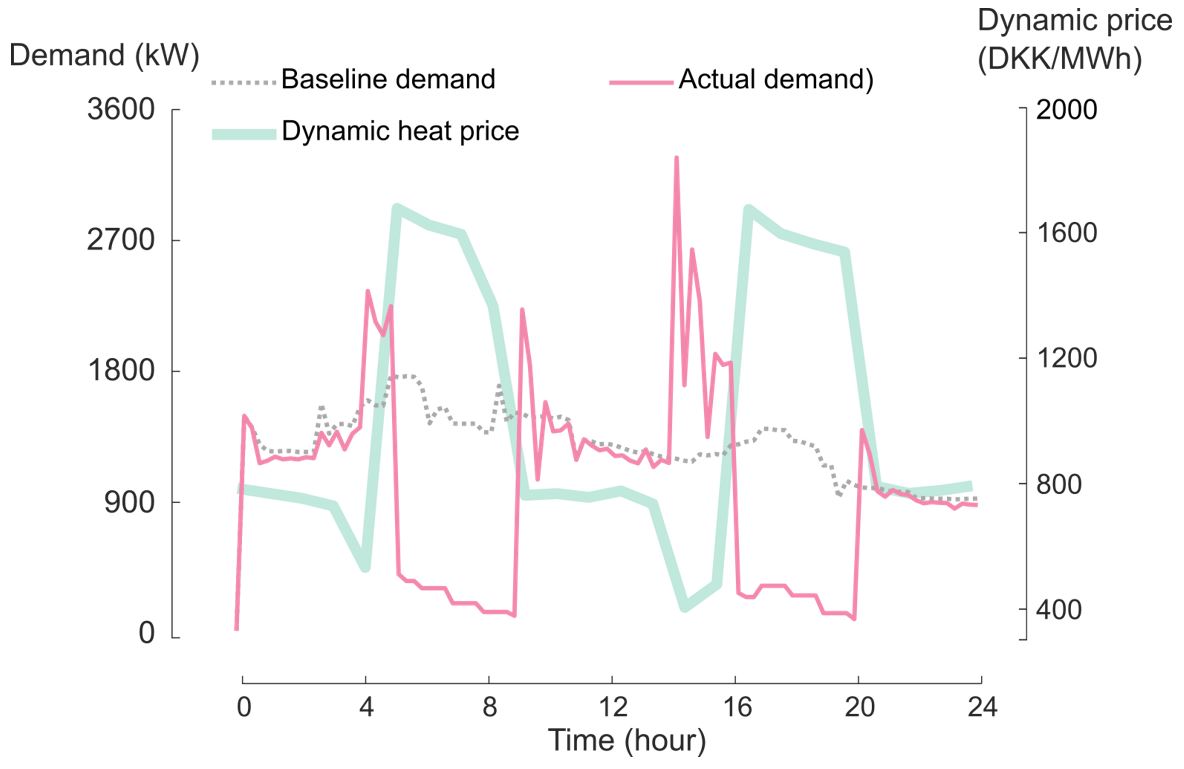
The results of a simulation study using a digital twin model of a neighborhood in Sønderborg, Denmark, showed that dynamic heat prices can potentially decrease the resident heat costs by 46% [4]. From the operator’s side, the peak load could be reduced by 84%. Even though these values are achieved under ideal conditions, it highlights the hidden potential of demand response for cost and peak-load reduction. This study showed that even slight adjustments to thermostat settings during extreme price periods could also lead to savings of up to 34%.
Downsides and challenges
Although dynamic pricing is promising, it introduces important challenges. Some buildings, such as hospitals or poorly insulated buildings, possess limited flexibility and may not benefit from price variations. In fact, they might end up paying more, raising concerns about fairness and inequality. One way to address this is to offer customers a choice between dynamic and fixed-price contracts.
Another key issue is the rebound effect. Users may reduce heat demand during high-price hours but then increase consumption sharply once prices fall. If many customers behave in this way simultaneously, new peaks may emerge. This must be considered carefully when designing dynamic pricing to prevent such issues.
Role of dynamic pricing in decarbonization
Expanding networks, installing large heat pumps, and deploying storage tanks all require significant investments, but are necessary to support the green transition. Dynamic heat prices can support decarbonization by directly engaging residents in the process. Customers receive lower bills and gain a clear insight into their climate contribution, and utilities gain flexibility, lower emissions, and a more resilient business model.
The next step toward the widespread implementation of dynamic heat pricing is to conduct large-scale field tests by district heating companies to measure the flexibility of different users and face practical challenges.
For further information, please contact: Reza Mokhtari, at remok@dtu.dk
References
[1] https://www.energycentral.com/energy-management/post/flexible-demand-denmark-conversation-claus-krog-ekman-IiAIOtjERiBbGRP
[2] Mokhtari, R., Montazeri, M., Cai, H., Heer, P., & Li, R. (2025). Price-responsive control using deep reinforcement learning for heating systems: Simulation and living lab experiment. Energy, 138517.
[3] Mokhtari, R., Junker, R. G., Madsen, H., & Li, R. (2025). A methodological framework for designing dynamic heat price for demand response in district heating. Energy, 324, 135937.
[4] Mokhtari, R., Madsen, H., & Li, R. (2025). Exploring the impacts of resident reaction to dynamic heat prices in district heating. Energy and Buildings, 116347.
“Dynamic Heat Pricing: A Smart Way for Decarbonizing District Heating” was published in Hot Cool, edition no. 1/2026. You can download the article here:
Did you find this article useful?
Subscribe to the HOT|COOL newsletters for free and get insightful articles on a variety of topics delivered to your inbox twice a month!