OPTIMAL PRODUCTION PLANNING AT LARGE AND COMPLEX HEAT SUPPLIES
This article describes Fjernvarme Fyn, a Danish district heating company that has become one of…
By Dan Andersen, BSc, Graduate Diploma in Business Administration, & Anders N. Andersen, PhD, Ext. Ass. Professor at Aalborg University, R&D projects responsible at EMD International
This article was published in Hot Cool, edition no. 1/2024 | ISSN 0904 9681 |
Fjernvarme Fyn is Denmark’s 3rd largest district heating company. This article will focus on the effects of the significant buildout on renewable energy, giving volatile electricity markets. This calls for a strategy of having multiple heat and electricity sources at a district heating company. A brief overview of Fjernvarme Fyn’s portfolio will be given, followed by the process of building a digital twin for the basis of optimal production planning. When failures occur (and they will), it is essential to have validated and financially feasible backup plans to ensure immediate and robust changes to operation following the company’s guidelines and targets.
The introduction of renewable energy and further expansion for technologies such as wind and solar production that feed into large national grids are key factors to significant and increasing price volatility in the power markets across the EU. Both for a large supplier with an extensive portfolio of powerplant units with grid connection or a large consumer of power from the grid, it is crucial to know how power prices will affect your economy during production and even more so during sudden unexpected changes in the production plan.
The need for optimal production planning for consumers and suppliers is thus essential.
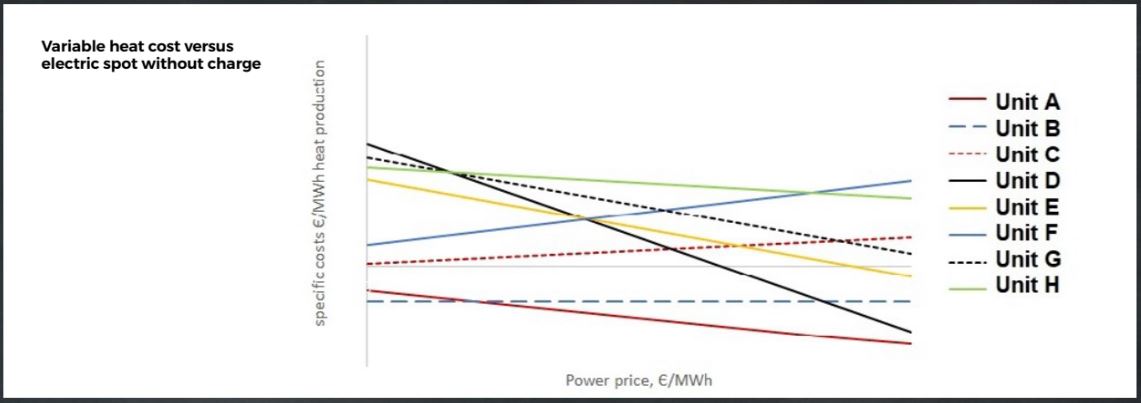
Let’s look at a large portfolio of maybe up to 20 CHP units with different marginal prices and multi-fuel. Such a diverse setup makes it difficult to calculate when and how to supply to the power grid in combination with heat delivery unless advanced software tools are taken into operation. The example shown in Figure 1 from different CHP units demonstrates how complex it is to identify the optimal operation point.
Figure 1 illustrates how eight different units (A to H) all have different price-production rate characteristics depending on heat and electricity.
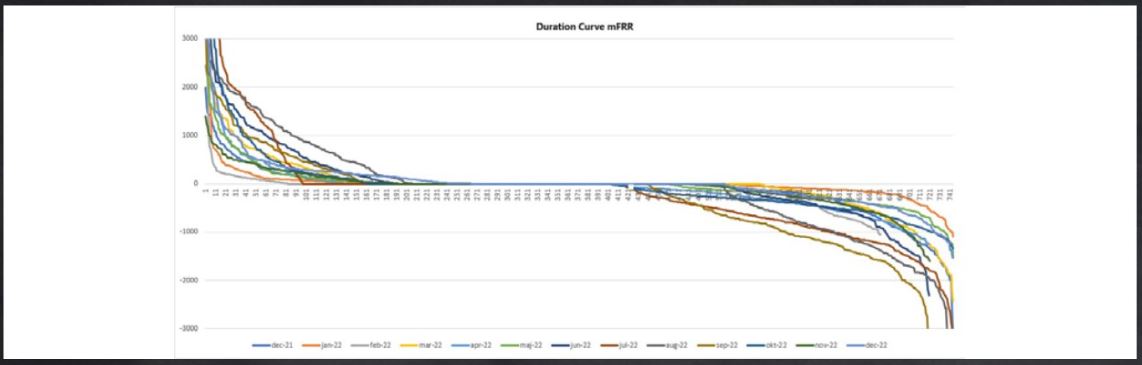
The fast-developing and expanding trend in volatility in the power markets will increase the demand for fast response for stabilizing energy products. Figure 2 shows a duration curve for mFRR in 2022 from the electricity market in DK1 West. It is remarkable that the midrange area where demand for mFRR activation is slowly decreasing still indicates that the need for national TSO supporting regulation and activation is increasing.
Each month consists of 744 hours. As an example, look at “dec-22,” where it is shown that only between hours 271 and 401 is the period where mFRR is not active (17% of the month). The rest of the time, mFRR is active, giving the possibility to produce or consume electricity at very high price levels if the plant has the setup supporting this.
Figure 2 shows how the regulating power market (mFRR) has gained a more significant percentage of the total daily production in the west Danish price area “DK1 West” in 2022. Figure 2 illustrates monthly duration curves for prices in mFRR in 2022. Data are from the local Danish TSO “Energinet.” From the duration curves, we observe that in several hours, the electricity prices are very high or very low, giving a considerable financial potential to DH companies, which can both consume or produce with very short notice during situations.
Risk management is crucial to unlock the full potential of production and minimize future electricity costs while ensuring that production facilities receive uninterrupted power supply as needed.
Fjernvarme Fyn is owned by the Municipalities of Odense and Nordfyn. The company owns the largest combined heat and power plants in Funen, has more than 300 employees, and is one of Europe’s largest heat utilities. The company covers approximately 97% of the heating demand in Odense and the surrounding area, corresponding to more than 100.000 homes, industrial companies, and institutions. The district heating supply takes place according to the general guidelines specified in the heating plan, which defines supply areas and more. Fjernvarme Fyn’s goal is to provide customers with the best possible heat supply at the lowest possible prices while contributing to increased energy and environmental awareness among customers.
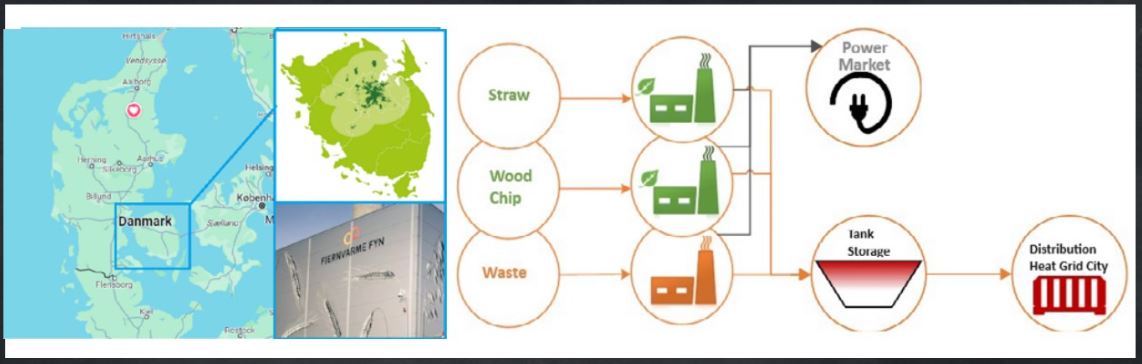
Figure 3: Fjernvarme Fyn, located in central Denmark, is an interesting district heating company with a palette of different heat sources and production technologies.
Figure 3 shows the location of Fjernvarme Fyn in Denmark. The system includes 2.300 kilometres of underground pipes, providing domestic hot water and heat to 100.000 households and businesses.
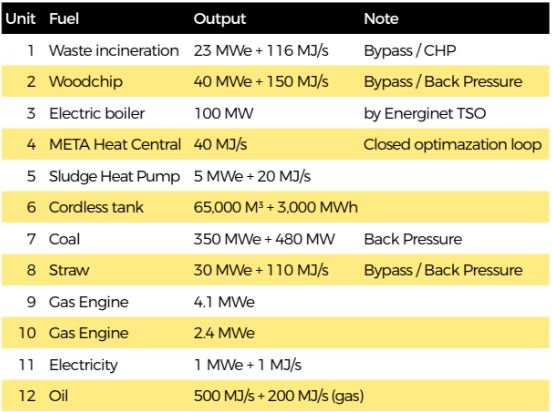
The complete plant consists of 12 different units with different electricity and heat input and output performances. See the plant overview in Box 1. On a system like Fjernvarme Fyn, the main objective is to produce the right amount of hot water for the district heating grid at the lowest possible price while supporting the company’s emission goals. Fjernvarme Fyn has combined the portfolio as several individual plants to ensure the possibility to spread the production into several plant units (heat and power) and by then ensure that production always is produced on the plant with the lowest marginal costs according to various input parameters, such as market fuel prices, tax, CO2, power prices, etc.
It is a unique technique to ensure the right economy 24/7 and to ensure the benefit of optimal production plans from the OPTI platform. Fact box 1 shows a countermove to a volatile power market due to the large renewable energy buildout. This ensures the lowest possible production price to benefit the customer.
This is a unique size and portfolio complexity in Denmark since Fjernvarme Fyn produces electricity and heat using various renewable energy technologies. For example, Unit 4 utilizes 165.000 MWh of excess heat from the META data centre server halls, using heat pumps driven by 100% renewable energy to lift the temperature, and then distributed to 7.000 households in collaboration with Fjernvarme Fyn.
The fuel portfolio furthermore includes waste, straw, woodchips, oil, coal, gas, sewage heat pumps, electric boilers, seawater heat pumps, and motor engine heat from several backup units. Heat accumulation through a central 3.000 MWh heat storage tank helps achieve an economic optimum “24/7”.
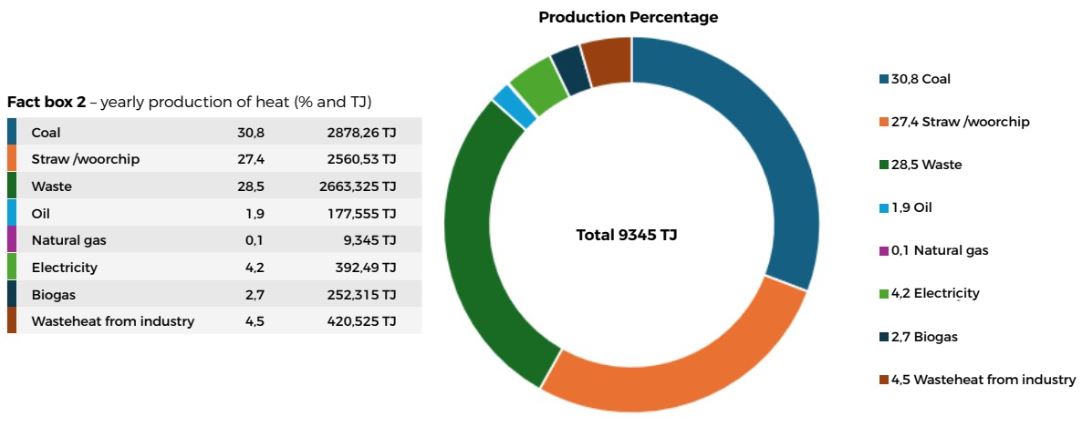
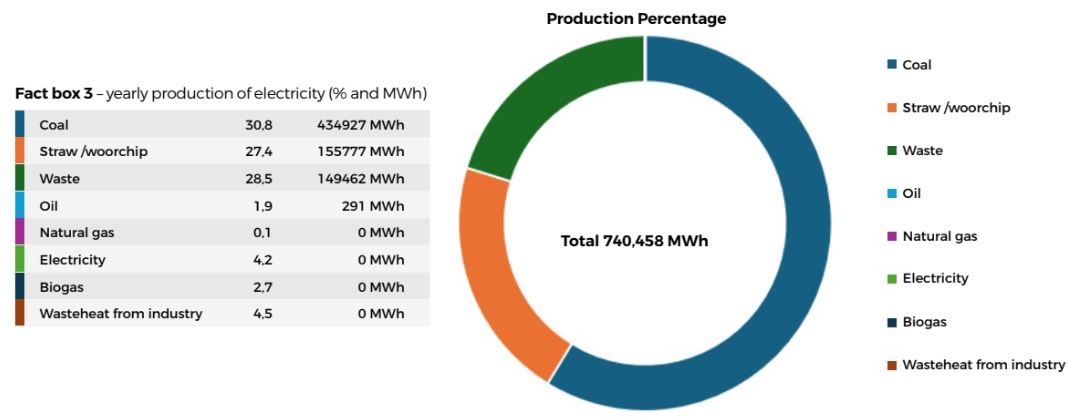
The diverse portfolio creates a unique interaction with the electricity market, where live bidding on the Nordic electricity exchange stock “Nordpool” is processed within 5 seconds every time a new bid is placed. Figure 3 illustrates the supply area for heat distribution and the main heat supply plants in the portfolio. Fact box 1 shows each plant’s specs, and fact boxes 2 and 3 show yearly production in heat and electricity.
The starting point of optimal production planning is the plant’s digital twin as an energy model that transforms the physical parameters into simple mathematical calculations. EMD International A/S delivers energyPRO, and in combination with the OPTI platform, it is possible to transform any energyPRO model into the platform. This process generates a digital twin, and the platform can be launched. The digital twin forms the basis for the model used to trade in the electricity market. It is a simple and flexible system that provides excellent opportunities to continuously adjust the model as the energy markets or the portfolio expands.
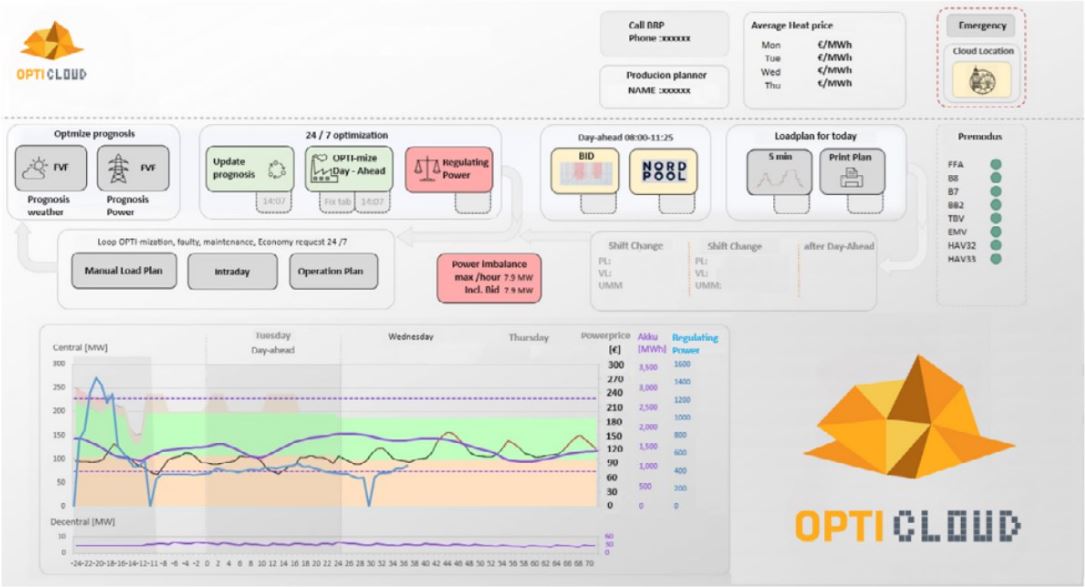
Figure 4 shows the tool’s user interface that Fjernvarme Fyn uses for optimal production planning. This software platform integrates computational technology with limitless capabilities through cloud technology, where calculations are made in a few seconds with high capacity.
Featuring a user-friendly interface, the platform is a pioneer in Denmark, transforming the green future for several companies. The platform calculates all input parameters at a speed of 10 million calculations per hour, regardless of complexity. The user-friendly interface shows decisions with a complete overview of all economic decisions and units in the portfolio.
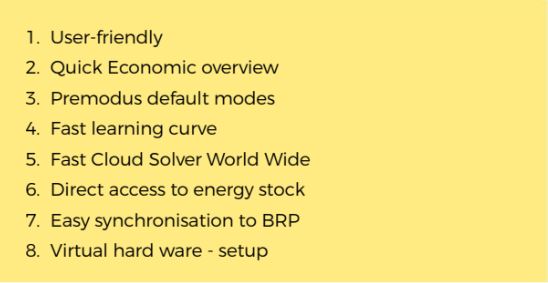
Fact Box 4 sums up the most essential advantages of the platform.
OPTI supports the daily work process of a production planner at a large district heating company.
The process steps in the morning are:
Pause: The morning routine is now finalized, and the planner is waiting for the electricity market to reach a clearing – which is done no later than 13:00
Perfect optimization occurs when all plant specifications and operational ranges are known for each facility in the portfolio. Awareness of specific fuel costs, taxes, CO2 levies, and other variable expenses is also essential.
When these costs are optimized with a global wind and weather model, contributed by electricity forecast on energy markets, load plans for each individual facility can finally be generated for optimal economic performance in the overall portfolio.
Operation and hourly load plans are generated based on day-ahead input down to 5-minute intervals. Still, they can also be executed instantly in case of breakdowns, accidents, or other changes such as unplanned maintenance. Additionally, flexibility bids mFRR, according to Figure 2, can easily be calculated, and all costs can be included according to individual preferences. Optimization can occur behind the meter and with ordinary production post-meter, and, in combination with specific and unique plant characteristics, any plant or facility can be considered for the OPTI platform.
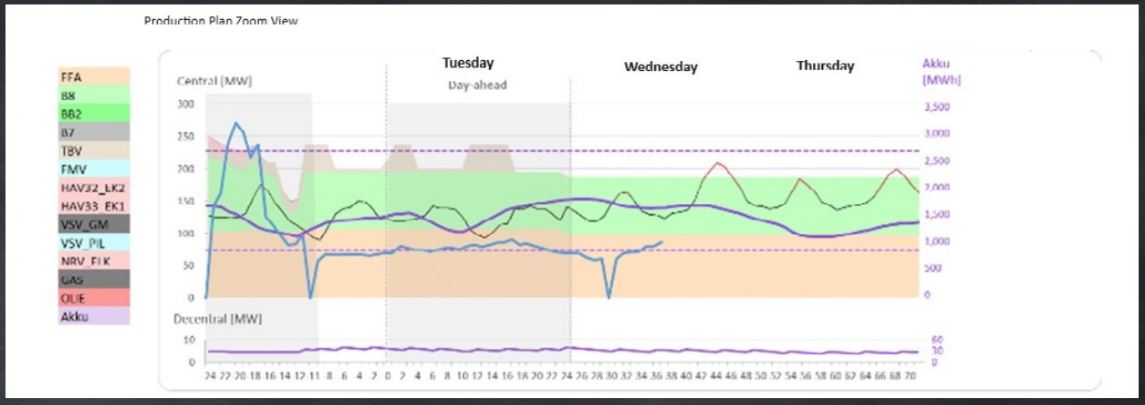
Figure 5 illustrates the ordinary portfolio planning for 14 individual units. The plan is transferred daily to electricity bids cleared at the Nordpool energy market. A fast and straightforward overview is the primary purpose and backbone of the platform.
A fault or outage in the production portfolio will immediately bring production to economic risk, whether seen from a power supplier or consumer view. The financial loss from missed electricity production can be extremely high when unprepared. No human is prepared for a situation where significant faults occur, which can cause millions of $ spent wrongly due to a manual choice in a stressful situation.
The OPTI platform has a fast safety mechanism that helps operations in case of emergency faults and outages. This is because every calculation predefines the worst-case scenario at any event that can create faulty operations among entire portfolio units.
If a new event or outage appears, pre-calculations from the last optimization are already done. The operator chooses to validate a new production strategy. After a few seconds, the OPTI platform generates a new scenario for the optimal production plan using other units and generate load plans at economic equilibrium.
The production planning tool acts like insurance to support the company’s economy in an emergency by optimizing the whole portfolio, even though maintenance strategies cannot eliminate outages for large complex plants. No decisions must be made before a final economic evaluation is performed, and OPTI will help support this.
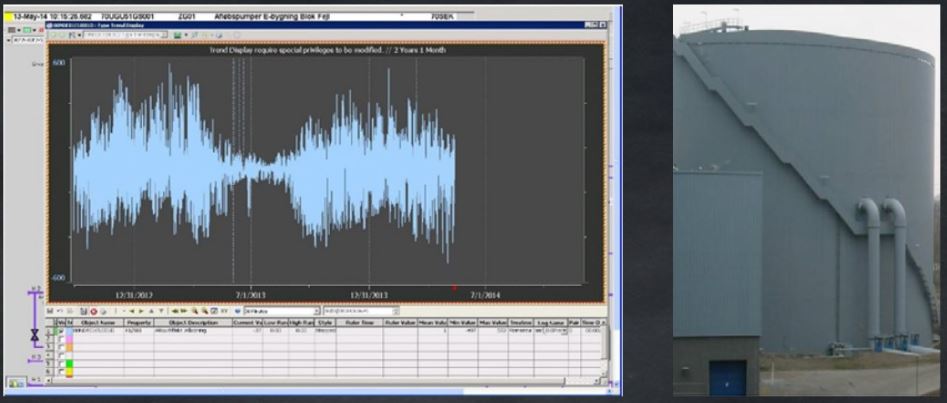
Historically, large accumulation tanks have been used as storage or as simple buffers in case of unit or plant failures or high demand for heat. Figure 6 illustrates the optimal economic behaviour at Fjernvarme Fyn and the large storage tank. Fact box 5 explains the technical specifications for the storage tank in operation.
This mindset needs to be readvised as overall and general purpose in the industry. New ways of optimization and better and more precise load forecasts will help generate more profit by leveraging the electricity and heat markets to your advantage.
This article described how optimization tools must be used for the day-to-day planning of bidding amounts and bidding prices in the different electricity markets.
You can read the scientific report here: “The business-economic energy system modelling tool energyPRO”
For further information, please contact: Christian Ingerslev Sørensen, cis@emd.dk
Subscribe to the HOT|COOL newsletters for free and get insightful articles on a variety of topics delivered to your inbox twice a month!
This article describes Fjernvarme Fyn, a Danish district heating company that has become one of…
This article describes the Danish district heating company, Hvide Sande District Heating, which has become…
The present European energy crisis with both very high gas and electricity prices show that…